David Gauke
HM Treasury · GBR
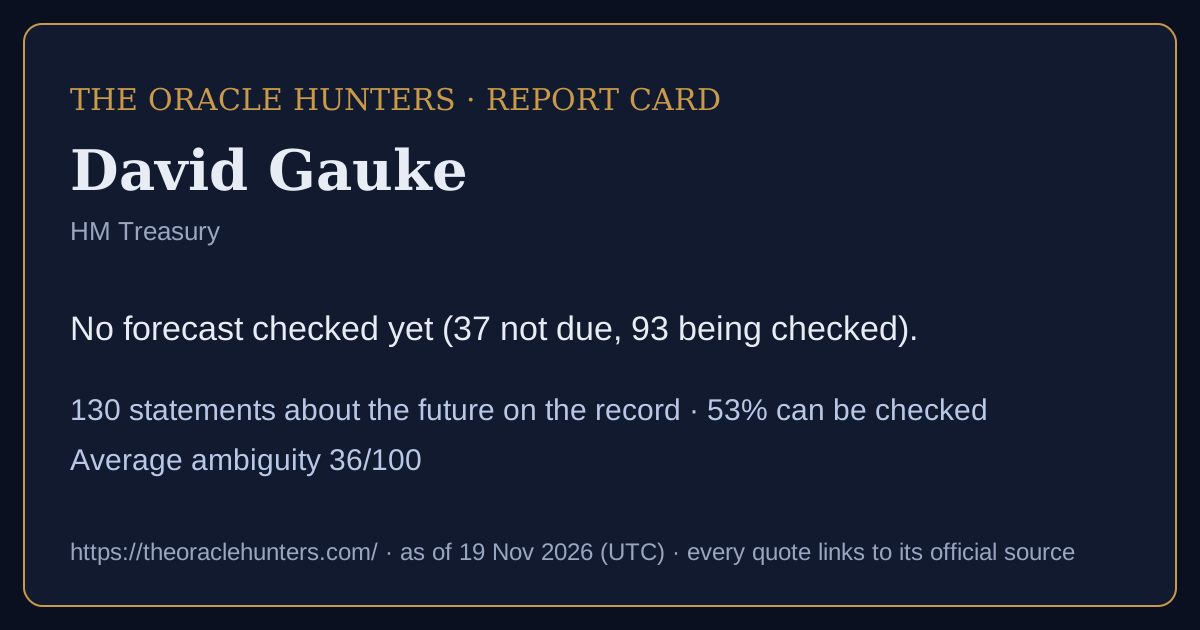
Track record: No forecast checked yet (37 not due, 93 being checked).
130forecasts & commitments on the record
53%can be checked as stated
36average ambiguity (0-100)
0goalpost moves recorded
0confirmed U-turns
Timeline
came true partly did not not due / being checked / too vague
Calibration score: shown after 10 checked forecasts with a stated likelihood (now 0).
How they speak about the future: based on data 106, stated on authority 21, educated guess 3.
Kinds of claim: forecast 99, mixed claim 21, commitment 8, scenario (if… then) 2. · Download this report card as a picture
In the nine words
πρόγνωσιςInference from evidence103 · 79%μαντείαInspired knowledge15 · 12%προαναγγελίαPublic pre-announcement8 · 6%πρόνοιαPreparing for the future2 · 2%εἰκασίαConjecture2 · 2%
How to read this
Each box is one sentence a public figure or institution said about the future, word for word, with a link to the official text. Can be checked means it names what will happen, by when, and how likely - so it can be compared with official figures later. Too vague to check means it does not. Ambiguity (0-100) is how many different ways the sentence can be read. When the date passes, the forecast is compared with official data and marked came true, partly or did not come true. Labels judge the sentence, never the person. Full guide and glossary.On the record (130)
The government is already helping UK firms to take better advantage of technology – in funding specific projects such as the Next Generation Services Fund, which recently awarded approximately £2 million for research on how the legal sector can adopt new technologies and artificial intelligence to boost productivity.
The UK legal services sector is worth an estimated £24 billion every year and its wider impact in facilitating trade and giving confidence to businesses is probably inestimable.
The LawTech Delivery Panel I announced earlier this year, as well as acting as an international champion for the UK’s LawTech industry, will provide the strategic direction we need, for example on education, which will be covered by one of taskforces established by Panel.
But spending more this year on our courts will help to make some improvements to the estate as we continue with our wider programme to modernise services and move more of them online so they are easier to use and more efficient.
Launching in spring next year, it will help ensure talented people from all backgrounds in the legal profession are given more support to apply to become a judge.
I can announce today that on top of the £15 million we have already proposed, the government will commit a further £8 million of additional funding to the scheme.
The precise details of our future relationship with the EU will be the focus of further negotiations once the UK has left on 29 March 2019, and we will continue to press for the best outcome for the UK justice system.
We will also bring a proposed 1% increase to all fees forward so that the rise comes into effect alongside the planned introduction of the new scheme, rather than from April next year.
When we consider that legal services is currently worth £24 billion every year to our economy, it would be remiss of us to ignore how that figure could grow if we encouraged a more diverse workforce.
In terms of the huge pool of female talent that exists in this country, McKinsey estimate that bridging the gender gap in work could add £150 billion to the UK economy by 2025 – £150 billion!
As announced in the Budget on Monday, we will spend an extra £30 million this financial year, on top of the £40 million we announced over the summer, to further improve decency, safety and security in prisons.
I can therefore announce today that, as part of the new £30 million investment, we will spend £16 million, on top of our day-to-day maintenance budget, to improve the facilities at 11 prisons with the most pressing problems - to start making progress in bringing them up to the standard we expect.
So, as part of the overall investment I am announcing today, we will spend £7 million this year to extend in-cell telephony - something we know is supported by the Chief Inspector of Prisons - and digital kiosks.
Furthermore, a £20 million fund, announced in April, will also help develop the next generation of services for accountancy, insurance and legal industries including technologies such as artificial intelligence and data analytics.
That’s why from April next year, they will be given full control of over how education is delivered in their prisons, able to tailor it to meet the needs of local employers and the local labour market.
In early 2018 we will publish our Areas of Research Interest, to increase collaboration with academics in putting evidence at the heart of our decisions.
And an estimated 10 million workers will be newly saving, or saving more, as a result of automatic enrolment by 2018.
And it’s for innovative projects too – like putting 10% of that £23 billion productivity fund I referred to earlier into a new Housing Infrastructure Fund, to unlock thousands of homes by getting the underlying infrastructure established.
Set for completion later this year, it’s going to reduce the risk of flooding to 7,500 homes.
And by the end of this year, we’re going to have 95% of all UK premises able to access superfast broadband.
Just this morning, in fact, the Science Minister, Jo Johnson, launched a competition to fund proposals that will establish the UK’s first spaceport by 2020, and keep us at the forefront of commercial spaceflight.
It projected that without mitigating action, in 50 years time, our debt would stand at 234% of GDP.
We’re also putting in place the digital infrastructure we will rely on – we already have one of the fastest 4G rollouts in Europe, and we announced in November a £1 billion investment in broadband, to spread fibre networks and 5G across Britain.
Research from the King’s Fund, for example, suggests that the cost to the NHS of mental health disorders and dementia will increase by half between 2007 and 2026.
Even with the difficult decisions we have taken over the last seven years – which mean that instead of borrowing one in four pounds, it’s now one in 10 - next year debt will stand at about 90% of our GDP.
We are introducing these reforms gradually – not phasing them in fully until 2020, because we know how important it will be to give taxpayers time to adapt.
What it means is that by 2020, most businesses will be keeping track of their tax affairs digitally, updating HMRC at least quarterly via their digital tax account.
These reforms will improve the quality of record keeping, reducing the likelihood of mistakes and contributing £920 million to the Exchequer in additional revenue by 2020, then £600 million a year thereafter.
We’re going further along the same route, so that by 2010 the rate of corporation tax will be 18%, the lowest in the G20.
We have a credible path for deficit reduction, backed by the independent Office for Budget Responsibility, which will take us into running a surplus in the 2019/2020 financial year.
Over the next year, HMRC will be undertaking a wide-ranging consultation exercise, and I want to work with you in ensuring that these reforms provide the maximum possible benefit for business.
In 2016, HMRC will consult on how information from more third parties might reduce the reporting burden on taxpayers.
Together, all these elements will ensure that, by 2020, HMRC will have moved to a fully-digital tax system.
By April 2016, every individual and small business will have access to a digital tax account which will be simple, personalised and secure, offering an ever-wider range of services.
By 2020, most businesses, self-employed people and landlords will be required to keep track of their tax affairs digitally and update HMRC at least quarterly via their digital tax account.
The review will report back at Budget 2016 and I would encourage all of you to engage with it.
These new cuts will save businesses over 10 billion USD by 2021 – helping over one million businesses of all sizes.
Our economic modelling suggests the cuts delivered since 2010 and announced this year will increase long-run GDP by more than 1%.
The independent Office for Budget Responsibility in the UK estimates that these cuts, plus reforms to our investment allowances, will help increase business investment – including from overseas – by over 2.4 billion USD a year by 2021.
We’re introducing a business tax roadmap by April next year, setting out our plans on business taxes for the next four years, to give businesses certainty about the environment they will be existing in.
These cuts will save businesses over 10bn USD by 2021 – helping over one million businesses, whether large or small.
And our independent Office for Budget Responsibility estimates that these cuts, plus reforms to our investment allowances, will help increase business investment by £1.6bn a year by 2021.
I’m delighted to say that by early next year, 2016, five million small businesses and ten million individuals will have access to their own digital tax account, and by the end of the next Parliament every individual and small business in the UK will have one.
That will be in place for the next business rates revaluation, in 2017.
According to Oxford University Centre for Business Taxation, the reduction in the corporate tax burden we have delivered will increase business investment by £11bn.
Indeed, to go below a 20 per cent rate of corporation tax may require us to address some of the structural issues in our system.
First, we will carry out the review on business rates, making the system fit for the 21st century, and conclude it by the end of the year.
Overall, the corporation tax cuts delivered since 2010 will save businesses £10bn a year from 2016.
Over 2014 and 2015, the UK is forecast by the IMF to grow over four times as fast as France – and twice as fast as even Germany!
The UK is forecast to be the fastest growing major advanced economy this year.
Showing the newest 50 - the ledger has all 130.
Also said - not checkable as stated (12 newest)
Remarks about the future with no date, figure or likelihood that could be checked. They are kept on the record and shown here, but not scored.
For this reason, I’d argue a bar should not apply to offences of physical or sexual assault, so that in the right cases courts will be able to impose a short prison sentence.
We will need to consider, therefore, what other offences raise significant issues of public protection where a short prison sentence should continue to be an option.
We will be ending Community Rehabilitation Company contracts early and streamlining responsibilities for public, private and voluntary sector partners.
Through our probation reforms – and with some bold thinking about what community sentences look like in the future – we will see a successful shift away from ineffective short prison sentences towards more effective ways of rehabilitating offenders.
As I announced this week, we intend to legislate so that for the first time, some sentences of more than four years will no longer have to be disclosed to employers after an appropriate period of time has passed.
A strengthened probation system will significantly improve the services that have been shown to help turn offenders away from crime – be it housing support, help finding a job, or help to turn away from drink or drugs or treat mental health issues.
Ministers and governments may change but our belief in the Rule of Law and the necessity to seek the truth must endure.
We will continue to work with the EU to improve our domestic market access frameworks to the greatest economic benefit and keep our equivalence frameworks under review.
So high was the quality of the answers that I wonder whether I could convince the entrants to consider taking jobs at the Department for Exiting the European Union.
That’s why we created the LawTech Delivery panel – so that experts from the legal sector could identify both barriers and catalysts to growth and support the UK to become a LawTech centre of excellence.
Ultimately, our flexible common law system, world leading judiciary and support for the growth and adoption of LawTech in the legal services market will ensure we continue to be a world leading legal centre through Brexit and beyond.
I know that this will also be a proud day for spouses, partners, parents, children, friends and wider family, who I hope will enjoy the ceremony and I know will recognise the importance of this day for you.