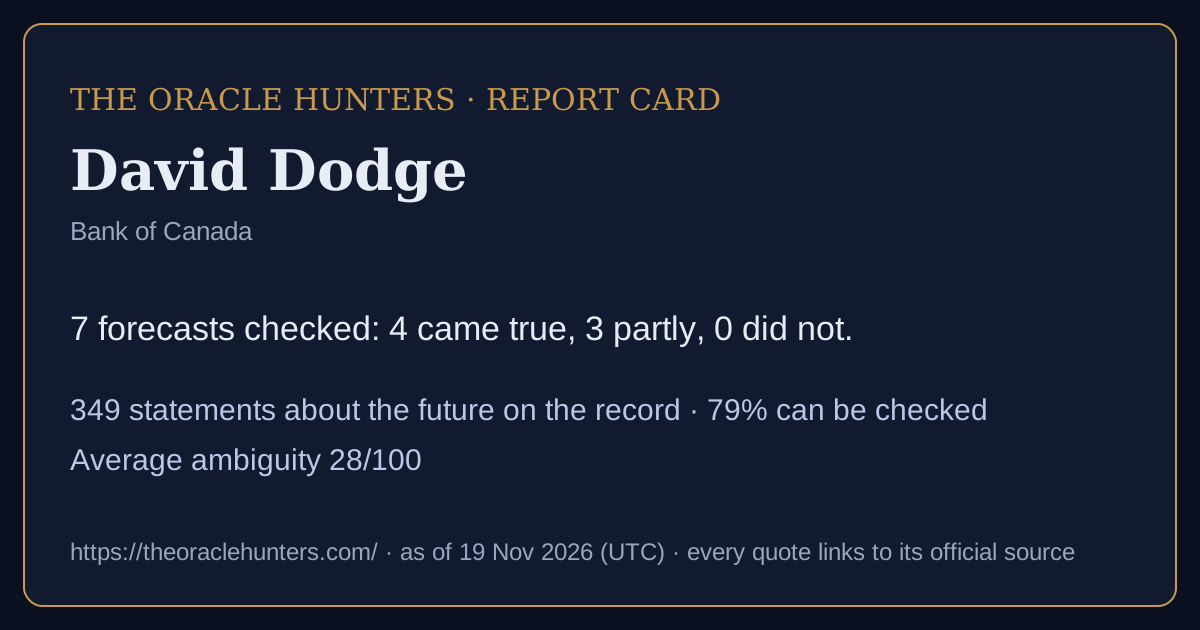
David Dodge
Bank of Canada
Track record: 7 forecasts checked: 4 came true, 3 partly, 0 did not.
349forecasts & commitments on the record
79%can be checked as stated
28average ambiguity (0-100)
0goalpost moves recorded
0confirmed U-turns
Timeline
came true partly did not not due / being checked / too vague
Calibration score: shown after 10 checked forecasts with a stated likelihood (now 1).
How they speak about the future: based on data 290, stated on authority 36, educated guess 23.
Kinds of claim: forecast 263, mixed claim 50, scenario (if… then) 23, commitment 13. · Download this report card as a picture
In the nine words
πρόγνωσιςInference from evidence282 · 81%μαντείαInspired knowledge23 · 7%πρόνοιαPreparing for the future22 · 6%προαναγγελίαPublic pre-announcement13 · 4%εἰκασίαConjecture4 · 1%πρόβλεψιςSeeing the signs3 · 1%φρόνησιςPractical wisdom2 · 1%
How to read this
Each box is one sentence a public figure or institution said about the future, word for word, with a link to the official text. Can be checked means it names what will happen, by when, and how likely - so it can be compared with official figures later. Too vague to check means it does not. Ambiguity (0-100) is how many different ways the sentence can be read. When the date passes, the forecast is compared with official data and marked came true, partly or did not come true. Labels judge the sentence, never the person. Full guide and glossary.Checked
Overall, we at the Bank of Canada project 2.8 per cent growth for real GDP in 2006, slowing to 2.5 per cent next year but coming back up to 2.8 per cent in 2008.
Came true. Said: economic growth below 2.8% in 2008. Official figure for Canada: 1.0% (World Bank open data). On target. official data · checked 14 Nov 2026 · automatic check against official data (rules v3)
The Bank's base-case projection now calls for average annual GDP growth of 2.8 per cent in 2006, 2.5 per cent in 2007, and a return to 2.8 per cent in 2008.
Came true. Said: economic growth around 2.5% in 2007. Official figure for Canada: 2.0% (World Bank open data). On target. Off by 0.5 points. official data · checked 14 Nov 2026 · automatic check against official data (rules v3)
The Bank's base-case projection now calls for average annual GDP growth of 2.8 per cent in 2006, 2.5 per cent in 2007, and a return to 2.8 per cent in 2008.
Came true. Said: economic growth around 2.5% in 2007. Official figure for Canada: 2.0% (World Bank open data). On target. Off by 0.5 points. official data · checked 14 Nov 2026 · automatic check against official data (rules v3)
The Bank projects economic growth of 3.2 per cent in 2006, 2.9 per cent in 2007, and 2.8 per cent in 2008.
Partly came true. Said: economic growth around 2.9% in 2007. Official figure for Canada: 2.0% (World Bank open data). Close: outside the margin, but within one more half point. Off by 0.8 points. official data · checked 14 Nov 2026 · automatic check against official data (rules v3)
In our Report , the Bank projects economic growth of 3.1 per cent in 2006, 3.0 per cent in 2007, and 2.9 per cent in 2008.
Partly came true. Said: economic growth around 3% in 2007. Official figure for Canada: 2.0% (World Bank open data). Close: outside the margin, but within one more half point. Off by 0.9 points. official data · checked 14 Nov 2026 · automatic check against official data (rules v3)
In the Bank of Canada's recent Monetary Policy Report, the Bank projects economic growth of 2.9 per cent in 2005 and 3.2 per cent in 2006.
Came true. Said: economic growth around 2.9% in 2005. Official figure for Canada: 3.2% (World Bank open data). On target. Off by 0.3 points. official data · checked 14 Nov 2026 · automatic check against official data (rules v3)
The economy is expected to grow by about 2 3/4 per cent in 2004, picking up to about 3 3/4 per cent in 2005.
Partly came true. Said: economic growth around 4% in 2005. Official figure for Canada: 3.2% (World Bank open data). Close: outside the margin, but within one more half point. Off by 0.8 points. official data · checked 14 Nov 2026 · automatic check against official data (rules v3)
On the record (349)
This growth profile implies that the economy will move into excess supply in the second quarter of this year, and then return to balance in early 2010.
Excluding the impact of the GST reduction, total CPI inflation is projected to average close to the 2 per cent target throughout 2008 and 2009.
Inflation is projected to fall below 1 1/2 per cent by the middle of this year before returning to 2 per cent by the end of 2009.
Overall, the Bank now projects that the Canadian economy will expand by 1.8 per cent in 2008 and 2.8 per cent in 2009.
My colleagues at the Bank will continue to search for technical improvements in our inflationtargeting regime, but I am confident that the Bank and my successor, Mark Carney, will continue to keep inflation low, stable, and predictable, for the benefit of all Canadians.
Inflation was expected to peak in the fourth quarter of this year before returning to the 2 per cent target around the middle of 2008, as you can see from Table 3.
At our next interest rate decision in January, we will assess all economic and financial developments and the balance of risks, and have a full updated projection for the economy and inflation in the Monetary Policy Report Update , to be published on 24 January 2008.
The main downside risk is that output and inflation could be lower if the Canadian dollar were to be persistently higher than the assumed average level of 98 cents U.S. for reasons not associated with demand for Canadian products.
As a result, Canada's gross domestic product is projected to grow by 2.6 per cent in 2007, 2.3 per cent in 2008, and 2.5 per cent in 2009.
The combined effect of a weaker U.S. outlook and a higher assumed level for the Canadian dollar implies, however, that net exports will exert a more significant drag on the economy in 2008 and 2009 than previously expected.
Total CPI inflation is expected to peak at about 3 per cent later this year and then move back down to the 2 per cent target in the second half of 2008.
With the economy moving back towards balance, and with the direct effect of the stronger Canadian dollar on consumer prices, core inflation is projected to gradually decline to 2 per cent in the second half of 2008.
Against this background of a likely weaker track for exports and tighter credit conditions, along with signs of stronger domestic demand, we judged that the current level of our target for the overnight interest rate - 4 1/2 per cent - is appropriate.
However, economic growth in Canada in the first half of this year turned out to be stronger than we had projected, and near-term prospects for economic growth outside North America continue to be very favourable.
In fact, it was a step in maintaining our monetary policy stance by keeping our target for the overnight rate at 4 1/2 per cent, which we judged appropriate for keeping inflation on target over the medium term.
However, economic growth in Canada in the first half of this year turned out to be stronger than we had projected.
In that context, our base-case projection for Canada was for average annual economic growth of about 2 1/2 per cent through 2009, slightly below our estimate for the growth rate of potential.
Inflation was projected to return to its 2 per cent target by early 2009.
On Tuesday, the Bank raised its key policy interest rate by one-quarter of one percentage point to 4 1/2 per cent, and we said that some modest further increase in the overnight rate may be required to bring inflation back to the target over the medium term.
The Canadian economy is now projected to grow somewhat more strongly in 2007 and somewhat more slowly in 2008 and 2009 than we previously projected.
Higher interest rates across the yield curve and a stronger Canadian dollar are expected to bring aggregate demand and supply in Canada back into balance in 2009.
Economic growth and inflation in Canada in the first half of this year have been stronger than was expected in the April Monetary Policy Report .
Statistics Canada projects that, under a medium population-growth scenario, the percentage of working-age Canadians - that is, Canadians aged 20 to 64 - is expected to peak in about 2011, and then fall off fairly sharply, even as our total population continues to increase.
Core inflation was projected to move down to 2 per cent in 2008, and total inflation was projected to return to target by mid-2008.
And we projected that with average annual real GDP growth of 2.2 per cent this year, the Canadian economy would move back down to its full production potential in the second half.
In the April Monetary Policy Report , we said that we expect the growth rate of trend labour input to decline by 0.1 percentage points in 2009.
Indeed, demographic and economic models suggest that annual growth of trend labour input will fall to about 1 per cent in 2010, and that it will continue to fall to about 0.6 per cent in 2015.
But from 2011 to 2020 we will see a more significant slowdown, as population growth continues to slow and the decline in the employment rate accelerates.
So, if the United States were to dramatically increase its net savings to suddenly wipe out its fiscal and current account deficits, the global economy would likely head rapidly into recession unless other economies took immediate steps to reduce their net savings by increasing their domestic demand.
The Canadian economy is now projected to grow by 2.2 per cent in 2007 and 2.7 per cent in both 2008 and 2009.
Total CPI inflation is projected to rise above the 2 per cent inflation target in the second half of this year, peaking below 3 per cent near the end of 2007 before returning to the target by mid-2008.
But with the economy projected to return to its production capacity in the second half of this year and with further easing of pressures from housing prices, upward pressure on core inflation is expected to moderate, bringing the core inflation rate back to 2 per cent by the end of 2007.
Core inflation should remain slightly above 2 per cent over the coming months, given pressures on capacity and the impact of higher core food prices.
The Canadian economy is projected to grow by 2.2 per cent in 2007 and 2.7 per cent in both 2008 and 2009, returning to its production capacity in the second half of 2007 and remaining there through 2008 and 2009.
But with the economy projected to return to its production capacity in the second half of this year and with further easing of pressures from housing prices, upward pressure on core inflation is expected to moderate, bringing core inflation back to 2 per cent by the end of 2007.
Or, if the economy is expanding more slowly and would likely operate below capacity, which would threaten to push inflation below our target, we would tend to lower rates.
To that end, the Bank has announced a major research program for the next three years to probe whether there might be ways to improve our inflation-targeting regime.
This means that we will continue with our goal of holding inflation to 2 per cent - the midpoint of a 1- to 3-per cent target band - over the coming five years.
Core inflation should remain near 2 per cent through to the end of next year.
Our base-case projection is that the world economy will expand by about 4 3/4 per cent this year, and by about 4 1/2 per cent next year - a more sustainable pace.
After this brief introduction, I will spell out the Bank's interpretation of recent economic developments and our outlook for 2007 and 2008, both in Canada and elsewhere.
Overall, given recent energy prices in futures markets, total inflation is projected to average just above 1 per cent in the first half of the year, before returning to the 2 per cent target in 2008.
Overall, we project that real GDP growth will pick up during 2007, averaging about 2 1/2 per cent in the first half of this year, and about 2 3/4 per cent in the second half.
On an annual basis, growth is projected to be 2.5 per cent in 2007 and 3.2 per cent in 2008.
Our base-case projection is that real GDP growth should recover to the rate of growth in potential output by the second half of 2007, before moving slightly above potential growth through 2008.
In 2008, growth is projected to remain in line with the growth of potential output (estimated at 2.8 per cent), keeping the economy operating near its capacity throughout the projection period.
Looking ahead, real GDP growth is now expected to average about 2 1/2 per cent in the first half of 2007, rising to about 2 3/4 per cent in the second half of this year.
As you may know, last month the Bank and the Federal Government renewed our joint inflation-targeting agreement for another five years, until the end of 2011.
Overall, we at the Bank of Canada project 2.8 per cent growth for real GDP in 2006, slowing to 2.5 per cent next year but coming back up to 2.8 per cent in 2008.
Came true. Said: economic growth below 2.8% in 2008. Official figure for Canada: 1.0% (World Bank open data). On target. official data · checked 14 Nov 2026 · automatic check against official data (rules v3)
Total inflation will likely average about 1 1/2 per cent through the second quarter of 2007, before returning to the 2 per cent target and remaining there through to the end of 2008.
Showing the newest 50 - the ledger has all 349.
Also said - not checkable as stated (12 newest)
Remarks about the future with no date, figure or likelihood that could be checked. They are kept on the record and shown here, but not scored.
The weaker U.S. economy will lead to additional downward pressure on Canada's export growth.
Despite tighter credit conditions, domestic demand in Canada is expected to remain strong, supported by continued income growth associated with the increase in commodity prices seen since October.
Perhaps even more importantly, we should not cling to activities that are no longer economically justified, however difficult and painful adjustment may be.
Vendors of financial instruments will then need to structure them in such a way that market players can clearly see what they are buying.
The world will evolve in ways that we cannot predict, so we must be prepared to deal with change and seize new opportunities as they arise.
You may be asking why the Bank of Canada, with its well-known responsibility for monetary policy, would put such emphasis on financial system issues.
To begin, I will give a brief overview of the Bank's role in the financial system, and review some of the issues I've raised in the past few years.
All these factors considered, the Bank judges that there has been a shift to the downside in the balance of risks around its October projection for inflation through 2009.
I hope that you have found them equally useful and that these regular appearances will continue long after I have left the Bank.
(per cent) | Expected growth (per centye | Expected growth (per centye | Expected growth (per centye | Expected growth (per centye |
Vendors of financial instruments will then need to structure them in such a way that market players can clearly see what they are buying and what leverage is embedded in the instrument.
How do you make provisions for liquidity calls that may come against the guarantees that your institutions provide, and for the support of products that represent a reputational risk should they fail?