David Currie
Office of Fair Trading · GBR
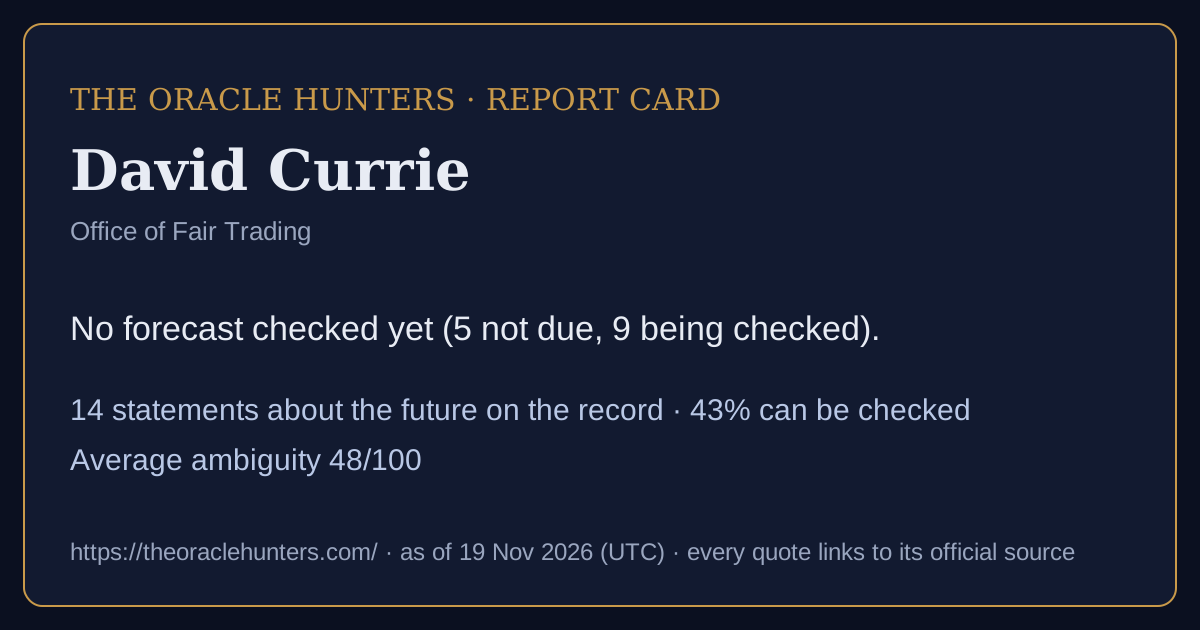
Track record: No forecast checked yet (5 not due, 9 being checked).
14forecasts & commitments on the record
43%can be checked as stated
48average ambiguity (0-100)
0goalpost moves recorded
0confirmed U-turns
Timeline
came true partly did not not due / being checked / too vague
Calibration score: shown after 10 checked forecasts with a stated likelihood (now 0).
How they speak about the future: based on data 10, stated on authority 3, educated guess 1.
Kinds of claim: forecast 10, commitment 2, scenario (if… then) 1, mixed claim 1. · Download this report card as a picture
In the nine words
πρόγνωσιςInference from evidence9 · 64%προαναγγελίαPublic pre-announcement2 · 14%μαντείαInspired knowledge2 · 14%πρόνοιαPreparing for the future1 · 7%
How to read this
Each box is one sentence a public figure or institution said about the future, word for word, with a link to the official text. Can be checked means it names what will happen, by when, and how likely - so it can be compared with official figures later. Too vague to check means it does not. Ambiguity (0-100) is how many different ways the sentence can be read. When the date passes, the forecast is compared with official data and marked came true, partly or did not come true. Labels judge the sentence, never the person. Full guide and glossary.On the record (14)
By the end of this year we will publish a final report on the £12 billion legal services market.
We are determined not to see consumers ripped off by anti-competitive practices because we know that vigorous competition benefits consumers through downward pressure on prices and upward pressure on quality and innovation.
He reminds us that if rates of return exceed the rate of growth, the historically normal state of affairs, then the natural laws of capital accumulation mean that wealth distribution will tend to become more unequal over time, a trend interrupted in the twentieth century by the wealth appropriated and destroyed by two world wars.
First, the effective or real degree of protection was hugely in excess of the nominal – nominal tariffs of 20% could easily generate real effective rates of around 100%, so that what might have been intended as a helping hand to domestic industry amounted to solid protection and feather-bedding.
The new formulation of the offence will apply only to cartel activity after April 2014: evidence that emerges over the next few years of cartel activity before that date will be prosecuted under the old regime.
A statement of intent committing to the new UK Competition Network (UKCN) as agreed with the chief executives on 18 September of this year, and will be published in the next month or so when approved by the boards of the regulators.
An important part of this is to apply competition law more effectively in the regulated sectors, which account for some 25% of the economy: I will leave that to discuss at some length later on.
An important development that we will wish to monitor is the growing collection, processing and use of consumer transaction data for commercial ends.
The rest of the positions in the organisation will be filled from the staff of the OFT and CC through a complex job-matching process which is currently underway and will be completed by the end of the year when virtually everyone will know their future role in the new organisation.
Sectoral regulation in total costs some £850mn a year, whereas the combined budget of the OFT and CC was less than £60mn and the CMA budget in 2014/15 will be £52mn, some 6% of the regulatory budget, and although our budget will rise to £68mn in 2915/16 the difference remains huge.
The CMA Board will be constituted in shadow form in October, in advance of the operational launch of the CMA in April 2014.
Both projects will be completed early next year.
Progress is rapid: the Enterprise and Regulatory Reform Act 2013 is now law, the Authority’s Board will be announced quite soon, we are in the process of selecting the senior executive team, we come into legal existence in October, the organisation will come together early next year and we assume our powers in April.
This means that, realistically, the earliest that legislation could be introduced would be the Third Session of Parliament, with implementation not before summer 2014 after the CMA will already be operational.
Also said - not checkable as stated (12 newest)
Remarks about the future with no date, figure or likelihood that could be checked. They are kept on the record and shown here, but not scored.
That it should be very largely independent of democratically elected politicians may therefore seem surprising.
If a widespread perception of unfairness erodes that trust, then the market system will work less well and we will all be the losers.
So competition authorities need to be sensitive to the question of fairness and vulnerability, and I will illustrate in a moment how the CMA does this.
If we decide that the law has indeed been broken, we will have to see if those decisions stand up to legal appeal.
It is important that the CMA and other competition authorities reflect on this and do what we can do address it, and I will come to this shortly.
In many markets, prices are higher to some than others – that has always been true, but may be accentuated in the online world where sophisticated algorithms based on large quantities of data can drive pricing tailored to individuals.
However, after the election we will continue to provide expert advice to the government on the implications for the regimes we operate.
So we will continue to seek further director disqualifications and pursue criminal investigations where appropriate.
Throughout the period ahead we will continue to promote the benefits of competition for people right across the UK.
All this while continuing to ensure mergers that might lead to worse consumer outcomes through higher prices, lower quality or reduced innovation, are mitigated, prevented or remedied.
And the appeal bodies will need to recognise that these effects are crucial, and may have to accept that the analysis is not as crisp, clear and hugely evidenced but nonetheless has to be weighed appropriately in the light of its importance.
And I am relieved to be having the first word, rather than trying at the end of the day to make sense of all that we will hear.