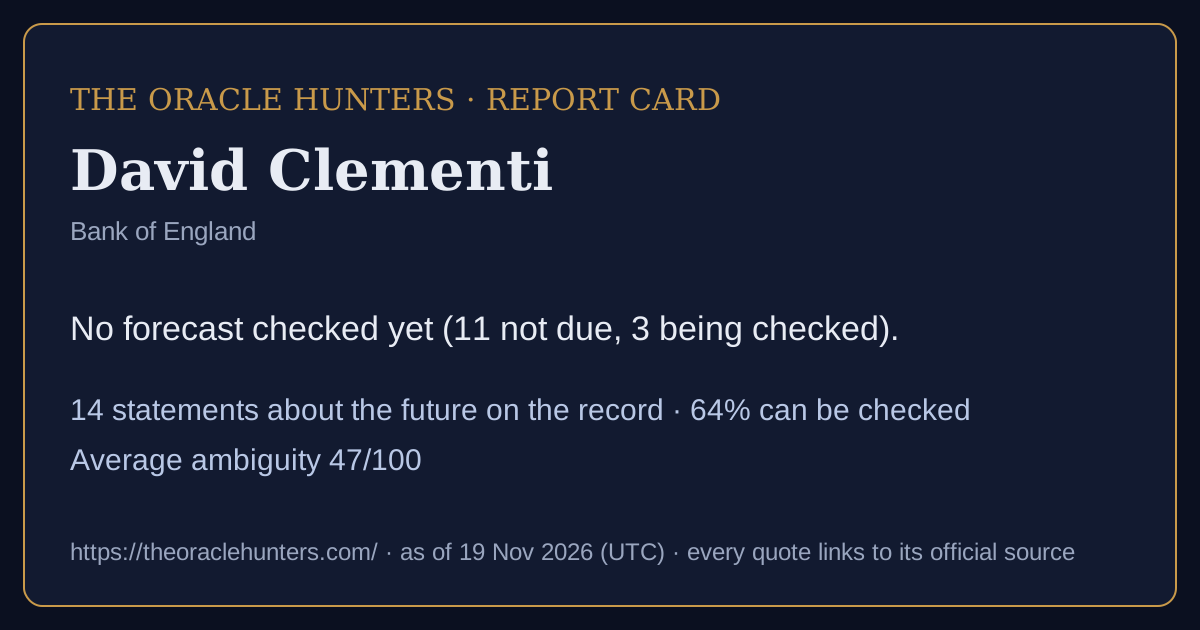
David Clementi
Bank of England
Track record: No forecast checked yet (11 not due, 3 being checked).
14forecasts & commitments on the record
64%can be checked as stated
47average ambiguity (0-100)
0goalpost moves recorded
0confirmed U-turns
Timeline
came true partly did not not due / being checked / too vague
Calibration score: shown after 10 checked forecasts with a stated likelihood (now 0).
How they speak about the future: educated guess 7, based on data 7.
Kinds of claim: scenario (if… then) 6, forecast 5, mixed claim 2, commitment 1. · Download this report card as a picture
In the nine words
πρόγνωσιςInference from evidence7 · 50%πρόνοιαPreparing for the future6 · 43%προαναγγελίαPublic pre-announcement1 · 7%
How to read this
Each box is one sentence a public figure or institution said about the future, word for word, with a link to the official text. Can be checked means it names what will happen, by when, and how likely - so it can be compared with official figures later. Too vague to check means it does not. Ambiguity (0-100) is how many different ways the sentence can be read. When the date passes, the forecast is compared with official data and marked came true, partly or did not come true. Labels judge the sentence, never the person. Full guide and glossary.On the record (14)
Of course, if we are to meet our inflation target, a strong domestic economy will be needed to offset the weakening influence of overseas markets.
And there may be the first sign of easing in the labour market which, if it persists, will reduce disposable incomes.
Since May 1997, when the current arrangements were put in place, RPIX inflation has averaged 2.3%.
There was a flurry of excitement earlier this year when inflation reached 1.8%, and many commentators thought that we might soon have to polish up our letter writing skills.
It is a clear example of how rational and indeed prudent behaviour by individual banks - raising capital, including cutting back on credit granted if no other route is possible, in the light of perceived heightened risk - could collectively be damaging to the system.
In the US, the Congressional Budget Office recently projected that the government debt might be repaid as early as 2006.
If you did not have a chance to subscribe to our euronotes in January, the issue - the 4.5% of 2004 - will reopen in April, July and October.
If banks are insufficiently forward-looking in their assessments of risk, more risk-sensitive capital requirements could lead to an added pro-cyclical effect to the extent that capital requirements would increase in recessions as the average riskiness of borrowers rose.
An analysis based on the market ratings of borrowers suggests that the statistically expected annual losses on UK bank's exposures to the US are likely to be around $1bn or about 1% of UK exposure.
that while the next few months may be difficult, for the year as a whole the US economy will continue to grow, by perhaps 2-3%, and the overall world economy - helped by steady growth in the euro area would grow again this year above its long-term average.
The fact that there are different paths to achieve the 2.5% target is one reason why there is no automatic link between our inflation forecast, which we publish on a quarterly basis, and that month's interest rate decision.
Even though we are concerned with protecting the system, I feel it would be inappropriate to expect most banks to hold an additional cushion of capital to cover these sorts of very rare events: it would either be grossly excessive for most of the time, or alternatively seriously inadequate if a major problem arose.
I hope that, at the end of the process, if differences of opinion remain between the authorities and the banking industry, this will be the result of rational divergence between our different perspectives, and certainly not through any failure of communication.
I would expect the euro corporate bond market to develop significantly in the medium term. it, I would expect to see other product markets develop, as they have elsewhere (in th especially in the US) - for instance markets for asset backed securities and commercial pap of this I think we will see a trend to greater issuance at the …
Also said - not checkable as stated (12 newest)
Remarks about the future with no date, figure or likelihood that could be checked. They are kept on the record and shown here, but not scored.
Market and survey evidence shows that people are now clear that the MPC will do what it takes to keep inflation on track.
In recent months, RPIX has been a little below target, and there has even been some interest in whether it might reach 1.5%, the point at which the Governor would have to write a formal letter to the Chancellor explaining what was going on.
For our part, we will continue to assess the case for interest rate changes on a month-by-month basis.
The current institutional arrangements were put in place in May 1997, when the Chancellor established the Monetary Policy Committee.
Of course, from month to month, inflation will still vary somewhat around 2½%.
And we regularly publish our best estimate about the likely future path of growth up to a two year horizon.
Some business costs, such as insurance, will rise, but that should be at least partially offset by the sharp fall in oil prices.
Some of you may even think you have detected clues in what I have said as to where I think rates should go.
The Bank of England is a voracious consumer of such analysis and expertise, and I very much hope that we will retain a close working relationship going forward.
A team led by Patricia Jackson at the Bank has been providing technical and policy support to the Basel Committee, and we hope to have an agreement in the course of next year.
Disclosure should also help to reduce uncertainties, which may mitigate the tendency of financial markets to lurch into periodic self-fulfilling crises.
This contagion may not be fully in any individual firm's interests - or powers - to resolve, and it is this 'gap in the market' which creates the need for public involvement via central banks.