David Carse
Hong Kong Monetary Authority
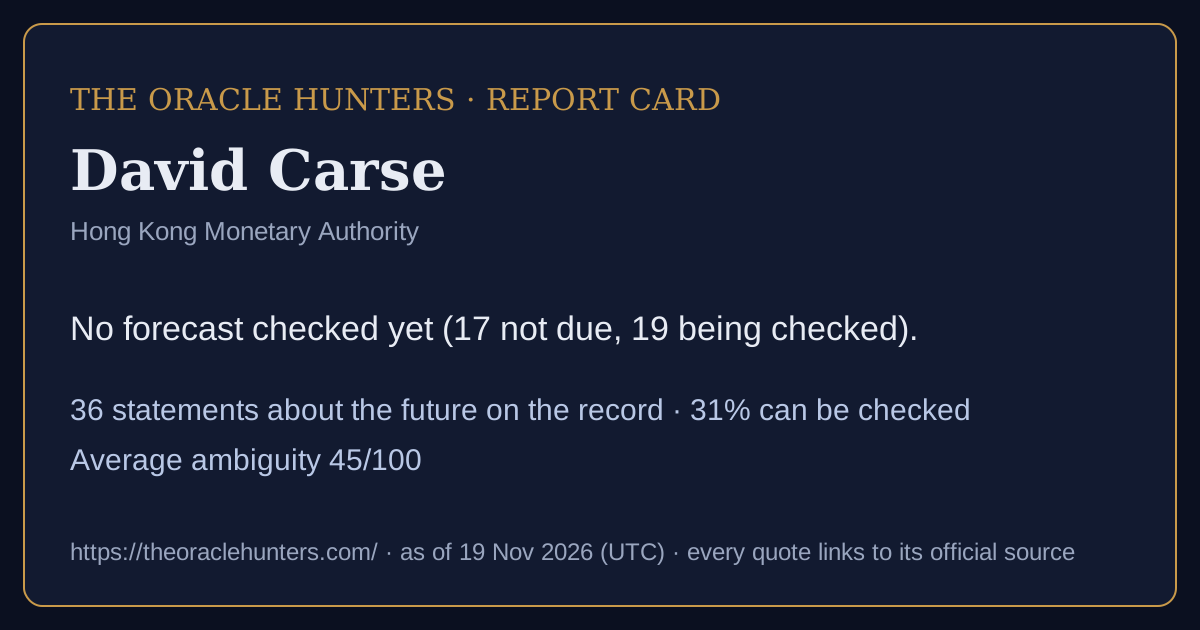
Track record: No forecast checked yet (17 not due, 19 being checked).
36forecasts & commitments on the record
31%can be checked as stated
45average ambiguity (0-100)
0goalpost moves recorded
0confirmed U-turns
Timeline
came true partly did not not due / being checked / too vague
Calibration score: shown after 10 checked forecasts with a stated likelihood (now 0).
How they speak about the future: based on data 16, stated on authority 13, educated guess 7.
Kinds of claim: forecast 24, mixed claim 7, scenario (if… then) 5. · Download this report card as a picture
In the nine words
πρόγνωσιςInference from evidence16 · 44%μαντείαInspired knowledge13 · 36%πρόνοιαPreparing for the future5 · 14%εἰκασίαConjecture2 · 6%
How to read this
Each box is one sentence a public figure or institution said about the future, word for word, with a link to the official text. Can be checked means it names what will happen, by when, and how likely - so it can be compared with official figures later. Too vague to check means it does not. Ambiguity (0-100) is how many different ways the sentence can be read. When the date passes, the forecast is compared with official data and marked came true, partly or did not come true. Labels judge the sentence, never the person. Full guide and glossary.On the record (36)
Most obviously, it poses an increased credit risk since loans in negative equity have a greater tendency to go into default; and if they do, the banks will suffer a loss since the loans are no longer fully covered by the value of collateral.
Although the overall mortgage delinquency ratio has edged up in recent months, it remained at a relatively comfortable 1.16% at end-May.
In the three months from March to May, property prices are estimated to have fallen by 8%.
The eight banks that will benefit from this would, according to our calculations, have the scope to open a total of as many as 20 branches in the Mainland over the next three years.
I will not dwell on the list, which will be familiar to you, but it includes two recessions, five consecutive years of consumer price deflation, a collapse in property prices of 65% from the peak in October 1997 and a surge in personal bankruptcies.
The process of revising the FATF Recommendations will probably not be completed until some time next year.
In particular, we need to make AIs aware of their responsibilities under the United Nations (Anti-Terrorism Measures) Ordinance that was enacted in July of this year and will begin to come into operation in the near future.
But, like the MPFA in respect of MPF business, the SFC will remain in the driving seat; and if problems arise in respect of a bank's securities business, the SFC will have the right to conduct its own investigation and to exercise disciplinary powers.
Perhaps the biggest surprise so far has been that some of the banks have been able to lower their benchmark savings account rate to 1.75%, which is probably 25bp below what it would have been without deregulation.
As a result, I understand that May of this year was one of the best ever months for fund sales in Hong Kong.
While the smaller banks may have to pay a higher rate for their savings deposits, they will still benefit if they can substitute such funds for even higher cost, and less stable, time deposits.
It is unlikely therefore that a DIS could be introduced before next year.
If the decision is taken to proceed, we will therefore be looking at the size of the premium to see whether it can be brought down from the 10 basis points indicated in our consultation paper.
If regional banks wish to remain competitive with the global players operating in their territories, they will need to become more conscious of return on capital and the need to economise on the use of capital.
The new Accord will be unveiled for further consultation at the beginning of next year.
That is something that we may review next year in line with the process of deregulation already referred to.
We increased this to three branches last year, and we may decide to remove the restriction altogether when we review it next year.
A particular landmark was the guideline on virtual banks which we issued in May of this year.
Of course, there could be a more significant impact in July 2001 when the process of deregulation is due to be completed with the removal of the interest rate cap on savings accounts and of the prohibition of interest on current accounts.
I am not in this speech going to summarise all our reform measures, which are due to be implemented over the period to the end of 2001.
Based on self-assessments that we asked the banks to prepare earlier this year, there is a general view that competition in the banking sector will intensify after the final phase of deregulation and that there could be quite a significant impact on the net interest margin.
Second, the fact that we are going to have to devote resources to this issue for the rest of this year means that one of our reform measures, namely a review of the current three tier system of authorisation, will be postponed from this year to next.
The detailed legal arrangements were finalised in May of this year and a formal invitation to join the system was issued to those RLBs with a clear business need to do so.
This is due to take place at the end of June 2001, and will only be postponed if the prevailing economic and financial conditions are clearly unfavourable, which we do not expect to be the case.
Admittedly, much of this was due to the reduction of 58% in the bad debt charge, which will be a temporary factor in improving profitability.
No banks required financial assistance from the Government during the crisis, in contrast to the situation in some of our Asian neighbours where the cost to the public finances of bank rescues and restructuring could reach as much as US$100 billion.
They will have to do this at a time when the last stages of interest rate deregulation in Hong Kong are taking place, starting in the middle of this year and finishing in the middle of 2001.
Similarly, it is possible that credit risks could increase in the future if the relationship with customers becomes more distant and more transitory, and if the banks relax credit standards because of competitive pressures.
Hong Kong Post is establishing a public key infrastructure for Hong Kong and will launch its Certificate Authority service before the end of this year.
Hopefully, the economy has now bottomed out and economic growth will resume this year as fo by the Government.
Rather, it is a crucial step in the economic integration of the European Union ('EU') countries and the creation of the single mar change will involve 300 million consumers, 16% of world GDP and 29% of world trade. demonstrates why the euro is an important event for Hong Kong.
The banks' desire to stay liquid also means that they are more cautious about Generally speaking, they will want to lend only if they can raise the deposits to do so, are growing more slowly.
The combination of re difficulties and domestic slowdown makes it inevitable that asset quality will deteriorate the first quarter of the year there was a noticeable rise in loans overdue for more tha although as a percentage of total loans the figure for the local banks (less than 2%) is s by international, let alone, regional standards.
This means that even if the banks do have to make higher p this year, it will be their profitability rather than their solvency that is affecte profitability is by no means welcome, it is not, by itself, a cause for concern in terms o of the banking system.
When the Hong Kong dollar is pressure as it was at the end of October 1997 and again in January of this year, the HK Hong Kong dollars from the banks in exchange for US dollars and the monetary base shrinks tightening of liquidity will in turn cause interest rates to rise, perhaps sharply so.
Fiscal surplus in 1997 so far is 4.4% of GDP and is expected to exceed 5% of GDP.
Also said - not checkable as stated (12 newest)
Remarks about the future with no date, figure or likelihood that could be checked. They are kept on the record and shown here, but not scored.
But at least the banks can take comfort from the fact that the current difficult operating environment may to a large extent be due to cyclical factors, which should eventually reverse.
I would stress that this does not mean that banks should simply sit back and wait for the rising tide of the economy to lift them up, or that they should ignore the opportunities that may arise from merger and acquisition.
This is something on which individual banks will have to take a view, but I would like to offer some general advice.
First, banks should accept that profits for 2003 may not reach budgetted targets as a result of the outbreak; and they should not strain too much to make up the difference.
This should not be seen as soft option for customers since the banks will certainly not benefit if those customers go bankrupt.
Speech by Mr David Carse, Deputy Chief Executive of the Hong Kong Monetary Authority, to the Hong Kong Foreign Bank Representatives Association, Hong Kong, 6 May 2003.
At the beginning of the year, we were all worried about the looming war in Iraq and the damage that it might cause to the global economy and to Hong Kong.
I am sure that you will agree that we all have a vested interest in keeping it that way - which means that we need to keep in line with international standards as they evolve.
Final revisions to our own guideline will probably have to wait until then.
But we will try wherever possible to be sympathetic to AIs' concerns on compliance costs.
But the process may need to be articulated more clearly so that AIs are in no doubt about what they should be doing.
Diversity of approach among banks should also help to mitigate the risk that an increasing proportion of the population will be excluded from the banking system by prohibitive costs.