David Cameron
Prime Minister of the United Kingdom · GBR
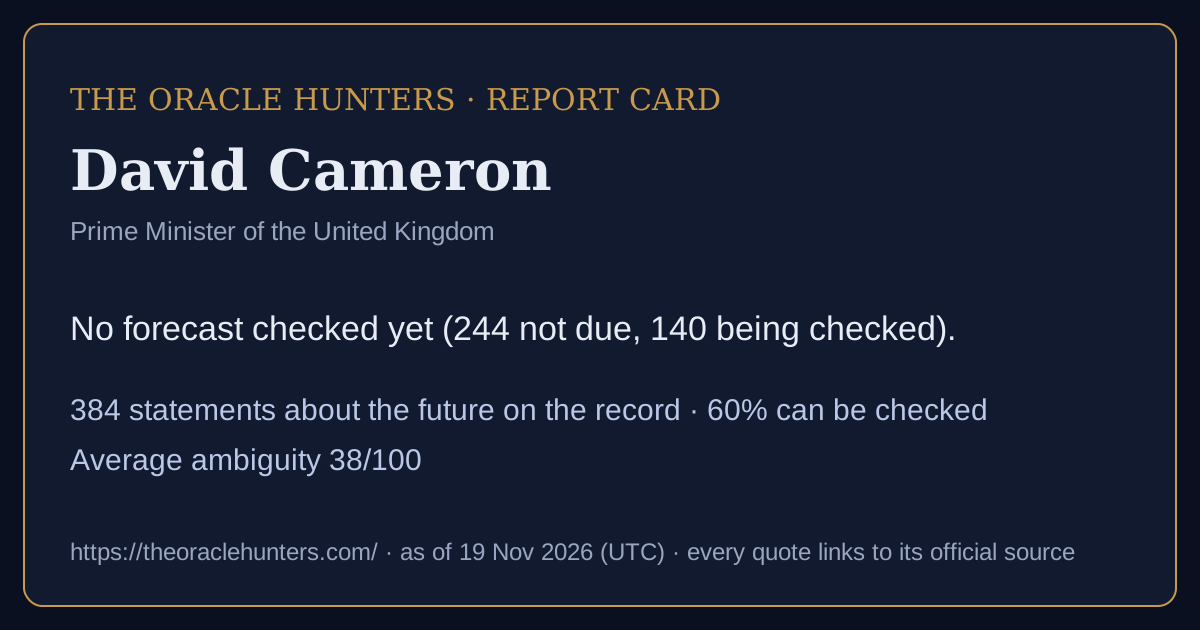
Track record: No forecast checked yet (244 not due, 140 being checked).
384forecasts & commitments on the record
60%can be checked as stated
38average ambiguity (0-100)
0goalpost moves recorded
0confirmed U-turns
Timeline
came true partly did not not due / being checked / too vague
Calibration score: shown after 10 checked forecasts with a stated likelihood (now 0).
How they speak about the future: based on data 284, stated on authority 72, educated guess 28.
Kinds of claim: forecast 176, mixed claim 124, commitment 67, scenario (if… then) 17. · Download this report card as a picture
In the nine words
πρόγνωσιςInference from evidence240 · 62%προαναγγελίαPublic pre-announcement67 · 17%μαντείαInspired knowledge36 · 9%εἰκασίαConjecture19 · 5%πρόνοιαPreparing for the future17 · 4%πρόβλεψιςSeeing the signs5 · 1%
How to read this
Each box is one sentence a public figure or institution said about the future, word for word, with a link to the official text. Can be checked means it names what will happen, by when, and how likely - so it can be compared with official figures later. Too vague to check means it does not. Ambiguity (0-100) is how many different ways the sentence can be read. When the date passes, the forecast is compared with official data and marked came true, partly or did not come true. Labels judge the sentence, never the person. Full guide and glossary.On the record (384)
This year there will be a service in the Foreign Office, where commemoration will be given and testimony read out.
She is absolutely right to raise the issue of contaminated blood, and I can today announce that we will spend the extra £125 million that we have identified.
Although Hull is the official city of culture next year, I am sure that Southend will benefit from the tireless campaign that he has run.
If the investment was going to the wrong places, we would not see 2.5 million more people in work and we would not see a fall in unemployment and a rise in employment in every single region in our country.
I am one of the first Prime Ministers in a while to attend the Farnborough airshow and I am happy to announce that I will be going back there this year, because it is very important.
The report shows that, if we do not take the necessary actions, we will see a continued north-south divide, which is why we are committed, for instance, to seeing increased spending on transport infrastructure go up by 50% to £61 billion in this Parliament.
If he looks more broadly, he will find that, for instance, the Blackpool Museum—I think—received a grant of more than £13 million.
I think 5% of our population are EU nationals—Italians, Germans, Poles, Spaniards and the rest of it—so if you stop 100 people in the street, only five will be EU nationals.
If there is less in tax receipts, we will clearly need to make cuts, put up taxes or increase borrowing.
You do not have to be an economic expert to see this: if the economy shrinks, and there are fewer jobs and lower wages, there will be less in tax receipts.
This brings us back, however, to the core argument today: if we remain in, we will have a stronger economy, and then, yes, we will have to take the proceeds of that growth and continue to put them into the NHS, as I have always done as Prime Minister.
If we vote out, the experts warn us that we will have a smaller economy, less employment, lower wages and, therefore, lower tax receipts.
We will be strapped for cash, if we believe the Institute for Fiscal Studies or the National Institute of Economic and Social Research—both impeccably independent—who say that there would be a hole in our public finances of between £20 billion and £40 billion.
I think that is partly because of the opportunities young people will have from being part of a single market of 500 million people, but also because our universities do very well out of research funding that helps to create the businesses and jobs of the future.
Friend is that we fixed the European budget for a seven-year period between 2014 and 2020, and we fixed a total for that budget that was lower than for the previous seven-year period, which means that European budgets are going to go down, not up.
When we look at what happened during the winter, we see that 82% of claims have been paid out, but if colleagues have specific examples the Secretary of State for Environment, Food and Rural Affairs will be interested to see them so that we can get on top of the insurance industry.
Barrow is home to the development of our nuclear submarines and we will hold a vote in this House to make sure that we renew Trident in full.
If we look at converter academies, we will see that 88% of them are either good or outstanding, and schools started by academies see a 10% improvement, on average, over the first two years.
That will enable HMRC to recover a cumulative £7.2 billion in tax over the next five years.
That is why the historic move last week to an £11,000 personal allowance means that by 2018 people will be paying about £1,000 less per taxpayer and we will have taken 4 million of the lowest-paid people out of tax altogether.
On pensions, we have introduced a pensions system which will benefit many, many women in years to come, because we have a single-tier pension without a means test, uprated by prices, earnings or 2.5%.
It is an extremely difficult market situation, with massive global overcapacity and the huge fall in steel prices, but there are areas where we have taken action already and we will continue to look at what more we can do: state aid compensation so that we can secure the energy costs; greater flexibility over EU emissions regulations.
I can make an announcement today that, subject to the usual conditions, we will be extending pub opening hours on 10 and 11 June this year, to mark Her Majesty the Queen’s 90th birthday.
I am the first to accept and admit that, and on every occasion that that happens it is very important that you learn the lessons, but as we do so, we will continue to increase spending on disability benefits, which will be more than £46 billion a year by the end of this Parliament, compared with £42 billion when I …
Gentleman one example, if we deliver on our carbon reduction plan for electricity generation, we will see roughly an 85% reduction in carbon between 1990 and 2030.
That is why we have an £8 billion housing programme to build 400,000 houses and we hope to build, by the end of this Parliament, 1 million new homes.
I think I am right in saying that some £2 million has been spent on RAF Odiham, but if more is needed we will make sure that that happens.
What I would say to Callum is that we are introducing in our country a situation where we uncap university places so as many people who want to go can go, and that we will be introducing, in this Parliament, 3 million apprentices.
As for the 30 hours, as I have said, there will be some pilot schemes this year and full implementation next year, which is in line with what we said in our manifesto.
The start of the 30 hours will come in through a pilot scheme this year.
The tax-free childcare will come in in 2017.
As they do so, they have the triple lock of knowing that pensions will always go up by wages, prices or 2.5%, whichever is the highest.
My mother is as proud of the NHS as I am, and she would be pleased to know that in the NHS today, there are 1.9 million more people going to A&E, 1.6 million more operations, 10,700 more doctors and 11,800 more nurses.
We will continue to invest in the Syrian refugee camps, not least with the $11 billion that we raised at the landmark London conference.
They know that, every year, it will increase either by wages, prices or 2.5%, and that is why the pension is so much higher than when I became Prime Minister.
What we are doing is this: an £8 billion housing budget that will provide 400,000 new affordable homes, a target to build a million homes during this Parliament, getting housing benefit down so we can spend money on housing, and having a strong economy that can support the housing we need.
The changes to housing benefit that we are talking about will not come into place until 2018, so there is plenty of time to make sure that we support supported housing projects.
What we will do is help by training 3 million apprentices in this Parliament, and we are giving special help to teachers of STEM subjects and encouraging them into teaching.
We are cutting Rosie’s taxes, so this year she will be able to earn £11,000 before she starts paying any taxes.
First, we are going to increase housing supply in the social sector through an £8 billion housing budget during this Parliament that is going to build 400,000 affordable homes.
I think that I am right in saying that the spending power will increase slightly in the next year.
On treating cancer in our country, we are putting an extra £19 billion into our NHS, and specifically—he is absolutely right to say that everyone in the House and every family in the country will know someone affected by cancer—we are treating more patients.
Never again will they get the 75p rise that they got from Labour; their pensions now rise either in relation to prices or wages, or by 2.5%.
We have also committed ourselves to that 2%, and we will make sure that the money is well spent so that we have the right equipment for our brave armed forces.
We are committed to spending £178 billion on defence equipment over the next decade, which we are only able to do because we have a strong economy.
In her own health economy, there are more GPs in the NHS, and next year, because we are putting more money into the NHS, the NHS Waltham Forest clinical commissioning group will get a cash increase of 3.7%.
If they are on low wages, if they are on the minimum wage, they will get a 7% pay increase because of the national living wage.
The introduction of the single-tier pension at £155 a week will be one of the best ways that we can end discrimination in the pension system, because so many women retiring will get so much more in their pension which, of course, under this Government, is triple-lock protected, so they will get inflation, earnings or 2.5%, and never again a …
They will pay more tax than they ever paid under Labour, when the tax rate for Google was 0%.
We have taken action, including action on energy bills that will save these industries £400 million in this Parliament.
Showing the newest 50 - the ledger has all 384.
Also said - not checkable as stated (12 newest)
Remarks about the future with no date, figure or likelihood that could be checked. They are kept on the record and shown here, but not scored.
I have always said that this will take a long time to work in Iraq and Syria, but we must stick at it and we must stay the course.
If we are going to talk about the economic record, let us get the facts straight.
The channel will not get any wider once we leave the European Union, and that is the relationship we should seek.
For those with hepatitis C at stage 2 or HIV, or who are co-infected with both, annual payments will increase over the lifetime of the Parliament, and we will enhance the support for those who have been bereaved and those who will be in future, significantly boosting the money for the discretionary payments.
We will obviously want to spend a lot of time talking about the decision to go to war and all the rest of it, but I think that the most important thing for all of us is to think, “How do we make sure that Government work better, that decisions are arrived at better, and that legal advice is considered …
I am sure that we will have plenty of time this afternoon to discuss the Chilcot report.
In the coming weeks, this unit at the heart of Whitehall can go through these issues very methodically and work out what might need to change in all the different scenarios in order to give these people certainty about their future.
We have looked at the options and the costs and benefits of the various things that we could do, and we will make an announcement in the coming months.
There are going to be very choppy waters ahead—I do not resile from any of the warnings I gave during the referendum campaign—but we have to find the best way through them.
I have to say to him—he talks about job insecurity and my two months to go—it might be in my party’s interests for him to sit there; it is not in the national interest.
We need to discuss the reassurances about stability that we can give now and the fact that our circumstances do not change until we leave the European Union, and then I will want to hear from them—as we draw up possible blueprints for Britain’s future position with Europe—what they think will be the right answer.
What we have in prospect in the European Union, in part because of British action, is the idea of saying that if large foreign multinationals want to invest in the European Union, they will have to report their country-by-country tax arrangements not just in Europe, but all over the world.