Darryl Chan
Hong Kong Monetary Authority
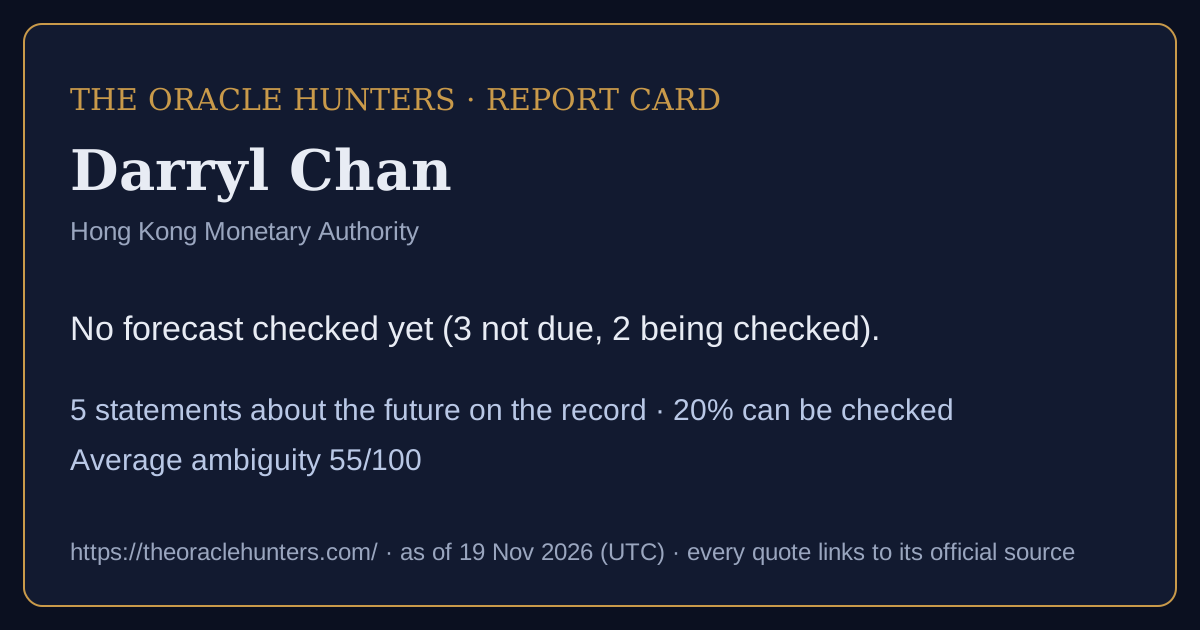
Track record: No forecast checked yet (3 not due, 2 being checked).
5forecasts & commitments on the record
20%can be checked as stated
55average ambiguity (0-100)
0goalpost moves recorded
0confirmed U-turns
Timeline
came true partly did not not due / being checked / too vague
Calibration score: shown after 10 checked forecasts with a stated likelihood (now 0).
How they speak about the future: based on data 4, stated on authority 1.
Kinds of claim: forecast 5. · Download this report card as a picture
In the nine words
How to read this
Each box is one sentence a public figure or institution said about the future, word for word, with a link to the official text. Can be checked means it names what will happen, by when, and how likely - so it can be compared with official figures later. Too vague to check means it does not. Ambiguity (0-100) is how many different ways the sentence can be read. When the date passes, the forecast is compared with official data and marked came true, partly or did not come true. Labels judge the sentence, never the person. Full guide and glossary.On the record (5)
So far the Government has issued US$47 billion equivalent of green bonds and infrastructure bonds to fund our capital works projects, some of which relate to climate-resilient infrastructure such as waste and drainage improvement, flood-prevention works, as well as green buildings and energy efficiency.
According to the World Bank, in the decade starting 2013, close to 80% of the private investments in infrastructure projects were raised through debt financing.
Another public-sector issuer is the Airport Authority, who in January this year raised US$7 billion equivalent, multi-currency notes to fund the airport's threerunway project and expansion of facilities.
Barring any surprise, this year will be marked by major changes - changes that echo political and economic events taking place in different parts of the world.
The success of decarbonisation in Asia will be critical to the global effort to tackle climate change, and some 66 trillion US dollars would be required over the next three decades.
Also said - not checkable as stated (12 newest)
Remarks about the future with no date, figure or likelihood that could be checked. They are kept on the record and shown here, but not scored.
- It requires comprehensive scenario planning and building buffers that will act as shock absorbers should a crisis hit.
I thank you and trust we will put our act together to realise the vision.
Together we will scale new heights for Hong Kong's treasury markets and financial industry in more decades to come.
While we may sympathise with the high-level goals of energy transition, biodiversity preservation and climate resilience, it is challenging to reach consensus when we delve into the practical issues of how, at what speed, and at what cost.
But we also need to address questions surrounding climate actions.
We do need to reflect on the climate agenda, taking into account the legitimate concerns.
For sure there will be plenty of insightful sharing and exchange regarding these important topics.
However, with the recent wide-spread tariff measures, some of which may highlight the significance of local value added content, it seems the end game is far from settled.
Over time, this could lead to more persistent dislocation of supply chains and increased fragmentation in a global trading system that aimed to optimise economic efficiency.
Let me highlight a few things that central banks and regulators should do to address emerging risks and safeguard financial stability.
A World Bank report estimates that the world needs to spend US$3.7 trillion a year on infrastructure to keep up with the economic and demographic developments till 2040.
The source of funding may come from fiscal surplus cumulated over time.