Darmin Nasution
Bank Indonesia
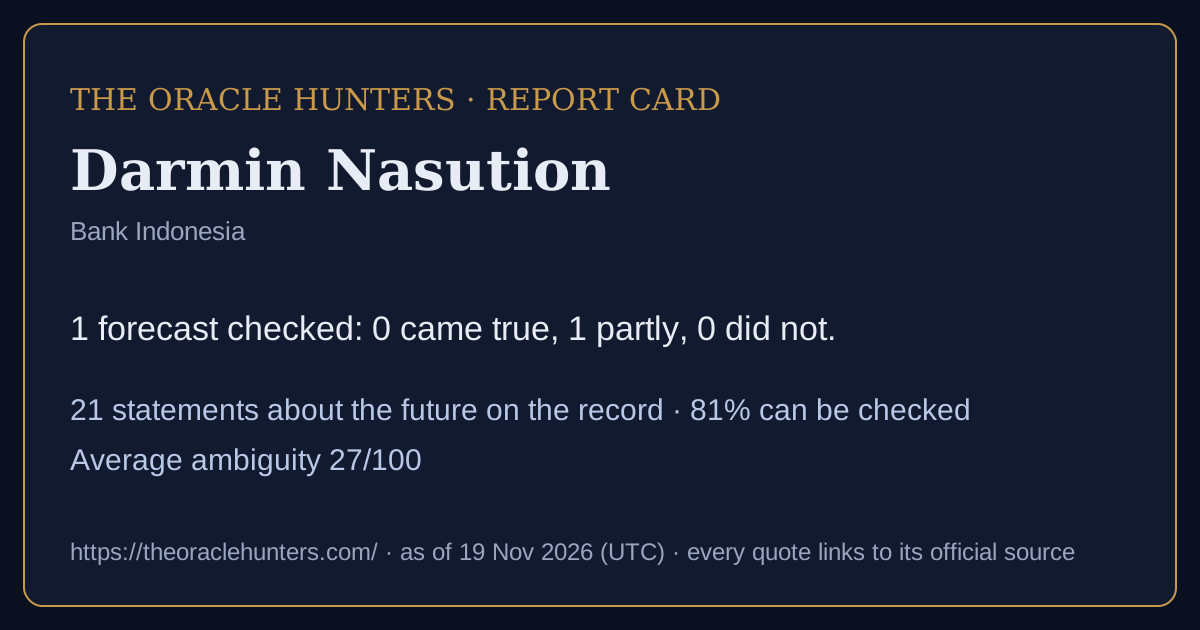
Track record: 1 forecast checked: 0 came true, 1 partly, 0 did not.
21forecasts & commitments on the record
81%can be checked as stated
27average ambiguity (0-100)
0goalpost moves recorded
0confirmed U-turns
Timeline
came true partly did not not due / being checked / too vague
Calibration score: shown after 10 checked forecasts with a stated likelihood (now 0).
How they speak about the future: based on data 20, stated on authority 1.
Kinds of claim: forecast 19, mixed claim 1, commitment 1. · Download this report card as a picture
In the nine words
How to read this
Each box is one sentence a public figure or institution said about the future, word for word, with a link to the official text. Can be checked means it names what will happen, by when, and how likely - so it can be compared with official figures later. Too vague to check means it does not. Ambiguity (0-100) is how many different ways the sentence can be read. When the date passes, the forecast is compared with official data and marked came true, partly or did not come true. Labels judge the sentence, never the person. Full guide and glossary.Checked
Bank Indonesia projects economic growth in 2011 to reach the range of 6.0%-6.5%, and increasing to 6,1%-6,6% in 2012.
Partly came true. Said: economic growth between 6.1% and 6.6% in 2012. Official figure for Indonesia: 6.0% (World Bank open data). Close: outside the margin, but within one more half point. Off by 0.1 points. official data · checked 14 Nov 2026 · automatic check against official data (rules v3)
On the record (21)
As such, we are optimistic that the national economy in 2013 will grow by 6.3%-6.7%.
First, to increase the community's trust in using payment system instruments, we will continue to improve the security of features in using non-cash payment instruments and support ways to make non-cash transactions more affordable and the services safe, prompt, and widely accepted.
On that account, in early 2013 Bank Indonesia will issue guidelines on the implementation of branchless banking which will be followed by the issuance of a number of supporting regulations.
Even though growth will continue to be on the upside, the 2013 inflation is forecasted to remain under control within the expected target range of 4.5 ± 1 percent.
With increasing investment, in due time, purchasing power will be sustained, thus household consumption growth in 2013 can be maintained at 5.0%-5.4%.
With such prognosis and also the support of increasing government capital expenditure, we see the 2012 growth of investment around 10.7%, and we expect that it will continue to increase to 11.6%-12% in 2013.
For 2012, we expect that inflation pressure will still be manageable within the range of inflation target 4.5%+1%, even taking into account the impact of limitation on fuel subsidy or rise in administered prices.
For that reason, in 2012 we will continue to refine several aspects related to customers and potential customers protection.
Policy rate response will be anchored so as to be consistent with the CPI inflation target of 4,5 percent ± 1 percent in 2012 and 2013, while at the same time maintain the momentum toward economic
CPI inflation in 2012 is projected to be consistent with the target of 4,5 percent ± 1 percent in 2012-2013 and is expected to be stable at around the level of 4,5%.
Vigorous investment will eventually buttressed purchasing power hence supporting household consumption growth in 2012 which is projected to reach 4.7%-5.1%.
Investment growth rate which reached 7.7% in 2011 is expected to grow even higher in 2012 at 9.7%-10.1%.
Amidst the global economic slowdown, we expect the domestic economy to grow 6.3%-6.7% in 2012, or slightly lower than in 2011 due to sluggish growth of export.
In return, those factors might potentially surpress credit growth in the range of 19%-21%.
The rise of import activities was still met by adequate export revenues hence could keep a net surplus on Indonesia's current account balance amounting to USD 6.2 billion or 0.9% of GDP.
The banking sector liberalization under the AEC will be effective in 2020.
Bank Indonesia projects economic growth in 2011 to reach the range of 6.0%-6.5%, and increasing to 6,1%-6,6% in 2012.
Partly came true. Said: economic growth between 6.1% and 6.6% in 2012. Official figure for Indonesia: 6.0% (World Bank open data). Close: outside the margin, but within one more half point. Off by 0.1 points. official data · checked 14 Nov 2026 · automatic check against official data (rules v3)
A low and stable inflation accompanied with improvements to various structural impediments will support the Indonesian economy which is estimated to grow by 7.5% by 2015.
The synergy between an appropriate policy mix and a well-built coordination will undoubtedly bring inflation to its target of 5%±1% in 2011 and 4,5%±1% in 2012.
Efforts to bring medium-term inflation down to a lower level are relevant in terms of maintaining the competitiveness of the domestic economy, especially in view of the upcoming ASEAN Economic Community in 2015.
In future, monetary policy will be directed towards maintaining low and stable inflation in the 5%±1% range for 2010; and continuing its declining trend until it is as low as neighbouring countries at around 3%.
Also said - not checkable as stated (9 newest)
Remarks about the future with no date, figure or likelihood that could be checked. They are kept on the record and shown here, but not scored.
I believe this seminar will be the right place to discuss both global and domestic challenges and how we should deal with them.
The main source of the growth is expected to come from domestic demand as investment activity gains momentum, owing to stronger economic fundamentals and improved business climate.
The recent upgrades of Indonesia's rating by Fitch and Moody's will help boost growth up to its potential level, as long as it is accompanied by efforts to utilize our large potential and address various structural issues.
The coordination between Bank Indonesia and the government in controlling inflation will certainly play an important role to bring down inflation.
In addition, this book also highlights the most binding constraints that need to be addressed to sustain and increase economic growth as well as to further lower vulnerability going forward.
Policy to shore up the bank supervision system will be achieved by strengthening risk-based supervision, enhancing operational bank supervision, feasibility and compliance testing, as well as improving collaboration among supervisory authorities domestically and abroad.
Policy to reorganize competition in the domestic banking industry will be achieved through bank restructuring in harmony with the appropriate business scale and capital requirement, as well as increasing the capacity to absorb business risk.
In addition, several regulations will cover, among others, mergers, consolidation, sources of funds for bank acquisition, the terms for bank acquisitions, the role of individual/family owners, as well as the terms and conditions of business development.
Policy to deepen the financial market will encourage the development of financial products that can be used as an alternative by banks for productive channelling and placements to the real sector, especially infrastructure financing.