Danny Alexander
HM Treasury · GBR
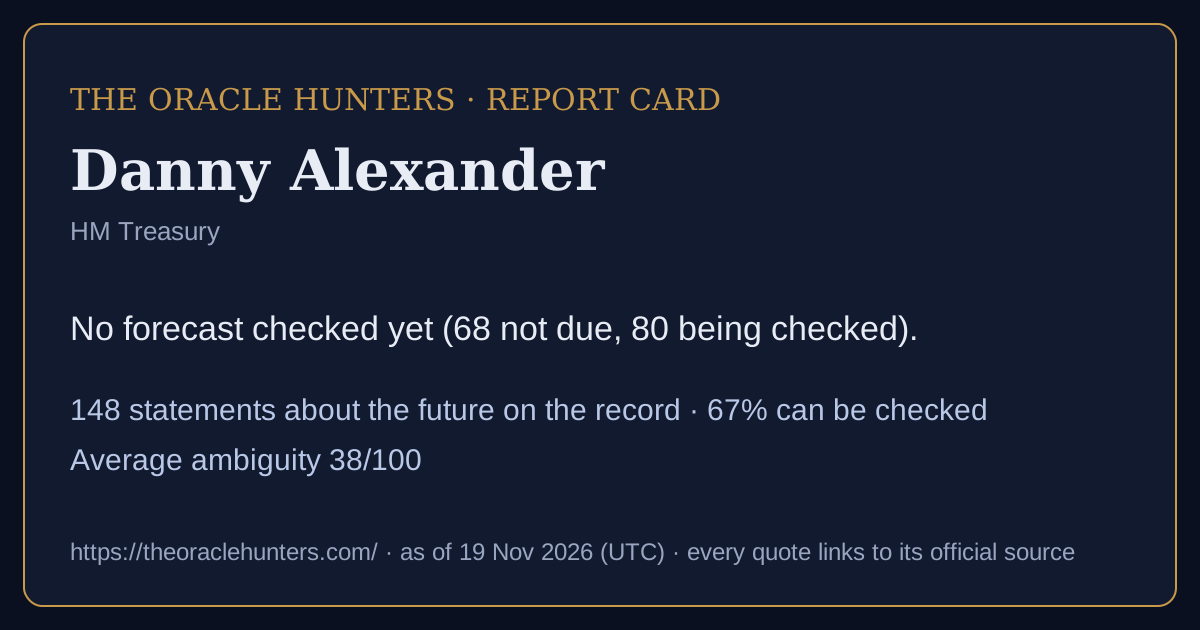
Track record: No forecast checked yet (68 not due, 80 being checked).
148forecasts & commitments on the record
67%can be checked as stated
38average ambiguity (0-100)
0goalpost moves recorded
0confirmed U-turns
Timeline
came true partly did not not due / being checked / too vague
Calibration score: shown after 10 checked forecasts with a stated likelihood (now 0).
How they speak about the future: based on data 115, stated on authority 26, educated guess 7.
Kinds of claim: forecast 100, mixed claim 28, commitment 15, scenario (if… then) 5. · Download this report card as a picture
In the nine words
πρόγνωσιςInference from evidence110 · 74%προαναγγελίαPublic pre-announcement15 · 10%μαντείαInspired knowledge15 · 10%πρόνοιαPreparing for the future5 · 3%εἰκασίαConjecture3 · 2%
How to read this
Each box is one sentence a public figure or institution said about the future, word for word, with a link to the official text. Can be checked means it names what will happen, by when, and how likely - so it can be compared with official figures later. Too vague to check means it does not. Ambiguity (0-100) is how many different ways the sentence can be read. When the date passes, the forecast is compared with official data and marked came true, partly or did not come true. Labels judge the sentence, never the person. Full guide and glossary.On the record (148)
It is money, for instance, that could be used to ensure the NHS has the £8 billion it needs to secure its future.
It will create a fund for infrastructure investment; speed up the development of over 33,000 planned homes; create 45,000 new jobs and 400 new apprenticeships for young people; and provide £1 billion of local and national public sector investment.
One possible way of doing this would be to allow local authorities to retain 100% of any additional growth in business rates above existing forecasts.
Analysis by HMRC and the Treasury suggest these corporate tax reductions will increase investment by 2.5-4.5% in the long term.
So if Scotland makes good economic decisions that allows it to grow its devolved tax base faster than the rest of the UK, then it will keep the upside.
In Manchester, where there are 300 investment projects in the pipeline worth £1.3billion and creating 19,000 jobs.
If we want to be serious about unlocking growth – which I suggest we absolutely do – then we need to be radical about empowering our cities and regions, to put in place the policies that they judge will work best for them.
Last year’s historic deal to tackle climate change and cut greenhouse gases by at least 40% domestically will ensure that we live in a cleaner Europe.
A 25% reduction in EU administrative burdens on businesses could lead to an increase of 1.4% in EU GDP.
If, tomorrow, we could complete all of the currently outstanding free trade negotiations, EU GDP could be increased by 2.2%.
Full implementation of the 2006 Services Directive, for example, could increase EU GDP by up to 1.8% – the equivalent of adding an economy the size of Denmark’s.
And completing the Digital Single Market could add 4% to EU GDP by 2020.
The IMF have confirmed that Britain was the fastest growing economy of any major, advanced nation in 2014 – forecasting 2.6% growth last year and 2.7% this year.
And as we work to get productivity up, I am confident that we will see an era of real and significant wage increases.
This will encourage the exploration and development of one of the biggest fields in the Continental Shelf, Culzean: creating 3,500 jobs directly and along the supply chain; generating over £3 billion of capital investment; at peak, providing 6% of UK gas demand; and helping our supply chain to lead the world in this new technology.
For every £1 billion spent, companies will get £200 million in tax relief.
This allowance – known as the “cluster area allowance”, because it incentivises companies to invest and explore in the area surrounding individual fields – will reduce the tax rate on a portion of the company’s profits from 62% to 30%.
Earlier this year, we commissioned Sir Ian Wood, one of the world’s foremost oil industry experts, to examine how we could maximise this country’s economic recovery.
One which supports jobs and growth and investment - and one which we will do what we can to support.
We will open discussions with industry and the OGA early in 2015.
Especially in the current economic circumstances, people would rightly be angry if they feel that pump prices don’t fall as much as they should on the back of falling oil prices.
That means that petrol and diesel prices will be 20p per litre lower by the end of this parliament than if we had stuck with Labour’s fuel escalator plans.
The findings we will be publishing in four weeks’ time, alongside the Autumn Statement, will have a strong focus on supporting the long-term competitiveness of the regime – through a lower tax burden over time, and through measures to support key stages of the industry lifecycle – so that we maximise the economic recovery of North Sea Oil and gas …
Next year the Oil and Gas Authority will be fully up and running, based right here in Aberdeen.
The recommendations in the Wood Review, commissioned by us and published earlier this year, could, if implemented fully and rapidly, deliver the equivalent of 3-4 billion barrels of oil more than would otherwise be recovered over the next 20 years.
But I think we can be sure that oil and gas will be important to the UK for quite some time: estimates indicate that 70 per cent of our energy needs will still be met by oil and gas in 2030.
But I suspect that even our most ambitious policies – releasing enough public sector land to build 100,000 homes by April 2015, or removing planning obstacles on brownfield sites to support up to 200,000 houses over the coming years – will be hard pressed to take us to the magic number.
And from next April, the Corporation Tax rate in the UK will fall to just 20 per cent, which is set to be the lowest business tax of any major economy in the world.
On the 18th of September this year, we in Scotland will face what is the most important vote of our lifetimes.
major push on superfast broadband, which will see 4G rolled out to 98% of the country by next year
At last year’s Budget – in March 2013 – independent forecasters predicted our growth this year would be 1.8%.
And this year we are forecast to have the fastest growth in the G7.
Our debt will start to fall as a share of GDP in 2016, on current forecasts, and the deficit is forecast to be removed completely by 2019.
The Catcher Project will see £1.5 billion of new investment and over 1,000 new jobs.
And next month we will launch a call for evidence to make sure you can all have your say as part of that review.
They estimate that oil and gas revenues will fall by around 95%, as a share of our economy, over the next 20 years.
A whole range of experts, from the National Institute to Deutsche Bank, calculate that, under independence, interest rates are likely to be around 1% higher.
Indeed, independent forecasters show that, in 2016, Scotland would be borrowing over 5% of national income.
So – by 2015-16 – a typical haulier will have saved a total of £21,000.
In fact, the government will have eased the burden on motorists and hauliers by £22.5bn over the parliament to 2015-16.
When we complete the Y network of HS2, for example, we will boost the Scottish economy by around £3 billion.
Over 2 million Scots will have gained from our personal allowance increases, as we get to the 10,000 personal allowance this year, 10,500 next year.
Next year corporation tax will be down to 20%, the most competitive rate in the G20.
Yet the independent Office for Budget Responsibility forecasts that whole UK revenues will be just £25 billion over the same period.
Their most cautious forecast for Scottish oil and gas revenues is £41 billion.
The Scottish Government forecast that in 2012-13, a Scottish share of North Sea oil and gas revenues would be almost £7 billion.
All told, more than £1 trillion is likely to be needed to extract the remaining oil and gas resources assumed by the Scottish Government.
But in recent years, gas – which accounts for 40% of forecast oil and gas production…
Scotland would be part of a nation with a deficit forecast of just 2.4 per cent of GDP in 2016-17, and falling further in subsequent years.
Including the £1.5 billion London Array offshore wind project, the £1.3 billion gas-fired power station in Pembroke, and the world’s largest solar bridge at Blackfriars Station.
Showing the newest 50 - the ledger has all 148.
Also said - not checkable as stated (12 newest)
Remarks about the future with no date, figure or likelihood that could be checked. They are kept on the record and shown here, but not scored.
We will introduce a new offence of corporate failure to prevent tax evasion or the facilitation of tax evasion.
We will introduce new civil penalties so that those who help evaders will have to pay fines that match the size of the tax dodge they facilitate.
We will finish the job of dealing with the deficit, and do so fairly.
And we will have no tolerance for people who evade tax, or those who help them.
And that if you have not been compliant, we will give you the chance to put your affairs in order – but then we will come after you.
We will examine alternatives for raising money through a local tax.
We will be working with Keith House and Natalie Elphicke, with the Local Government Association and the business community, to implement a Housing Finance Institute, as recommended by their review.
We will be seeking ideas for reform within the widest possible context.
This will need to continue over the coming years.
But we need to know more about this sector, because CDFIs have an important role in lending to viable businesses that might struggle to access finance from mainstream providers.
Now I know that if you’re starting out, then some lenders will say “you don’t have enough security; you don’t have enough of a track record”.
Once you’re an established businesses, you will of course want to operate in as competitive a tax system as you can.