Daniel Mminele
South African Reserve Bank
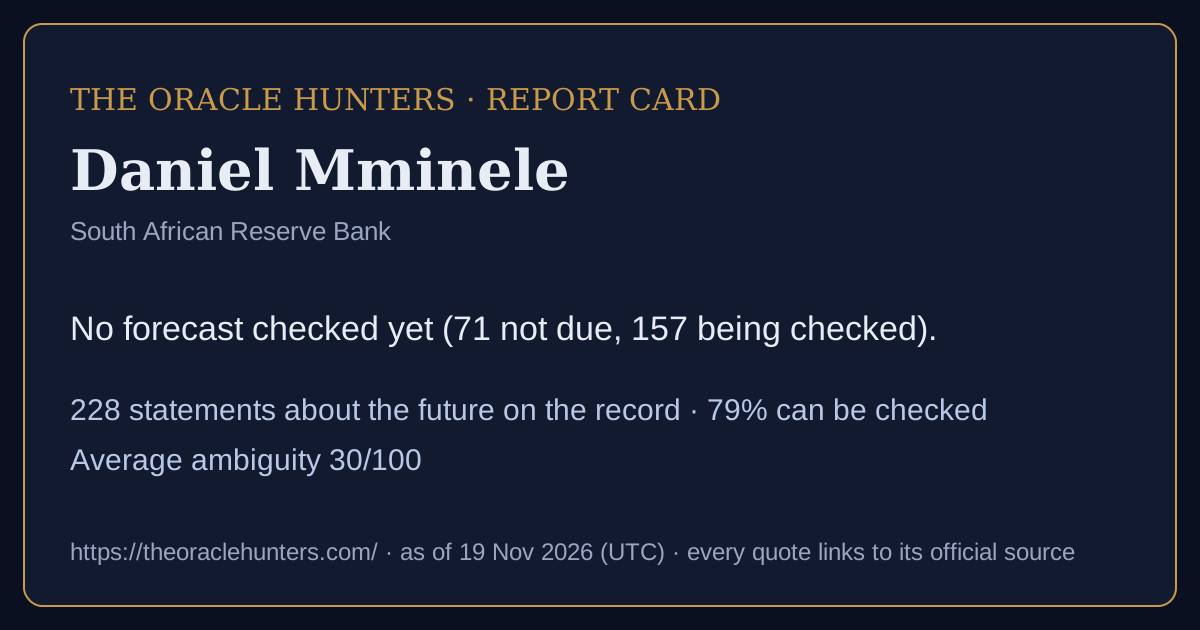
Track record: No forecast checked yet (71 not due, 157 being checked).
228forecasts & commitments on the record
79%can be checked as stated
30average ambiguity (0-100)
0goalpost moves recorded
0confirmed U-turns
Timeline
came true partly did not not due / being checked / too vague
Calibration score: shown after 10 checked forecasts with a stated likelihood (now 0).
How they speak about the future: based on data 201, stated on authority 20, educated guess 7.
Kinds of claim: forecast 199, mixed claim 20, scenario (if… then) 8, commitment 1. · Download this report card as a picture
In the nine words
πρόγνωσιςInference from evidence193 · 85%μαντείαInspired knowledge19 · 8%πρόνοιαPreparing for the future8 · 4%πρόβλεψιςSeeing the signs4 · 2%εἰκασίαConjecture2 · 1%προαναγγελίαPublic pre-announcement1 · 0%φρόνησιςPractical wisdom1 · 0%
How to read this
Each box is one sentence a public figure or institution said about the future, word for word, with a link to the official text. Can be checked means it names what will happen, by when, and how likely - so it can be compared with official figures later. Too vague to check means it does not. Ambiguity (0-100) is how many different ways the sentence can be read. When the date passes, the forecast is compared with official data and marked came true, partly or did not come true. Labels judge the sentence, never the person. Full guide and glossary.On the record (228)
Conversely, if global growth data surprise on the downside, emerging markets could suffer from a 'flight to safety' and renewed appreciation of the US dollar.
Hence, even if a specific emerging country is not directly exposed to higher tariffs, or if it is not in the region where a geopolitical issue is flaring up, it can experience capital outflows as investors will require a higher premium on its assets.
The World Bank now only expects a 1.2% increase in the eurozone's gross domestic product (GDP) this year.
Compared to its January forecast, the World Bank has this month downgraded its forecast for global growth in 2019 by 0.3 percentage points to 2.6%.
While the G20 observed that global growth appears to be stabilising more recently and may pick up into 2020, downside risks overall are still perceived to be tilted to the downside.
The IMF G20 Surveillance note mentioned earlier indicated that based on simulations conducted by the IMF, recently announced tariffs, together with previously announced ones, could reduce global GDP by 0.5 per cent in 2020.
From 1.9% six months ago, our model's projection for GDP growth in 2019 has now been revised to just 1.0%.
Some people might also wonder whether our current inflation target range of 3-6% is too high or not wide enough, and whether it consequently imposes unnecessary constraints on the economy.
Our internal research, for example, suggests that the country could benefit from somewhat lower borrowing costs if inflation expectations were credibly anchored at around 4.5%.
And while an acceleration is expected over the next two years, the projections for 2020 and 2021 (1.8% and 2.0% respectively) only indicate, at best, a sluggish recovery in the absence of implementing reforms to restore confidence, attract investment, support growth, and rebuild buffers.
Meanwhile, core inflation is expected to average 4.8% in 2020 (compared with a forecast of 5.5% six months ago) and 4.5% in 2021.
As of the MPC meeting in May 2019, the SARB projects headline inflation to average 4.5% in 2019, 5.1% and 2020 and 4.5% in the fourth quarter of 2021.
Elsewhere in Europe, methodological changes have been made to the Sterling Overnight Index Average to strengthen the benchmark, while the method used to calculate the Euro Interbank Offered Rate will be overhauled by 2020.
But what is perhaps most pertinent is the looming 2021 deadline for when the Financial Conduct Authority will no longer compel banks to contribute to the London Interbank Offered Rate (LIBOR).
The International Monetary Fund (IMF) has, in its latest World Economic Outlook report 1 , pencilled in a 3.3% global growth forecast for this year, with an expected pickup in 2020 predicated on Chinese stimulus measures, improved market sentiment, dissipating temporary drags on euro-area growth, and stabilisation in certain stressed emerging market economies.
Following its decision to hike the policy rate by 25 basis points at the November 2018 meeting, the MPC felt that the inflation backdrop and outlook had improved sufficiently enough to warrant keeping the policy rate unchanged at the January meeting.
Second, the impact of the 1 percentage point value-added tax (VAT) hike implemented in April 2018 proved lower than expected.
While the MPC still judged the policy stance as broadly accommodative, the endogenous rate path generated by the QPM now only entails one hike of 25 basis points in the policy rate, to 7.0% by the end of 2021.
Equally, many risks, both external and internal, could result in higher inflation should they materialise.
Projections for 2021, published for the first time in January, show both headline and core inflation falling back below 5% in this end-part of the forecast.
The SARB now expects inflation to average 4.8% in 2019 (down from 5.5% in the November projection) and 5.3% in 2020 (slightly below the previous forecast of 5.4%).
According to the Quarterly Projection Model, this undervaluation is expected to persist through 2019, as the local currency is expected to only gradually revert to its equilibrium level.
The year 2021 - the date towards which market participants seem to be converging in marking the end of Libor - may seem like a distant future, but the amount of preparatory work to be done leading up to that time will make it seem sooner than it seems at the moment.
Cognisant of these risks, Libor currency areas have moved to identify alternative reference rates to replace Libor amid growing consensus that, at some point, Libor will cease to exist - not least because the Financial Conduct Authority has already made it known that it will not persuade or compel banks to submit Libor beyond 2021.
The International Monetary Fund is yet to release its October 2018 World Economic Outlook , but the last time it published an update to its forecasts in July, its 2018 and 2019 global growth projections were unchanged from the previous forecasting exercise, at 3.9% for both years.
The SARB's QPM model projects that in order to bring inflation back towards the target midpoint in the long run, five interest rate increases of 25 basis points each will be needed by the end of 2020.
Core inflation is expected to follow a relatively similar, though smoother, profile, peaking at 5.6% year on year during the course of 2019.
While inflation is still expected to remain within the 3-6% target range over the forecasting period, according to the latest forecasts from the SARB's Quarterly Projection Model (QPM), inflation will peak at 5.9% year on year in the second quarter of 2019, before eventually settling at 5.4% in the last few quarters of 2020.
Earlier this year, a decline in both actual and forecast inflation - relative to what the SARB's models had been projecting - had allowed the Monetary Policy Committee (MPC) to ease policy moderately, by 25 basis points in March, in an environment of weak domestic demand.
The output gap remains negative and unlikely to close until late 2020, suggesting that risks of demand-led price pressures should remain low over the forecasting period.
Furthermore, economists agree that, with per capita GDP growth rising by only about 1% a year, it will not make a major dent in poverty and inequality.
Nonetheless, as I have mentioned earlier, the growth levels projected for the next year or two remain insufficient to engineer a serious reduction in poverty as well as the other social or economic ills that typically accompany it, such as crime, malnutrition and illiteracy.
growth of 3.5% next year, after 3.1% in the current year and 2.6% in 2017.
Economic growth has recovered since the abrupt deceleration of 2016, and major international institutions now forecast a moderate pickup into 2019.
However, the IMF expects that it will widen moderately again this year and the next, to around 3% of GDP.
Furthermore, more than 60% of its population is under the age of 25, and it is estimated that, by 2030, SSA will be home to more than one-quarter of the world's total under-25 population. 7
A McKinsey report 3 estimates that, by the year 2030, at least one-third of the activities of 60% of all the occupations could be automated.
The SARB's forecast for GDP growth for 2018 was revised down from 1.7% to 1.2%, while the forecasts for both 2019 and 2020 were slightly higher at 1.9% and 2.0% respectively.
The forecast for core inflation is expected to average 4.6% in 2018 (up from 4.5%), 5.5% in 2019, and 5.3% in 2020 (up from 5.1% in both years).
Headline inflation is now expected to average 4.8% in 2018 (down from 4.9%) before increasing to 5.6% in 2019 and decreasing again to 5.4% in 2020 (up from 5.2% in both years).
This implies that, globally, up to 375 million people may need to change jobs or learn new skills within the next 12 years.
I should also mention that Mr Callie Hugo will be going on retirement later this year, and that this will be his last attendance of the annual cocktail function in his current capacity.
In its July meeting, the MPC of the SARB lowered the repurchase rate by 25 basis points, both in reaction to a sequence of better-than-expected inflation data and a stronger likelihood that inflation would remain comfortably within the target range over the forecast period.
In recent weeks, and in particular since the upward revision to the deficit and debt projections in the Medium Term Budget Policy Statement , the sell-off in both the local currency and domestic bonds is a much clearer indication of investors' nervousness about South Africa's rising economic and fiscal risks as we draw the curtain on 2017 and move towards …
In an October report, the Institute of International Finance (IIF) projected that such flows would rise to US$1.1 trillion this year, or to about 4% of emerging-market GDP - meaningfully higher than the lows of 1.5% in 2015 although still far off the pre-crisis peak of over 9% in 2007.
The FOMC 3 raised its Federal funds target rate by 25 basis points each at its March and June meetings, and markets largely anticipate a third hike in December, which would bring the funds target rate to 1.25-1.50%, in line with the median forecast of the FOMC participants at the start of 2017.
The Bank's inflation forecast shows some deterioration, with inflation expected to be 0.2 percentage points higher in both 2018 and 2019, at levels of 5.2 and 5.5 per cent, respectively.
Consequently, the debt-to-GDP ratio is now projected to keep rising throughout the period, approaching 60% by 2020/21.
We may not be in a recession, but it is quite doubtful that the 2.5% momentum of the second quarter can be sustained.
For these reasons, the SARB projects only a moderate acceleration in actual real GDP growth, from 0.6% this year to 1.2% in 2018 and 1.5% in 2019.
Showing the newest 50 - the ledger has all 228.
Also said - not checkable as stated (12 newest)
Remarks about the future with no date, figure or likelihood that could be checked. They are kept on the record and shown here, but not scored.
ICE Benchmark Administration anticipates launching the Bank Yield Index 2 in early 2020 should there be a favourable market response.
While the MPC assessed the risks to the inflation outlook as more or less evenly balanced, the most recent developments in relation to oil prices and the exchange rate, along with other previously identified risks, such as electricity and water tariffs, and food prices, show that vigilance and data dependency must remain the order of the day.
The significant shifts that we have observed were mainly influenced by both the adopted and expected policy stances of major central banks.
In this vein, we will continue to allow the exchange rate to absorb the initial shocks, and focus our policy actions on addressing second-round price effects, much as at times it can become difficult to distinguish first and second round effects in the wake of extended or multiple supply side shocks.
The most important one was probably the tightening in global financial conditions.
This, in turn, could further undermine investment and international trade, ultimately lowering global productivity
Signs of an adverse impact on the global economy through a further weakening in demand from China for commodities such as metals and other raw materials could weigh further on commodity prices and therefore on export-oriented countries.
The prospects of further US monetary policy normalisation, financial market volatility and less certain global trade environment coupled with weak economic fundamentals suggest that the EM currencies will remain volatile.
We believe that, with the assistance of the private sector through the MPG, we will be able to create a more robust financial market structure that will not only reduce systemic risk, but also add to transparency and allow for more efficient implementation of monetary policy.
My comments thus far referred to the work that needs to be done by both local and international market participants in respect of Libor, much of which will at some point be applicable to the transition that we envision also taking place in South Africa.
While the transition to alternative interest rate benchmarks is still somewhat uncertain, given how resolute regulators and policymakers are about the need for reform, and considering the steps they have already taken to give effect to that, I can comfortably predict that the future of a new or reformed set of benchmarks will come soon enough.
If alternative reference rates differ markedly from Libor or other reference rates which they seek to replace, a mere adjustment for that spread is unlikely to be sufficient, particularly because, from a behavioural point of view, secured and unsecured interest rates do not necessarily exhibit similar trends in times of market stress.