Damian Hinds
HM Treasury · GBR
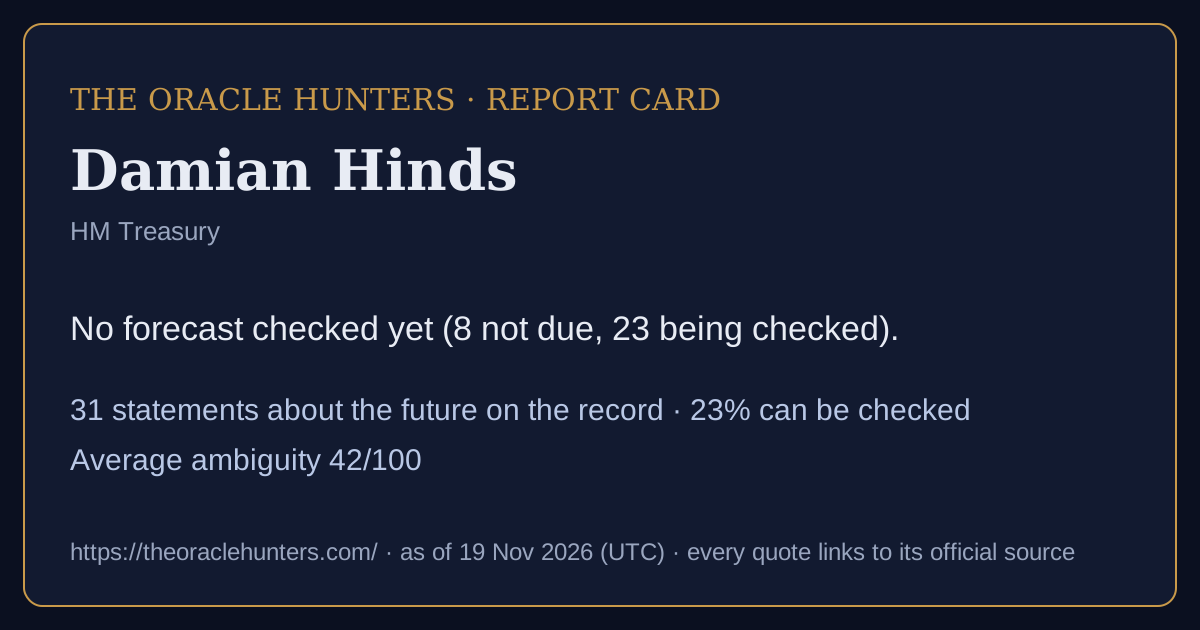
Track record: No forecast checked yet (8 not due, 23 being checked).
31forecasts & commitments on the record
23%can be checked as stated
42average ambiguity (0-100)
0goalpost moves recorded
0confirmed U-turns
Timeline
came true partly did not not due / being checked / too vague
Calibration score: shown after 10 checked forecasts with a stated likelihood (now 0).
How they speak about the future: based on data 19, stated on authority 12.
Kinds of claim: forecast 19, mixed claim 7, commitment 5. · Download this report card as a picture
In the nine words
πρόγνωσιςInference from evidence15 · 48%μαντείαInspired knowledge11 · 35%προαναγγελίαPublic pre-announcement5 · 16%
How to read this
Each box is one sentence a public figure or institution said about the future, word for word, with a link to the official text. Can be checked means it names what will happen, by when, and how likely - so it can be compared with official figures later. Too vague to check means it does not. Ambiguity (0-100) is how many different ways the sentence can be read. When the date passes, the forecast is compared with official data and marked came true, partly or did not come true. Labels judge the sentence, never the person. Full guide and glossary.On the record (31)
And so we’re introducing a new programme, which will come out next month to support parents.
So, from next academic year, all “RI” schools not currently benefitting from this year’s package will be offered funded support from an expert leader to give them bespoke guidance.
I also announced that we’ll invest just over £30 million to train more than 200 new educational psychologists a year, from next year, to help you and your teams access the right specialists.
We have allocated £6 million to that end this year, and future years will be considered as part of the spending review.
By the time the new framework is fully in place we will fund additional support and training for new teachers up to at least £130 million every year.
From September this year we will no longer publish these standards, nor use them for any purpose.
From 2020 all primary schools will be required to teach children about relationships as well as health – secondary schools will have to teach sex education too – so that all children have the knowledge they need to be healthy and safe, and to manage their lives and relationships in a positive way.
It will report back by the end of this year.
So by the time the framework is fully in place we will back it up with substantial extra investment and we expect to be spending at least an extra £130 million every year on its delivery.
I very much look forward to seeing you again this time next year and to seeing the progress I know we are going to make between now and then.
Speaking of keeps on growing, we’re really proud that this show happens here in London because we’re very proud in the UK of our EdTech sector; the fourth largest in the world with a projected export value of around £170million (over $200million).
The group will report recommendations in September with a view to implementing next year.
With the growth in the knowledge economy and the demands of business – we will need a high number of graduates in the future, but we also need more people with higher technical skills.
We will be consulting next year on how to deliver this new approach.
This process will be overseen by the Institute for Apprenticeships, who will soon become the Institute for Apprenticeships and Technical Education… and we will have the first recognised qualifications in place from 2022 – ready for those first T Level students who will just have completed their course.
Today, as part of our T Level Action plan, I am also announcing the next set of T Levels we will roll out in 2021…
We have now around 6,200 this year and I think that’s a trend which will continue.
For example, the latest statistics on destinations of sixth form and college students have shown that disadvantaged white pupils are less likely to be studying in higher education the next year than disadvantaged pupils of any other ethnic groups.
And in fact, it’s a similar result for children identified with special educational needs – 25% less likely to be in sustained employment at 27.
Children eligible for Free School Meals when they are at school are 23% less likely to be in sustained employment at the age of 27, compared to their peers.
That is why we will be investing £20 million to train and develop early years professionals, focusing in some of the most disadvantaged areas of the country.
As part of this, today I’m announcing we will launch a capital bidding round of £30 million to invite leading schools to come forward with projects to create new high-quality nursery places, demonstrating innovative approaches to closing the gap for disadvantaged children.
Indeed, next year universities expect to spend £860 million to improve access and success for disadvantaged students this is a lot of money and it needs to be spent well.
We expect him to report back by the end of the year.
Which is why, earlier this year, we asked Edward Timpson to carry out a review in to exclusions, in particular looking in to why certain groups of pupils – including those with SEND and particularly ethnic minority pupils - are more likely to be excluded than others.
Earlier this year I published a roadmap for reforming Alternative Provision that will see us focus on sharing best practice across the sector.
In addition, I will be asking Ofsted and the Care Quality Commission to design a programme of further local area SEND inspections to follow the current round, due to conclude in 2021; and for their advice on further inspection or monitoring of those areas required to produce a ‘Written Statement of Action’.
And a new national deal on supply agency fees will be launched later this year.
This has grown to around 6,200 this year and I do expect that’s a trend which will continue.
So I’m announcing today that funding for governor and trustee training will be doubled to £6 million up to 2021.
We hope to informally consult on draft regulations over summer, before introducing changes in April 2016 – and I hope you will continue to support this important work.
Also said - not checkable as stated (12 newest)
Remarks about the future with no date, figure or likelihood that could be checked. They are kept on the record and shown here, but not scored.
You will know that you don’t really have to persuade kids to engage with technology.
I think that we’re going to have to move towards, and we should move towards, eventually, having a global approach, global institutions looking at these issues around technology and young people.
When I did my first job, I went to work for the computer giant IBM, and I learned about some of the transformational effects that technology could have on businesses.
So, in schools we are bringing in health education as a mandatory subject in both primary and secondary, and that’s going to include mental health education, from quite a young age.
They should have no limits other than the talents and the application that they themselves will put in.
So, if we’re going to sustain the progress on narrowing the gap, we need to figure out what else we need to do.
It’s not something I’m going to cover today, but it is something that we will be coming back to in a similar vein.
And I said, although we’ve got a lot of focus on the permanently excluded, we need to worry as much actually about these children, those who are on unauthorised absence, and particularly the vulnerabilities that they may then experience.
But if we are serious about social mobility, we have to go there; we have to care about the home learning environment, because it is going to determine the futures of a lot of those children.
We know that domestic market development and export success are closely linked, so we will support UK EdTech businesses in both.
Our Mandarin Excellence Programme is on track to ensure 5,000 students in state-funded schools are working towards fluency in Mandarin Chinese, alongside 100 newly qualified Chinese teachers, to be trained by the end of the programme in March 2020.
This will set the direction we need to take to make the most of the digital revolution.