Commissioner Vălean
European Commission · EU
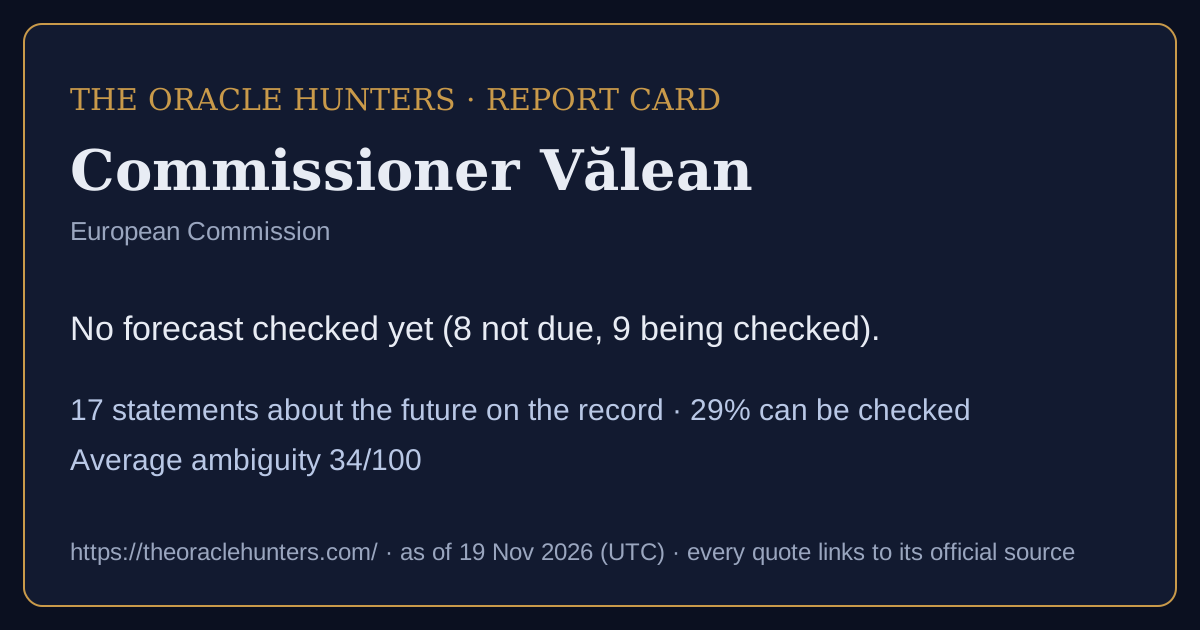
Track record: No forecast checked yet (8 not due, 9 being checked).
17forecasts & commitments on the record
29%can be checked as stated
34average ambiguity (0-100)
0goalpost moves recorded
0confirmed U-turns
Timeline
came true partly did not not due / being checked / too vague
Calibration score: shown after 10 checked forecasts with a stated likelihood (now 0).
How they speak about the future: based on data 10, stated on authority 7.
Kinds of claim: forecast 13, mixed claim 4. · Download this report card as a picture
In the nine words
How to read this
Each box is one sentence a public figure or institution said about the future, word for word, with a link to the official text. Can be checked means it names what will happen, by when, and how likely - so it can be compared with official figures later. Too vague to check means it does not. Ambiguity (0-100) is how many different ways the sentence can be read. When the date passes, the forecast is compared with official data and marked came true, partly or did not come true. Labels judge the sentence, never the person. Full guide and glossary.On the record (17)
Between May 2022 and August 2023, the Solidarity have allowed Ukraine to export more than 53 million tons of agricultural products, including about 48 million tons of grain, oilseeds and other related products.
By 2050, we estimate that 104 production plants will be needed across the EU.
Its provisions will result in a minimum of 1 million electric charging points on our roads by 2025, and over 16 millions by 2050.
The key direction of the reform will be to reduce the dependence of the electricity bills from the price of gas and to make our electricity framework fit for an energy system where in 2030 70% of electricity will come from renewables.
Our data show that electricity demand for electric vehicles will increase total electricity consumption in the EU by at least 2% by 2030.
It will build on the new Transport Strategy, foreseen for adoption later this year, and it will reflect the priorities contained in each.
Member States will submit ‘Recovery and Resilience Plans', by April next year, in order to receive grants or loans.
It will accelerate the completion of the core TEN-T network, due by 2030.
This will also allow us to take the economic and societal impact of the crisis into account when preparing the measures planned for this year.
We will have to prepare to deal with higher volumes of freight and passenger traffic, all while certain health and safety measures at borders may remain, as we enter progressive de-confinement phases, and as we start recovery.
We still plan on launching our flagship strategy on sustainable and smart mobility this year, knowing that it will have to also take into account the much needed recovery of the transport sector from COVID-19.
Finally, on road transport, I also hope that the Council will be able to take a position on our proposals on hired vehicles, and on buses and coaches, in the first half of this year, allowing us to move forward with both files.
We expect to present proposals for these by the end 2020.
This will be followed next year by the revision of the Alternative Fuels Infrastructure Directive and other related proposals.
We will need to increase investment in low- and zero-emissions solutions, including infrastructure.
It will set out how transport can contribute to carbon-neutrality by 2050, and how we use digital technologies in our sector.
We will work on a new proposal for a holistic approach to greening cargo transport in Europe, and I expect to be able to present specific proposals to you in 2021:
Also said - not checkable as stated (12 newest)
Remarks about the future with no date, figure or likelihood that could be checked. They are kept on the record and shown here, but not scored.
They will have to look beyond civil standards and consider also questions of weight or size of troops and military equipment.
With a war at our border, fixing the missing links and bottlenecks in our European infrastructure that could jeopardise the movement of military forces became a priority.
For the first time, the TEN-T transport corridors will be extended into neighbouring countries: Ukraine, Moldova and the Western Balkans.
This means that whatever we do on the civil transport side, if well-designed, will be to the benefit of Military Mobility.
Tomorrow, we will launch a new call under the EU's Connecting Europe Facility.
Commission's services had good preliminary discussions with the Ukrainian teams and we will organise more technical meetings to identify the best projects to be financed.
As you may know, the Solidarity Lanes were set up in May last year, to establish alternative routes for Ukraine's agricultural exports and for Ukraine to import what its people desperately need.
Even stronger cooperation between Ukraine, Romania and Moldova, specifically on streamlining border control procedures, will also increase capacity along the land routes to the Danube ports and the port of Constanța.
For the first time, Ukraine and Moldova will be able to apply for funding for infrastructure projects along the Solidarity Lanes, and without needing EU partners.
By adding drones into the transport mix, we will not only have less traffic congestion, but also fewer emissions, and all this with no expensive infrastructure requirements.
And just as I am certain that we will all benefit from our exchanges on all these topics over the next two days, I am equally convinced we would benefit even more from setting up a shared platform for regular dialogue and cooperation on the broad variety of aviation-related issues of mutual interest.
But we will still need more electricity production and better distribution.