Commissioner Várhelyi
European Commission · EU
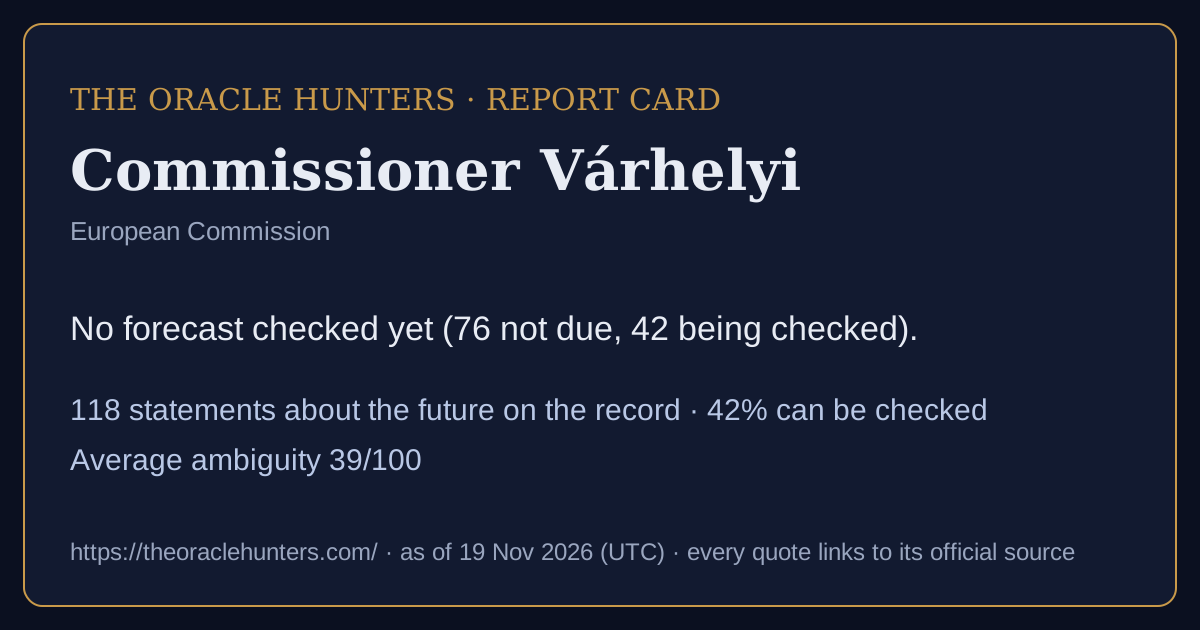
Track record: No forecast checked yet (76 not due, 42 being checked).
118forecasts & commitments on the record
42%can be checked as stated
39average ambiguity (0-100)
0goalpost moves recorded
0confirmed U-turns
Timeline
came true partly did not not due / being checked / too vague
Calibration score: shown after 10 checked forecasts with a stated likelihood (now 0).
How they speak about the future: based on data 72, stated on authority 35, educated guess 11.
Kinds of claim: forecast 60, mixed claim 36, commitment 12, scenario (if… then) 10. · Download this report card as a picture
In the nine words
πρόγνωσιςInference from evidence65 · 55%μαντείαInspired knowledge26 · 22%προαναγγελίαPublic pre-announcement12 · 10%πρόνοιαPreparing for the future10 · 8%εἰκασίαConjecture5 · 4%
How to read this
Each box is one sentence a public figure or institution said about the future, word for word, with a link to the official text. Can be checked means it names what will happen, by when, and how likely - so it can be compared with official figures later. Too vague to check means it does not. Ambiguity (0-100) is how many different ways the sentence can be read. When the date passes, the forecast is compared with official data and marked came true, partly or did not come true. Labels judge the sentence, never the person. Full guide and glossary.On the record (118)
We will strengthen cooperation on surveillance, emerging threats, and emergency preparedness through the joint action plan agreed between the European Centre for Disease Prevention and Control, the ECDC, and the Mexican Secretariat of Health.
This builds on our ongoing partnership with COFEPRIS, and we will also extend our joint regulatory capacity building project beyond 2027.
We're losing 1.7 million lives to cardiovascular diseases every year in Europe. 80% of these lives could be saved if we had a different strategy.
We expect to launch this by the end of the year.
In this the role of Artificial Intelligence cannot be circumvented, this is why in the coming days we will launch the CHAIN project coordinated by the European Society of Cardiology: this programme with 20 million euro eu4health financing will bring together all initiatives and expertise to make those solutions available everywhere in Europe.
If you look at the figures now, you will find that 21%, 21%, so one-fifth, more than one-fifth, 21% of the adolescents are already now in that category.
But if you go outside, just to the next street, most likely you will find that, I would say, roughly 60% of the people don't know.
So we will have double the number of people suffering from cardiovascular diseases by 2050.
We will not alleviate workforce shortages, without alleviating the burden that is on our health systems: Aging demographics, and rising communicable diseases.
The proposals on pigs will follow next year.
On the basis of this evaluation, the Commission will now carry out an impact assessment and continue consulting widely to propose a revision of the legislative framework on tobacco control this year, as it has already been announced in the Safe Hearts Plan.
In this context and to bridge the existing funding gap: In partnership with the European Investment Bank Group, we will already mobilise 10 billion euro of investments into biotech this year and next.
This pilot links equity instruments with venture-style debt and will mobilise 10 billion euro into the sector over the next two years while waiting for the next MFF to kick-in.
In this regard, we will perform a higher number of checks in Member States, to ensure controls at the borders comply fully with EU standards.
This is why the Commission will increase its export related audits in non-EU countries by 50% over the next 2 years - starting from 1 January 2026.
These will target health biotech in particular, which makes up over 80 percent of the value of the overall biotechnology market.
We will adopt the first EU Prevention, Preparedness and Response Plan this year.
If we do not fix shortcomings of the medical devices rules, the sector will shrink, which means there will be less operators, less competition and higher prices.
The 2024 Ageing Report estimates that public healthcare spending in the EU will go up from the current share of 6.9 percent of GDP to 7.7 percent of GDP in 2070.
In parallel, we will adopt short-term measures that will apply by the end of the year.
But for the first time, we will have an EU cardiovascular health plan by the end of this year.
Because if you look at all the sectors of our economies, what you will find is that it is the biotech sector and the health sector where Europe has the biggest potential to become or to stay a leader.
We hope that this will be concluded already this year.
I think what you see today and what you're going to read is a very clear roadmap, or if you will, a clear expression of a European offer: how to make Europe the global leader in life sciences by 2030.
And of course, when it comes to talking about the rest of this year, the most important elements we anticipate to come forward with is going to be first of all a full review of the medical devices sector, a Biotech Act and also that should include a revision of the Clinical Trials Regulation.
So if you basically stick up markets to a size of, let's say, 100 million people, then it's almost guaranteed that there will be supply.
The biotech act is going to be also about that, something that will come up, I hope, very soon next year.
So everything we will do this year, the next, is going to be all about that.
To this end, this year we will launch an EU Network of National Comprehensive Cancer Centres.
If we achieve all this, and strengthen domestic healthcare systems, we will have a more robust international framework for preparedness and response, in full respect to the health policy competencies and responsibilities of individual EU Member States.
The pharmaceutical package is in the pipeline and hopefully this year we will get an agreement.
This year will be about consultations, and I want to open these discussions to all stakeholders as promised.
Once we complete these discussions, hopefully next year, we will be able to present proposals, taking into consideration the results of these consultations and also the data on the impact on farmers and the agri-food chain system.
The first one you could expect sometime next year.
And I think that any vision which is to be put forward will have to be tested through dialogues, and the dialogue must continue, because I think that effective action can only be achieved if the dialogue that we are going to have next year on animal welfare will come up with solutions that respect the priorities and perspectives of …
We will use cutting-edge technology and health data to help prevent cardiovascular diseases.
Therefore, the Commission will continue to support Member States as they make progress towards our 2030 targets to tackle this issue.
We have also all the chances that in December this year some further chapters could be provisionally closed with Montenegro, and an additional cluster could be opened with Albania.
I hope that this is going to still improve until the end of the year.
Here, I want to underline that together with the Reform and Growth Facility, the total EU financial support given to the Western Balkans will, by 2027, reach a comparable level of aid intensity as we see in the current cohesion and structural funds countries of the European Union.
Once adopted by the Council, this decision will bring EUR 16.1 billion in total funds disbursed this year under Pillar 1 of the Facility, meaning the Ukraine Plan.
And the third one -the latest one - is the Growth Plan, which is now accelerating enlargement to make it possible that by the end of the mandate of the next Commission we will see Prime Minister Rama nominating his first Commissioner to the Commission.
We also will continue our cooperation under the Economic and Investment Plan - which has by now mobilised EUR 1.5billion in public and private investments in key sectors such as energy, transport and access to finance for businesses.
I hope to see all of you including it, so that the 1st of January next year will mark the fact that the whole of the Western Balkans is part and parcel of the single euro payment area, meaning at least half a billion EUR of cost saving for businesses and citizens every year, every year.
Just to give you one element, with all the tools we have in place, by 2027 the Western Balkans will be receiving the same or comparable level of aid intensity as our current Cohesion and Structural Funds beneficiary Member States.
That means that they will reach 90%, nine zero percentage points of eight intensity of the 13 Cohesion and Structural Funds countries by the end of this multiannual financial period which runs out at 2027.
The Growth Plan will not work, unless the region works as one, because the Common Regional Market is the backbone of this.
This means that by 2027 all the possibilities are going to be there for the region to join the European Union.
And with this package, together with the Economic and Investment Plan of EUR 30 billion, Serbia and the whole region will benefit from aid - aid intensity, as we call it in Brussels - comparable to current Cohesion and Structural Funds countries by the end of this multi annual financial framework, by 2027.
Development, meaning, getting up to speed when it comes to being an attractive investors hub of foreign direct investments, meaning, being capable of producing more growth and jobs locally for the people, and meaning, that the Balkans, if they are to catch up with Europe in terms of economic and social development, they would have to have at least double …
Showing the newest 50 - the ledger has all 118.
Also said - not checkable as stated (12 newest)
Remarks about the future with no date, figure or likelihood that could be checked. They are kept on the record and shown here, but not scored.
Moreover, the Biotech Act will streamline clinical trials and facilitate complex technologies combining pharmaceuticals, medical devices and AI.
It will also create a coherent framework for AI-enabled devices.
And of course, we will pursue this while maintaining patient safety, ethical standards, and the quality of evidence.
I have invited Mexico to Brussels to continue and have the next high-level dialogue on health already next year.
Public health ambition and industrial competitiveness should, therefore, reinforce each other.
Ladies and gentlemen, our innovation agenda must also respond to health challenges people face every day.
It is going to be through innovation that we will be able to reinvent the European healthcare system.
These are the values that can actually create a competitive environment, but also this is the guarantee that European patients will continue to have access also long-term for the best therapies, because we will have the clinical trials here in Europe and we will have manufacturing in Europe of European inventions that we are creating with our European scientists.
We will not be able to treat double the number of people from the same resources and we will not be able to help and cure these diseases for double the number of people.
And because I'm convinced that we will find some really interesting and also challenging discoveries.
And we also know that if we don't act, we will have a whole generation who are going to have a condition in the next 10, 15 years.
Otherwise, it's a continuum that we will not be able to stop.