Commissioner Urpilainen
European Commission · EU
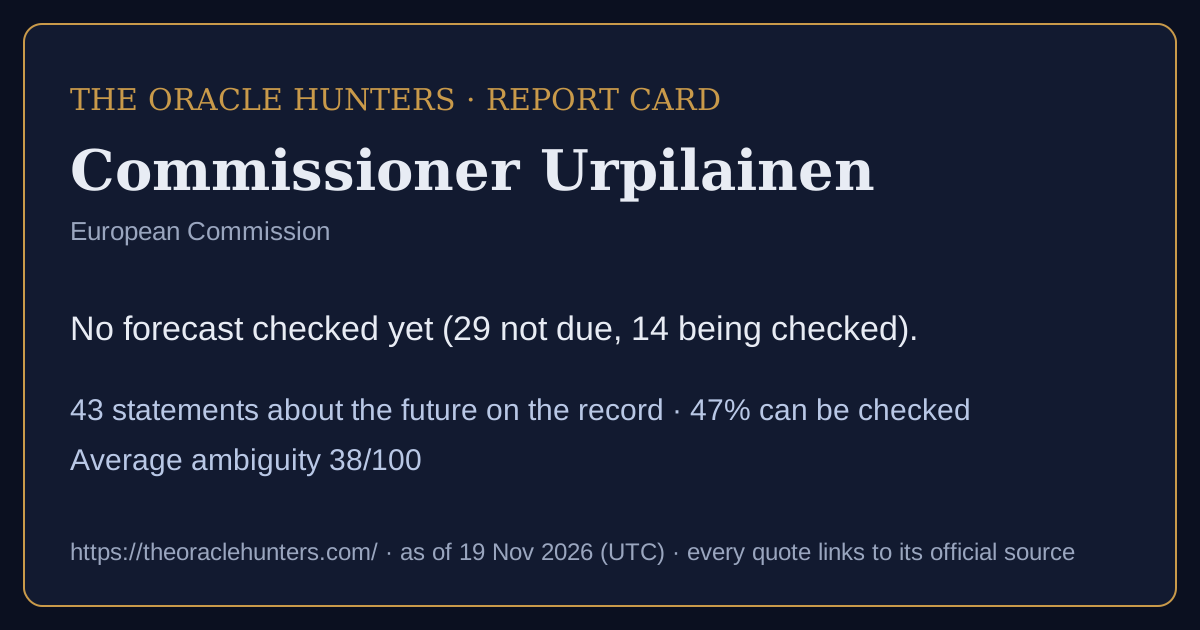
Track record: No forecast checked yet (29 not due, 14 being checked).
43forecasts & commitments on the record
47%can be checked as stated
38average ambiguity (0-100)
0goalpost moves recorded
0confirmed U-turns
Timeline
came true partly did not not due / being checked / too vague
Calibration score: shown after 10 checked forecasts with a stated likelihood (now 0).
How they speak about the future: based on data 38, stated on authority 5.
Kinds of claim: forecast 24, commitment 10, mixed claim 9. · Download this report card as a picture
In the nine words
πρόγνωσιςInference from evidence32 · 74%προαναγγελίαPublic pre-announcement10 · 23%μαντείαInspired knowledge1 · 2%
How to read this
Each box is one sentence a public figure or institution said about the future, word for word, with a link to the official text. Can be checked means it names what will happen, by when, and how likely - so it can be compared with official figures later. Too vague to check means it does not. Ambiguity (0-100) is how many different ways the sentence can be read. When the date passes, the forecast is compared with official data and marked came true, partly or did not come true. Labels judge the sentence, never the person. Full guide and glossary.On the record (43)
As African vaccine and medicine manufacturing picks up pace, we will work to strengthen broader health systems and access to care – ensuring better health and wellbeing for all.
Today, as we take stock of our progress towards the 2030 Agenda, it will put our collective action to the test.
By 2025, we anticipate that 85% of new EU actions will contribute positively to gender equality and women's empowerment.
It will be launched this year in 11 African countries and builds on the experiences of the VET Toolbox, a programme implemented in several African countries to meet investment needs.
By 2050, one third of the global population aged between 15 and 24 will be from Africa.
Together, we will help Lao PDR to preserve and use sustainably its rich natural resources, in line with your National Green Growth Strategy 2030.
In Cambodia, we are committed to support the country's integration into ASEAN and the upcoming graduation from Least Developed Country by championing Green Growth and Decent Jobs.
And it comes with financial firepower – as announced by President von der Leyen, Team Europe will contribute over EUR 45 million in support of our LAC partners until 2027.
The I-Marker will guide our actions by the end of 2023, and the EU will make the tool available to governments, international organizations, NGOs, and researchers worldwide.
By 2025, 85% of new EU actions will positively contribute to gender equality.
We will build on this in the lead up to COP28 this year.
By 2025, 85% of new EU actions will contribute to gender equality alongside other priority areas.
Reaching the goals of the 2030 Agenda will be a struggle.
We will have almost doubled it by the end of my mandate, to close to 13%.
As of 2023, I am proud to announce it will be extended to the Caribbean.
The Caribbean will also benefit from key initiatives between the EU and the broader Latin American and Caribbean region which we build towards the Summit next year.
Thanks to a partnership between the EU as Team Europe, Rwanda, and BioNTech, vaccine manufacturing will begin in 2023, in Africa for Africans.
We will provide a total of 26.7 billion euros guarantee to cover EIB investments in sectors like clean energy, green infrastructure, and health.
That was my main message in Niger but also in Côte d'Ivoire and Ghana who are impacted by the spill over of security threats We will remain engaged, in line with our integrated strategy for the Sahel, around five pillars: political dialogue, security and stabilisation, development assistance, international and regional coordination, and strategic communication.
I am pleased to confirm today that our GAP III target, which was successfully introduced in the NDICI thanks to the support of this House, of 85% of gender-sensitive projects by 2025 is already almost in reach.
This will include EUR 1.2 billion for the green transition through Green Alliances, more than EUR 600 million for sustainable growth and digitalisation and more than EUR 500 million to support human development.
And of course, learning the lessons from COVID-19, we will strengthen our health systems and research capacities, notably through our initiative to support university teaching hospitals.
We will promote sustainable, comprehensive and rules-based connectivity, including health infrastructure and people-to-people connectivity with bilateral programmes worth EUR 2.3 billion until 2024.
Colleagues, according to our initial estimations at this stage, the EU will indeed devote over EUR 6 billion by 2027 to improving education worldwide – this represents around 13% of our funding and is EUR 2 billion more than in the previous period.
Over the next six years, we will dedicate 35% of European external action funding to climate action and we will double our external funding for biodiversity.
During the next 15 years, more than 400 million young Africans will enter the labour market.
If we do not take full-scale action – urgently – we will not reach the Sustainable Development Goals by 2030.
We will continue to lead the global response to COVID-19 and contribute to achieving global priorities, particularly the 2030 Agenda and the Paris Agreement.
We will work with them at the multilateral level to advance our strategic priorities: Green Deal, Digital, Sustainable Growth and Jobs, Migration, and Peace, Security and Human Development.
This €1 billion initiative will help create an enabling environment for local vaccines manufacturing in Africa and tackle barriers on both supply and demand sides.
Last week, at the Global Health Summit Team Europe committed to share at least 100 million doses to low and middle-income countries – and this number will only grow.
Under our new Gender Action Plan, we will be ensuring that 85% of our actions have a gender component.
In this spirit, we will all strive to implement the United Nations 2030 Agenda and the Paris Agreement, the overarching frameworks guiding our partnership.
We will increase funding on education from seven to at least 10 %.
And, we will ensure 85% of our actions have a gender component.
In Africa, EUR 100 million will be provided in humanitarian assistance to rollout vaccination campaigns led by the Africa Center for Disease Control and Prevention.
It will secure 1.3 billion doses of vaccines for 92 low and middle-income countries by end of 2021.
I think in particular of important upcoming multilateral events, like the UN Food Systems and the Nutrition for Growth Summits next year where we have high hopes for ambitious outcomes beyond SDG2.
Or next year's Biodiversity COP15 in Kunming, and later at the Climate COP26 in Glasgow, where we will join forces for an ambitious deal for nature and people.
The Commission is co-organising an online pledging event on 4 May to team up with partners to boost funding for diagnostics, medicines and vaccines to up to 7.5 billion euros.
12.3 billion euros will address the economic and social impact of the pandemic.
2.8 billion euros will bolster research and health systems in partner countries.
In concrete, we will reallocate EUR 500 million to urgent, short-term emergency response.
Also said - not checkable as stated (12 newest)
Remarks about the future with no date, figure or likelihood that could be checked. They are kept on the record and shown here, but not scored.
And through the EU Alumni and other initiatives that are about to be launched, we will continue to connect young leaders across the world, create networks of changemakers, and offer exchange opportunities.
Investing in connectivity will foster not only sustainable economic growth but also deeper political and cultural ties between our regions.
But importantly, crucial to its success will also be the robust engagement of the private sector – from the outset.
We need to diversify our supply chains, make them more resilient and forge new partnerships with resource rich countries.
We need to help our partner countries to do the same to avoid future pandemics and situations where supply chain shocks put at risk global food security.
Second, we need to pay attention to longer-term resilience – meaning sustainability – of our supply chains.
And a joint EU-Greenland business mission starting in two weeks in Nuuk – focusing on strategic raw materials and renewable energy – will further underpin these efforts.
As we prepare for the Summit of the Future in three weeks, we must stress that there are today 225 Global Gateway flagship projects around the globe, delivering on all 17 Sustainable Development goals.
We must drive forward the reform agenda for Multilateral Development Banks, which is crucial to mobilise additional financing to address global challenges and achieve the SDGs.
This is why we need to step up the implementation of the G20 Common Framework on Debt Treatment to make the process faster and more predictable.
And we need to prevent more countries from falling into debt distress.
For example, we are exploring a Green Energy Park project that could become a reference case for green hydrogen production.