Commissioner Simson
European Commission · EU
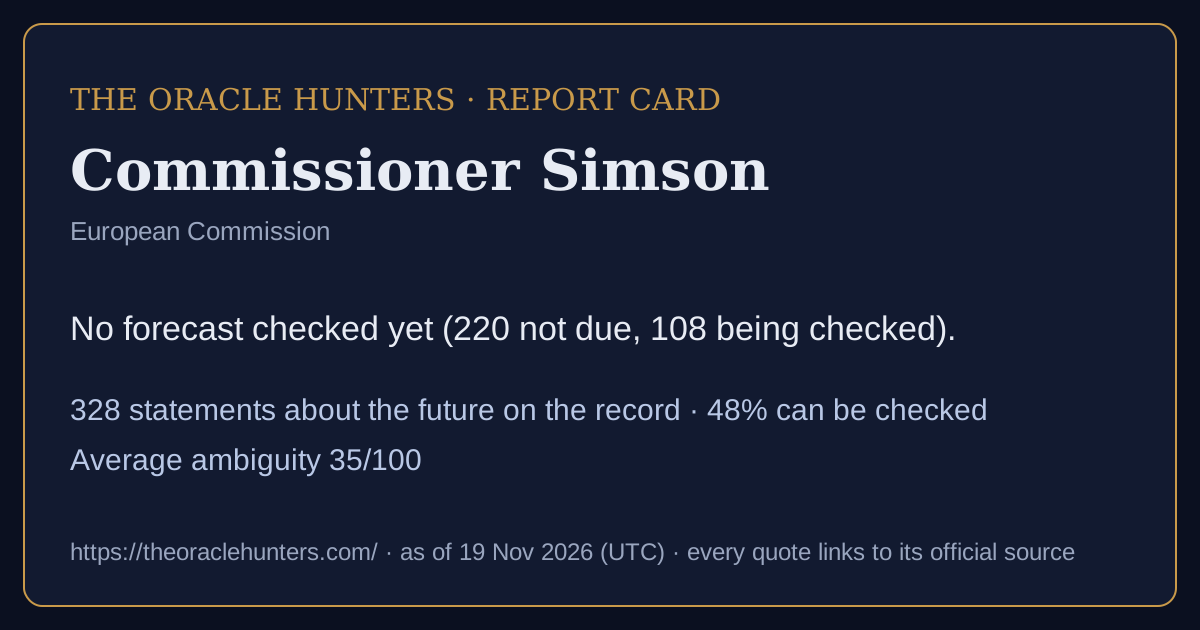
Track record: No forecast checked yet (220 not due, 108 being checked).
328forecasts & commitments on the record
48%can be checked as stated
35average ambiguity (0-100)
0goalpost moves recorded
0confirmed U-turns
Timeline
came true partly did not not due / being checked / too vague
Calibration score: shown after 10 checked forecasts with a stated likelihood (now 0).
How they speak about the future: based on data 248, stated on authority 77, educated guess 3.
Kinds of claim: forecast 226, mixed claim 76, commitment 24, scenario (if… then) 2. · Download this report card as a picture
In the nine words
πρόγνωσιςInference from evidence238 · 73%μαντείαInspired knowledge61 · 19%προαναγγελίαPublic pre-announcement24 · 7%πρόνοιαPreparing for the future2 · 1%πρόβλεψιςSeeing the signs2 · 1%εἰκασίαConjecture1 · 0%
How to read this
Each box is one sentence a public figure or institution said about the future, word for word, with a link to the official text. Can be checked means it names what will happen, by when, and how likely - so it can be compared with official figures later. Too vague to check means it does not. Ambiguity (0-100) is how many different ways the sentence can be read. When the date passes, the forecast is compared with official data and marked came true, partly or did not come true. Labels judge the sentence, never the person. Full guide and glossary.On the record (328)
It will provide at least EUR 86.7 billion to directly support the most vulnerable groups affected by the new Emissions Trading System that applies to fuel combustion in buildings and road transport.
First, repair: we are committed to restoring over 2 GW, 12% of Ukraine's winter energy needs.
The last energy neutrality goal alone will slash emissions by around 3.4 million tonnes of CO2 equivalent in 2045.
And the more we advance into the next two decades, even with the rapid growth of renewables and the use of conventional nuclear energy, we will need a new generation of energy sources to meet our needs.
The Commission's 2040 Target Plan – published last February – sets the EU on course for an electricity sector where over 90% of power will be generated from zero emission sources.
We expect to have these acts adopted by March 2025.
Skills will be an important challenge and is a key priority for the Commission, highlighted in the Commission President's political guidelines for 2024-2029.
As you know, at the end of the year we will see the end of the gas transit agreement between Gazprom and Naftogaz.
Here in France, the D'Artagnan project, is expected to begin construction next year, pioneering open access infrastructure for the transport, liquefaction and export of CO2 through maritime channels.
Carbon capture, utilisation and storage will play a major role in our journey to 2050.
On top of this, the Innovation Fund supports carbon capture projects that will allow capture of 10 million tonnes of CO2 annually as of 2027.
The recent opening of a government call to develop hydrogen projects through a USD 10 million fund that supports projects up to 10 years in construction, production, and different applications of green hydrogen like heavy-duty transport, e-methanol, e-kerosene, green fertilisers is an important step.
We have calculated that 584 billion euros will have to be invested in grids by 2030.
Supporting Ukraine through the winter and ensuring secure and affordable supplies to Europe will remain my top priorities in the closing months of my mandate as Energy Commissioner.
They guide private investors and will help to trigger the necessary investments to meet our 2030 targets.
And innovative hydrogen projects are also eligible under the Innovation Fund's latest call for proposals which has a record budget of EUR 4 billion.
The winning bidders plan to produce 1.58 million tonnes of renewable hydrogen over ten years – and in turn this will reduce CO2 emissions by 10 million tonnes.
It will also put in place the right conditions to further build on its potential with 2050 in mind.
This is an important forum which will ensure we don't just deliver on our biomethane objective for 2030.
And yet again it's another great example of the “Team Europe” approach in action – its 8 million euros budget will be implemented by the German and Spanish development agencies, GiZ and AECID.
In the past ten years, this programme has allocated EUR 6,8 billion in funding to 65 electricity and 39 gas projects, triggering investments worth around EUR 16 billion.
Together, we have laid the foundations that will shape the future of our grids towards 2030 and beyond.
And the Baltic synchronisation project will help the three Baltic States to cut – at last – its energy links with Russia and Belarus in 2025 and be synchronised with Continental Europe.
This is one of the biggest elections the world will see this year.
This will help producers and off takers make their business case and we will launch a new auction before the end of the year.
Under the first auction of the EU Hydrogen Bank, we decided to award nearly EUR 720 million for seven highly innovative renewable hydrogen projects in Europe.
We will have a second domestic auction this year and we are confident that next year we could organise the first auction to finance hydrogen projects outside the EU.
The final National Energy and Climate Plans which Member States will submit next month, will be a test of our ambitions.
The immediate next steps will be the Alliance's technology roadmaps by Q4 this year and its Strategic Action Plan by Q1 next year.
Renewable energy, complemented by nuclear energy in some Member States, is projected to cover over 90% of the EU's electricity consumption in 2040.
From now until 2027, the EU-Ukraine Facility will also provide stable and sustainable financing to Ukraine to the tune of 50 billion euros.
Alongside renewable energy, we need energy efficiency to meet the world's growing energy demand because otherwise we will not phase out fossils on time.
In the next days, we will launch the new 2024 call of proposals under the Renewables Energy Financing Mechanism, for around 53 million euros.
This is why the final energy and climate plans will need to include more ambitious energy efficiency contributions for 2030.
The EU's goal is to produce 10 million tonnes of hydrogen while importing a further 10 million tonnes by the end of this decade.
We expect the share of electricity in our energy consumption to double, from 25% in 2030 to 50% in 2040.
In the EU, our projections for 2040 suggest that EU gas consumption will decline by half, oil consumption will significantly decrease, and we will consume nearly no coal.
From now until 2027, the EU-Ukraine Facility will provide stable and sustainable financing to the tune of 50 billion euros.
IEA expects 29 GWs of new nuclear capacity to come online globally by 2026.
Without strong, independent regulators, we will not develop nuclear energy at the speed we need it to help us decarbonise and reach net-zero by 2050.
85% of residential buildings were built before 2010 and will stay until 2050.
I am pleased that the Ministers today found an agreement on the Commission recommendation to continue voluntary demand reduction by 15% over the next year.
And this Council also showed that we remain as committed as ever to supporting Ukraine, and we will stay the course to create a better and cleaner energy future for our consumers.
At this pace, we will arrive at the end of the heating season with a storage level between 45 and 55%.
This is critical given we expect electricity consumption in the EU to grow by more than 16% by 2030 and then again by almost 80% by 2040.
Innovative hydrogen projects are also eligible under the Innovation Fund's latest call for proposals which has a record budget of EUR 4 billion.
We expect to have the first certification schemes recognised this year.
This decade alone, the EU will need to invest more than EUR 1.2 trillion annually for decarbonising energy and transport sectors.
Offshore wind is set to become the third-most important energy source in the European power system, and the energy provided will be enough to supply 55 million households.
But I also believe that the Belgian Presidency starts at a crucial time, and they will set a new tone for our targets beyond 2030.
Showing the newest 50 - the ledger has all 328.
Also said - not checkable as stated (12 newest)
Remarks about the future with no date, figure or likelihood that could be checked. They are kept on the record and shown here, but not scored.
The different measures, in particular the acceleration of renewables deployment and the reform of the electricity market design, will produce its full effects in the medium-term while laying the groundwork for the decarbonised power system.
This will help us to maintain a steady gas supply during the winter.
Most of the legal provisions need to be transposed in 2025-2026 so there is a strong focus on implementation in the political guidelines for the next mandate of the Commission.
We are really only at the beginning of this journey, and I know that high energy prices and energy poverty will be a top priority for the next Commission mandate.
Member States need to ensure that a share of their energy savings come from low income and energy poor households.
It also asks for an assessment, by the end of 2026, of emissions coming from rearing livestock, particularly cattle, within the Union.
The EU has also further strengthened waste related legislation, which is expected to significantly reduce methane emissions.
To advance our agenda of shaping the global market, it is essential to align with other major importers on data collection and transparency .
And as your allies, and partners, we will be by your side every step of the way.
We need to create the right conditions to spur private investments for Ukraine's reconstruction and green transition.
Fusion could be an alternative that avoids reliance on fossil fuels and power the world's growth, Including for emerging economies with their expanding populations and rising energy needs.
International collaboration will be key to commercialising fusion energy, and the IAEA's World Fusion Energy Group is a step in the right direction.