Commissioner Serafin
European Commission · EU
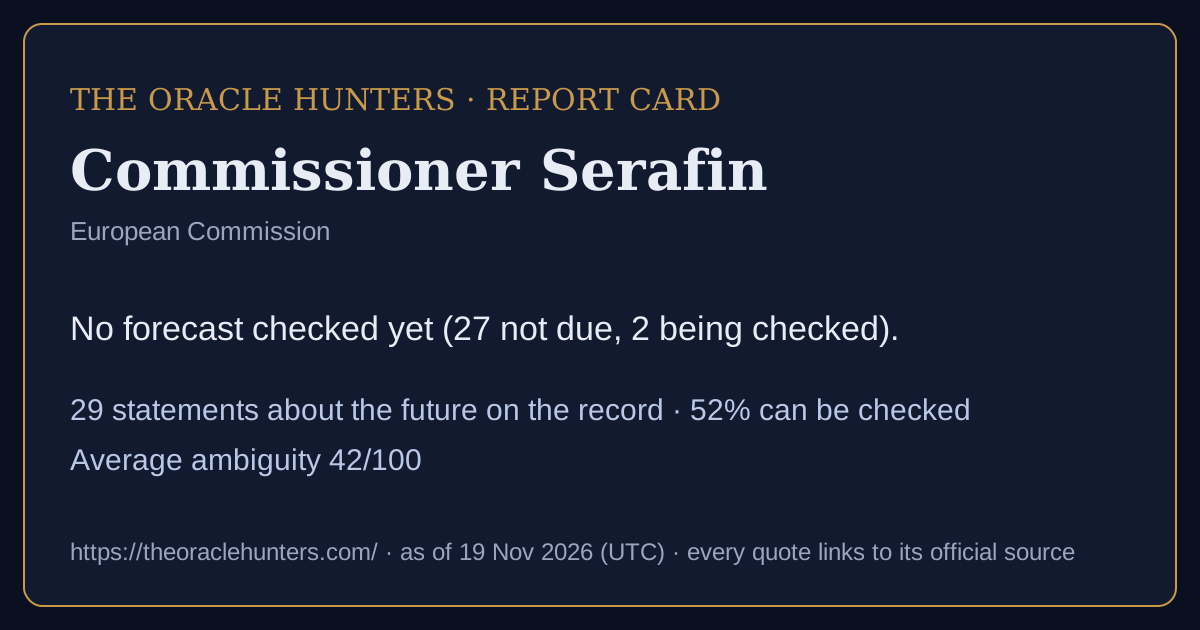
Track record: No forecast checked yet (27 not due, 2 being checked).
29forecasts & commitments on the record
52%can be checked as stated
42average ambiguity (0-100)
0goalpost moves recorded
0confirmed U-turns
Timeline
came true partly did not not due / being checked / too vague
Calibration score: shown after 10 checked forecasts with a stated likelihood (now 0).
How they speak about the future: based on data 21, stated on authority 6, educated guess 2.
Kinds of claim: forecast 15, commitment 9, mixed claim 3, scenario (if… then) 2. · Download this report card as a picture
In the nine words
πρόγνωσιςInference from evidence17 · 59%προαναγγελίαPublic pre-announcement9 · 31%πρόνοιαPreparing for the future2 · 7%μαντείαInspired knowledge1 · 3%
How to read this
Each box is one sentence a public figure or institution said about the future, word for word, with a link to the official text. Can be checked means it names what will happen, by when, and how likely - so it can be compared with official figures later. Too vague to check means it does not. Ambiguity (0-100) is how many different ways the sentence can be read. When the date passes, the forecast is compared with official data and marked came true, partly or did not come true. Labels judge the sentence, never the person. Full guide and glossary.On the record (29)
If you read some statements, you might think that the Commission has proposed a huge budget increase.
I know it's complicated, but we should take account of the fact that there is an inflation and if we want to have the same financial capacity to fund common projects through the EU Budget, we should make comparisons in constant prices, or even better – and this is what we do on many occasions at national level – we …
This 4% cut will not result in savings in public spendings.
In the next Multiannual Financial Framework (so in case you will have questions about the budget)we propose 131 billion euros for modernization of European defence industry .
But I know also, having many exchanges in many of our Members States, that if we would stick to the national contributions only based on GNI, then it will not be possible to meet the challenges, I have just outlined, then it would not be possible to provide sufficient resources for cohesion and agriculture, to provide increases for competitiveness and …
But I am afraid it is not going to happen, at least not this year.
And one last point, I said it at the beginning, in two weeks time because of the conditionality regulation, another 1 billion of European budget money for Hungary will be decommitted, will evaporate.
And talking about Hungary and the conditionality regulation, exactly in two weeks' time, at the end of the year, unfortunately, because of lack of notification from the Hungarian government, another 1 bln euro from cohesion funds will be decommitted.
Horizon Europe, our programme for research and development, will remain a flagship, with a doubled budget of EUR 175 billion.
Member States will receive a pre-allocated amount of EUR 34 billion for migration and border management: three times the current envelope.
Enlargement is not just a political obligation, but a strategic investment in our future and we will support it with increased pre-accession support with almost EUR 43 billion through Global Europe Funds.
To strengthen Europe's capacity to respond to shared challenges at our borders we will integrate the funds for borders, and migration into the National and Regional Partnerships.
We will ensure that income for farmers is protected by ringfencing €300 billion.
In this very context in July this year, the European Commission presented its proposal for the next Multiannual Financial Framework - a budget that will take the European Union up until 2035 and beyond.
The Defence and Space window of the Competitiveness Fund will amount to €131 billion, five times the current budget.
Member States will receive a pre-allocated amount of EUR 34 billion for migration and border management, three times the current envelope.
Enlargement is not just a political obligation, but a strategic investment in our future: we will support it with increased and better targeted pre-accession support with almost EUR 43 billion through Global Europe.
To strengthen Europe's capacity to respond to shared challenges at our borders we will integrate the funds for borders, security and migration into the National and Regional Partnerships.
In this context that last July, the European Commission presented its proposal for the next Multiannual Financial Framework - a budget that will take Europe forward to 2035 and beyond.
I can tell you: with the proposal which we have tabled, with the 24 billion euros for Next Generation EU — because it was debts for grants — actually, if it is adopted, it will be the tool to reduce our collective debt.
Try to understand what it is, and I also want to assure you that we will continue to look into the opportunities on how to increase the revenues of the EU Budget while putting no burden neither on the households nor on the European companies.
The next MFF will be an ambitious EU budget with a total size of 2 trillion euros.
To strengthen Europe's capacity to respond to shared challenges at our borders we will integrate the funds for borders, security and migration into the National and Regional Partnerships with a tripling of their financing.
We will ensure that their income is protected by a ringfencing of 302bn, including a doubled agricultural reserve.
Honourable Members, the post-2027 MFF will be the fourth I have worked on, in various capacities.
And from 2028 onwards, around 25 billion euro in our budget will be committed to repaying loans from the NextGenerationEU instrument.
Research and Development (R&D) could be an example – 90% of public spending on R&D still takes place through the national budgets and 10% through the EU budget.
The stark reality is that without new Own Resources or increased contributions from Member States, the EU could see a reduction of up to 20% in its annual budget because of the cost of repaying NextGenerationEU.
What I took from the meeting with Danish SMEs in defense sector, whom I visited two months ago, was not only the hope that soon, thanks to their work and the European Defense Fund, we will have the equipment to strengthen the protection of critical infrastructure in the Baltic Sea.
Also said - not checkable as stated (12 newest)
Remarks about the future with no date, figure or likelihood that could be checked. They are kept on the record and shown here, but not scored.
Our common objective should be to ensure that the next multi-annual budget can hit the ground running in 2028.
In the current geopolitical and trade context, I am afraid that the next period will bring more crises, not less.
So do not be surprised when the next natural catastrophe hits a European region or when there is negative shock on the agricultural markets, the EU budget will not have sufficient tools to react and assist those affected.
For funding to flow without interruption, the Plans must be adopted before the end of 2027.
That means the Regulation must be adopted in the first half of 2027.
So a smaller budget compared to 2020, precisely at a moment when the European nations need to intensify co-operation in many areas: competitiveness, security and defence, energy, migration, climate change, etcetera.
Second, regulatory discipline: we introduce reporting requirements only when they are strictly necessary, and we will act at EU level only when justified in line with the principles of subsidiarity and proportionality.
We see right now Putin escalating his aggression against Ukraine, tensions in transatlantic relations and trade disputes intensifying, we know that we will need to have more common projects, not less.
So we will again have to navigate future storms with our hands tied behind our backs.
And if more common projects are needed we also need to have resources to fund them.
Because the investments in competitiveness, connectivity, and security still need to be carried out.
A lot has been said about the volume of the EU budget, and why it needs to be cut.