Commissioner Schmit
European Commission · EU
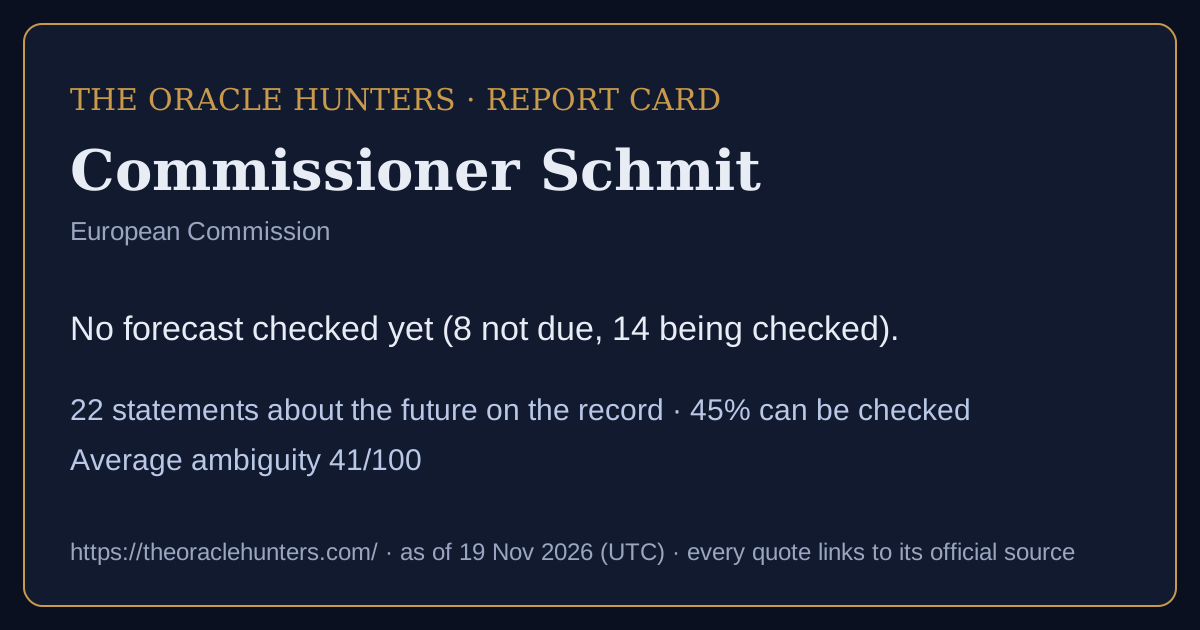
Track record: No forecast checked yet (8 not due, 14 being checked).
22forecasts & commitments on the record
45%can be checked as stated
41average ambiguity (0-100)
0goalpost moves recorded
0confirmed U-turns
Timeline
came true partly did not not due / being checked / too vague
Calibration score: shown after 10 checked forecasts with a stated likelihood (now 0).
How they speak about the future: based on data 19, stated on authority 3.
Kinds of claim: forecast 18, mixed claim 4. · Download this report card as a picture
In the nine words
How to read this
Each box is one sentence a public figure or institution said about the future, word for word, with a link to the official text. Can be checked means it names what will happen, by when, and how likely - so it can be compared with official figures later. Too vague to check means it does not. Ambiguity (0-100) is how many different ways the sentence can be read. When the date passes, the forecast is compared with official data and marked came true, partly or did not come true. Labels judge the sentence, never the person. Full guide and glossary.On the record (22)
By 2025, their number is expected to reach 43 million.
The working age population is projected to decline by 7 million by 2030, which will further intensify these labour shortages.
By 2030, the solar energy sector alone could account for 1 million jobs in the EU.
For example, around 800,000 workers will have to be trained or reskilled in the battery sector by 2025 to meet demand for this growing industry.
• Over the next three years, the Academy will bring together young entrepreneurs, social entrepreneurs, policy-makers and experts from the EU to reflect jointly on how to best support young people who want to become entrepreneurs.
Implementing the strategic reforms and investments foreseen under Member States' Recovery and Resilience Plans timely and fully by 2026 will be essential to improve the resilience and competitive position of the European economy.
But only 57% agreed that policies to fight climate change will create more new jobs than they will remove.
On the 18th of May this year, the European Commission presented REPowerEU, the EU's ground-breaking plan to phase out its dependency on Russian fossil fuels through, first and foremost, the accelerated roll-out of renewable energy.
If we put the right policies and conditions in place, an additional 2 million jobs could be created by 2050 in sectors such as sustainable transport, renewable energy production and the circular economy.
And the Commission will set up in 2022 a new European Competence Centre for Social Innovation.
It will also launch new financial products in 2022 under the InvestEU programme.
The Commission will launch a new EU Social Economy Gateway in 2023 to ensure social economy actors can find all the information they need in one place on EU funding, policies, training and initiatives.
To address these issues, the Commission will propose a Council Recommendation on developing the social economy framework conditions in 2023.
The number of people working for them has been mentioned: 28 million, and we expect, indeed, that this number will increase very rapidly and reach 43 million by 2025.
The proposal for a Joint Employment Report will now be discussed by the EPSCO Council's advisory committees with a view to final adoption by EPSCO in March 2022.
In our Pillar of Social Rights Action Plan, we have set a target to reduce people at risk of poverty or social exclusion by at least 15 million by 2030, of which 5 million will be children.
Before the end of the year, we will propose two new initiatives under the Skills Agenda which will help us to meet the EU-wide target of getting 60% of adults in annual training, that we set in the Pillar of Social Rights Action Plan.
Today the European, economy is on the road to recovery, with GDP in 19 Member States expected to return to pre-crisis levels by the end of the year but there are still major risks, as recent spikes in infections show.
So the Commission will prepare an EU-level initiative by the end of next year related to mental health at work.
To that end, we will update the Commission recommendation on occupational diseases by 2022 to include COVID-19.
We had announced that we could devote €22 billion to fighting youth unemployment.
But, we are braced for future impact in the coming months, and when we link this increase in unemployment to the number of lost jobs we have what we call the discouraged worker effect.
Also said - not checkable as stated (12 newest)
Remarks about the future with no date, figure or likelihood that could be checked. They are kept on the record and shown here, but not scored.
You get to experience the world of work, you can make connections, and it might lead to a job – either with the same employer, or somewhere else.
Because a traineeship should always be a stepping stone to a regular job.
We will bring back into the fold people who have lost their way, or have been caught in a cycle of marginalisation over generations.
And I hope we will soon come to an agreement on the Right to Disconnect.
We must constantly ask ourselves: “What will be the impact of our actions?
People of all ages will take on new challenges in their working lives, learning new skills, moving between sectors, earning decent wages, enjoying a good work-life balance, feeling empowered to try new things, to fail sometimes and to try again and to be successful.
Companies and workers will make full use of Artificial Intelligence and new technologies, saving time, increasing productivity, and improving health and safety.
Housing will become more affordable, energy-efficient and a place for people to call home.
Importantly, cohesion policy has been and will continue to be instrumental for Europe's green and digital transitions.
This is why, as our economies and societies are transformed to meet our climate and technological needs, we must ensure sustained investment in our people, in our labour force and in the social infrastructure that defines Europe's social market economy.
While the green and digital transitions provide new opportunities for quality job growth, they must be actively managed and steered in our preferred direction.
Based on where we stand now, it is clear that we must invest more in those outside of the labour market, the long-term unemployed, women, but also older people and, importantly, the young.