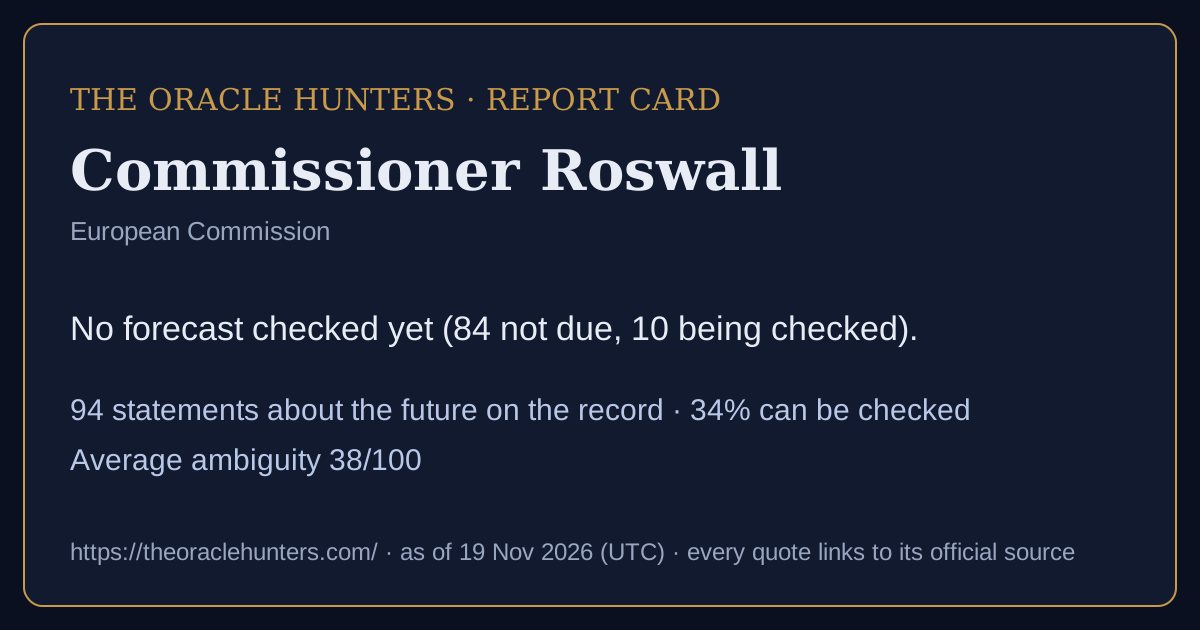
Commissioner Roswall
European Commission · EU
Track record: No forecast checked yet (83 not due, 10 being checked).
93forecasts & commitments on the record
34%can be checked as stated
38average ambiguity (0-100)
0goalpost moves recorded
0confirmed U-turns
Timeline
came true partly did not not due / being checked / too vague
Calibration score: shown after 10 checked forecasts with a stated likelihood (now 0).
How they speak about the future: based on data 57, stated on authority 35, educated guess 1.
Kinds of claim: forecast 61, mixed claim 25, commitment 5, scenario (if… then) 2. · Download this report card as a picture
In the nine words
πρόγνωσιςInference from evidence56 · 60%μαντείαInspired knowledge30 · 32%προαναγγελίαPublic pre-announcement5 · 5%πρόνοιαPreparing for the future2 · 2%
How to read this
Each box is one sentence a public figure or institution said about the future, word for word, with a link to the official text. Can be checked means it names what will happen, by when, and how likely - so it can be compared with official figures later. Too vague to check means it does not. Ambiguity (0-100) is how many different ways the sentence can be read. When the date passes, the forecast is compared with official data and marked came true, partly or did not come true. Labels judge the sentence, never the person. Full guide and glossary.On the record (93)
So, the EU will continue to support its competitiveness, especially as climate, environmental and supply pressures grow.
This year will recharge and renew the strong commitment of vital stakeholders.
By 2050, we could avoid 144 million premature deaths and hundreds of millions of cases of chronic disease.
In some parts of the EU, the agriculture sector could lose 15 percent of its economic output because of drought.
This year, we will deliver a digital action plan for the water sector as well as a Research and Innovation Strategy dedicated to Water Resilience.
Later this year, the European Commission will present a new plan for climate resilience and risk management.
Allianz, the insurance group, estimates that extreme heat alone could cost France, Germany, Spain and Italy EUR 550 billion in economic output between 2026 and 2030.
In some parts of Europe, the agriculture sector could lose 15 % of its economic output because of drought.
By the end of this year, we will have a much clearer idea of these financing needs – and then the hard work really begins.
This year, the international community will gather for the COPs of the three Rio Conventions — on desertification, biodiversity and climate change.
In the EU, extreme heatwaves, severe droughts, and destructive floods cost us a staggering 43 billion euros last summer — expected to soar to 129 billion euros by 2029.
For example, biogas from waste could meet 10 per cent of Europe's gas needs.
In a few weeks, we will publish a Call for Evidence on the Digital Action Plan for water, which I intend to put forward later this year.
And material recovery from batteries could supply half of the EU's cobalt demand by 2040.
A recent study suggests additional circular practices could cut metals use for EU manufacturers by 10%, electricity by 7% and fossil fuels by 6%.
Later this year the Commission will adopt a Circular Economy Act, with an overarching goal:
Additional circular solutions could improve the EU trade balance by 35 billion euros per year—reducing exposure to price volatility and shortages.
For example, in a circular Europe, material recovery from batteries could supply more than half of the EU's cobalt demand by 2040.
A recent study suggests additional circular practices could cut metals use by 10%, electricity by 7% and fossil fuels by 6%.
That is why the Circular Economy Act later this year will be so important.
The Commission will propose a Circular Economy Act later this year to accelerate the transformation to circularity.
Extreme heatwaves, severe droughts, and destructive floods cost the EU a staggering 43 billion euros last summer — expected to soar to 129 billion euros by 2029.
And it is backed by the European Investment Bank, which will invest 15 billion euros between 2025 and 2027 to tackle Europe's water crisis.
We are especially interested to see the direction the UK will take with its Circular Economy Strategy later this year.
That is why, in the Circular Economy Act later this year, we will be looking at boosting demand for recycled fibres.
This year, we will adopt a Circular Economy Act to build a circular single market that addresses these questions, and more.
If we don't adapt, annual drought costs could reach up to EUR 45 billion and coastal flooding could exceed EUR 1 trillion per year by the end of the century.
We want to give technical support to SMEs to help them make the leap from innovation to growth, and we will set up test environments for bio-solutions, so-called regulatory sandboxes, to help them move from niche to normal.
The Water Academy will be launched next year to support this effort.
Next year, the Commission will adopt a Digitalisation Action Plan for the water sector that will help to manage every drop effectively.
And I am thrilled to announce that we will launch a Water Resilience Stakeholder Platform early next year.
But it also brings opportunity: to directly shape the behaviours, expectations, and markets that will determine whether Europe meets its 2030 and 2050 climate and circularity goals.
This is why 2026 will be a defining year for Europe's construction ecosystem.
The Circular Economy Act next year will speed up this transition, by creating real markets for secondary materials and supporting a Single Market for waste.
The Act will come next year, but in the meantime, the Commission has acted quickly with the First Circularity Package, to be adopted in the coming weeks.
We will give technical support to SMEs to help them make the leap from innovation to growth.
The Agreement has now been ratified by a sufficient number of parties, and it will enter into force on 17 January 2026.
These two important treaties will contribute to meeting the target of protecting 30% of land and sea by 2030, which is an EU priority.
Before the end of this year, we will adopt a package of short-term measures to take first steps towards deepening the single market for secondary raw materials, boost circular investment, and ensure a level playing field, including through trade measures when justified.
And looking further ahead, the Commission will also present a Circular Economy Act in 2026.
And, next year, the Commission will adopt a Digitalisation Action Plan that will help to manage every drop effectively.
Before the end of this year, we will adopt a series of short-term initiatives designed to boost investment, to apply trade measures where justified, and to simplify.
Circular measures alone could deliver at least 20–25% of the greenhouse gas emissions reduction we need to achieve climate neutrality by 2050.
By 2030, global water demand will exceed available resources by 40%.
Extreme heatwaves, severe droughts, and destructive floods have cost Europe a staggering 43 billion euros this summer — expected to soar to 129 billion euros by 2029.
And the Strategy is backed by powerful commitments from the European Investment Bank, which will invest 15 billion euros between now and 2027 to tackle Europe's water crisis.
For example, circular measures alone could deliver at least 20–25% of the greenhouse gas emissions reduction we need to achieve climate neutrality by 2050.
To design a trophy that will be awarded to the winners of the New European Bauhaus Prizes in 2026.
The trophy should embody the New European Bauhaus values of sustainability, beauty, and togetherness – and the winning design will be unveiled during the NEB Festival 2026, next June.
For example, innovation Hubs – to be set up next year – will help boost the demand for safer, sustainable chemicals.
Showing the newest 50 - the ledger has all 93.
Also said - not checkable as stated (12 newest)
Remarks about the future with no date, figure or likelihood that could be checked. They are kept on the record and shown here, but not scored.
And we will help shape a global agenda where water is finally recognised for what it is: not a side issue, but the lifeblood of our world and the foundation of climate resilience.
Next month, the UN Water Conference in Abu Dhabi, offers an important opportunity to drive that agenda.
If we get this right, we will not only protect our citizens from growing shocks.
We will build more resilient and secure societies.
According to recent research by the European Central Bank, water scarcity alone could put a quarter of the euro area's economic output at risk.
If partner countries face worsening water insecurity, Europe will feel the consequences.
I am confident that it will send a clear message that circularity should be embedded in climate policy.
And it will show that circular solutions reduce greenhouse gas emissions.
And it should be a cornerstone of climate policy.
The EU is exploring how credible nature credits might attract private funding.
We need to turn our commitments into results by 2030.
And it will build on the valuable work already undertaken by the International Advisory Panel on Biodiversity Credits (IAPB), the Biodiversity Credit Alliance (BCA), and other international partners.