Commissioner Reynders
European Commission · EU
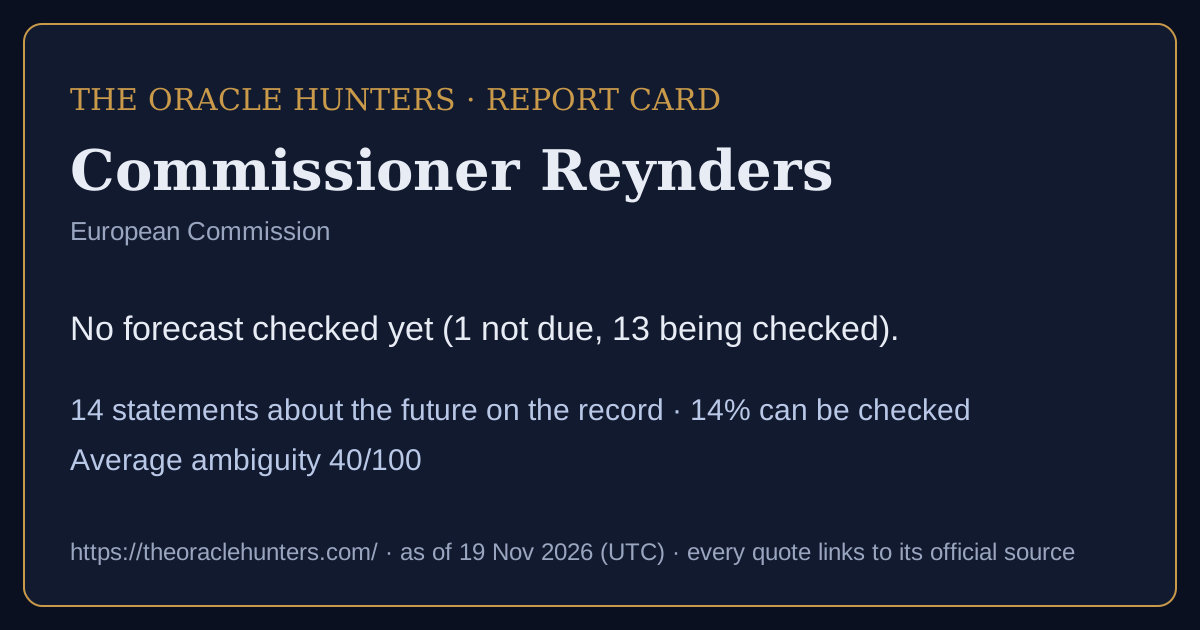
Track record: No forecast checked yet (1 not due, 13 being checked).
14forecasts & commitments on the record
14%can be checked as stated
40average ambiguity (0-100)
0goalpost moves recorded
0confirmed U-turns
Timeline
came true partly did not not due / being checked / too vague
Calibration score: shown after 10 checked forecasts with a stated likelihood (now 0).
How they speak about the future: based on data 10, stated on authority 4.
Kinds of claim: forecast 11, mixed claim 3. · Download this report card as a picture
In the nine words
How to read this
Each box is one sentence a public figure or institution said about the future, word for word, with a link to the official text. Can be checked means it names what will happen, by when, and how likely - so it can be compared with official figures later. Too vague to check means it does not. Ambiguity (0-100) is how many different ways the sentence can be read. When the date passes, the forecast is compared with official data and marked came true, partly or did not come true. Labels judge the sentence, never the person. Full guide and glossary.On the record (14)
But, if I may, it's more than a “data protection event” – a large part of this year's program is dedicated to AI governance.
This project is expected to deliver its first results around the end of 2027.
The database was launched on 9 February and will be fully operational by mid 2023.
The fourth edition will again be published in July this year.
As a crucial first step, the “International Centre for the Prosecution of the Crime of Aggression against Ukraine” (ICPA), will start its work by summer 2023 embedded in the current Joint Investigation Team.
In this year's Report, we will assess the follow-up given to the recommendations.
A financing decision was recently adopted on to continue an EU support project to the ICC, which is scheduled for 2025 and will encompass an amount of EUR 3 million.
Discussions will therefore continue amongst the members of the ‘Core Group' next month, with 17* EU Member States plus Australia, Canada, Liechtenstein, Japan, the UK, and the US.
This year, civic space will be the topic of the Commission's annual report on the application of the Charter of Fundamental Rights.
In Spring next year, the Council will have discussed the situation in each of the 27 Member States, completing the first cycle of country-specific dialogue.
In particular, this year we could see some of the effects on the national justice systems that could potentially be attributed to the impact of the COVID-19 pandemic.
We also have a revised Regulation on Consumer Protection Cooperation in place now which we will evaluate next year.
In Europe, we are working on many of the issues that the U.S.-led summit on democracy in 2022 will likely cover:
The Commission will do everything in its power to ensure that the European Public Prosecutor's Office receives the resources it needs to start its activities as planned, and in this perspective we have already proposed a significant increase in the budget for the year 2021.
Also said - not checkable as stated (12 newest)
Remarks about the future with no date, figure or likelihood that could be checked. They are kept on the record and shown here, but not scored.
As we explore each of these themes later in the day, we will see how a dynamic, adaptable, and forward-thinking approach can elevate the role of internal audit.
Gone are the days when annual audit plans could be set in stone; today, internal auditors must be prepared to pivot quickly in response to changing organisational or external dynamics.
In the area of data flows, this has involved developing new forms of engagement and collaboration such as, just to mention two examples amongst many others, mutual adequacy arrangements – like the ones we are currently negotiating with Brazil and Kenya – or developing bridges between sets of model contractual clauses adopted in different regions, as we did with ASEAN …
To just mention the latter, a new Digital Fairness Act to be developed by the Commission in the coming months will pick up on the studies we have carried out that show how addictive design elements, social media influencers and dark patterns push consumers into making choices they didn't necessarily intend to make.
There is clearly a growing gap in power and information between businesses and consumers which has revealed many vulnerabilities, including for young people, that will need to be addressed
By that I mean that data protection is and will remain a key foundation of the expanding digital regulatory framework – whether it's about AI, fair competition on digital markets, or a safer on-line environment.
We were also present, and I hope additional regional networks will join this important initiative.
The inaction against climate change already has and will increasingly have a cost for our economies and societies.
Our new rules on many points closely align with the draft instrument, which provides a good basis for the EU's future engagement, and we are looking forward to the negotiation round next month.
This is why, under the next Commission, the Rule of Law Report will also include a Single Market dimension, looking at issues affecting companies, especially SMEs, when they operate across borders.
The Commission will also build a closer link between the recommendations of the report and funding under the EU budget.
This will be an important consideration under the next Multiannual Financial Framework.