Commissioner Oettinger
European Commission · EU
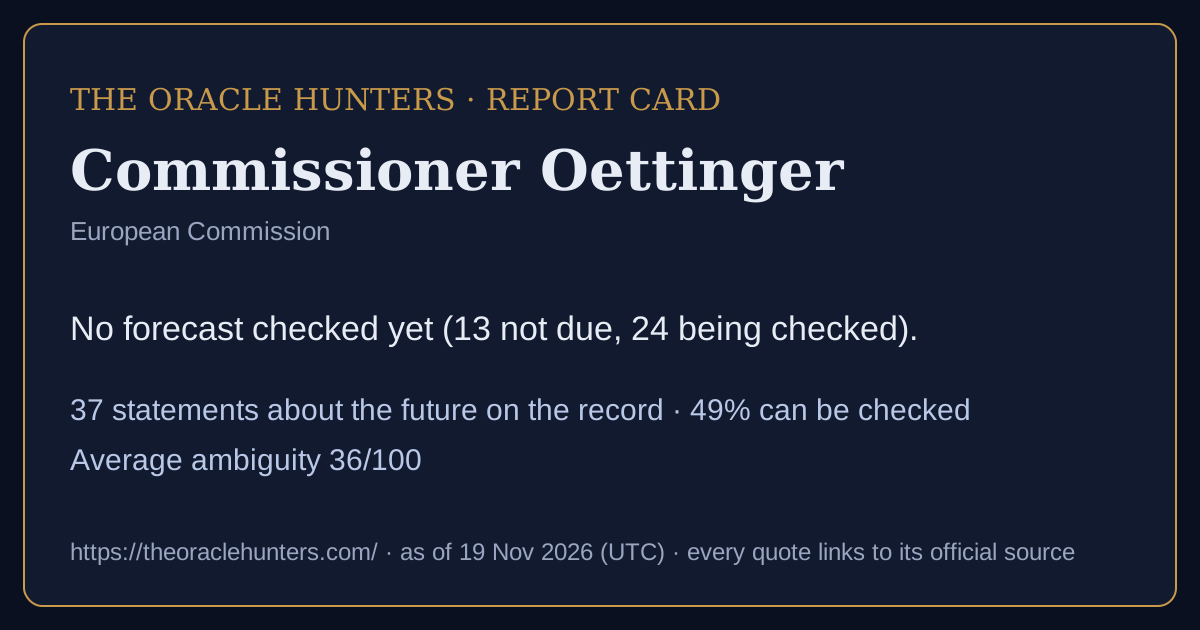
Track record: No forecast checked yet (13 not due, 24 being checked).
37forecasts & commitments on the record
49%can be checked as stated
36average ambiguity (0-100)
0goalpost moves recorded
0confirmed U-turns
Timeline
came true partly did not not due / being checked / too vague
Calibration score: shown after 10 checked forecasts with a stated likelihood (now 0).
How they speak about the future: based on data 30, stated on authority 7.
Kinds of claim: forecast 29, mixed claim 5, commitment 3. · Download this report card as a picture
In the nine words
πρόγνωσιςInference from evidence29 · 78%μαντείαInspired knowledge5 · 14%προαναγγελίαPublic pre-announcement3 · 8%
How to read this
Each box is one sentence a public figure or institution said about the future, word for word, with a link to the official text. Can be checked means it names what will happen, by when, and how likely - so it can be compared with official figures later. Too vague to check means it does not. Ambiguity (0-100) is how many different ways the sentence can be read. When the date passes, the forecast is compared with official data and marked came true, partly or did not come true. Labels judge the sentence, never the person. Full guide and glossary.On the record (37)
Investment in platform-building in Horizon 2020 is expected to reach more than 800 million euro in the next five years.
Member States have already identified almost five hundred proposals for ICT and broadband projects representing a total investment sum of 151.7 billion euro in the next 3 years.
- Second, the development of standards. 5G standardisation is expected to start in 2016.
More is under way, as we will soon award the research grants for 125 million euro to 20 projects to deliver the key building blocks for 5G.
What is common however to all these scenarios, is that the imports from third countries will increase until 2030 or 2035 due to the depletion of the EU's own reserves.
If for example the part of Russian gas imports covers around 25% of the European gas consumption, Russia could in 2030 export more than 150 bcm of gas to the EU.
The available scenarios and forecasts for gas demand in the European Union until 2030 vary between 370 and nearly 600 bcm, and may have to be adapted again after the tragic events in Japan.
Your support and input will be key in making this new energy infrastructure policy a success, up to 2020 and for the period after, which will very much depend on our choices in the coming months.
The investment challenge ahead of us is huge: 200 billion euro until 2020 for renewal and extension of transmission networks in electricity and gas, beyond storage and smarter grids.
I have therefore been working, since my arrival as European Commissioner in charge of energy, on a new energy infrastructure policy for Europe that will make our energy grids fit for 2020, but that will also allow us to plan ahead and make our networks "future proof".
The share of renewables in electricity could grow from 19.5% today to around 35% in 2020, with about half of this increase coming from variable energy sources, such as wind and solar.
Decreasing EU energy consumption by 1% means that we could spare us 50 coal power plants or 25 000 wind turbines.
Considerable investments will be needed over the next 10 years to modernise energy generation and transportation (around 1 trillion €; for the UK this means at least doubling the current investment rate).
China and India alone could represent over half (54%) of the global increase in energy supply by 2035.
China alone is expected to use 20% of global energy by 2035.
According to the International Energy Agency estimates, world primary energy demand is projected to increase by more than 30% until the year 2035.
By 2020 we will only reach half of the 20% target if we carry on at the current pace.
In this way we shall strengthen energy security, diversification.
Therefore, we shall already look at the specific financial possibilities for crossing the Mediterranean through super grids to be built mostly after 2020
We will have a stable investment climate for new projects and products.
The various elements will be the main topics for the European Council's extraordinary meeting on energy on 4th February next year.
Parts of the EU could lose more than one third of their generation capacity before 2020, while the demand for electricity is growing.
Many decisions between now and 2020 will shape our 2050 energy mix.
Lastly, let me refer to the Commission's Energy Strategy for 2011-2020 which will appear in due course.
I expect the package to be followed by a legislative proposal for a new EU Energy Security and Infrastructure Instrument in 2011, as requested by the Council in its March 2009 conclusions.
The Commission is going to table an Energy Infrastructure Package by the end of this year.
With the renewable energy share of electricity expected to more than double by 2020 (to over a third), can we be sure that our electricity infrastructure will support increasing renewable energy production beyond 2020?
The Commission will therefore by the end of the year, examine what actions can be taken to strengthen the financing of renewables, not only for established technologies but also for research and innovation.
We will be undertaking our own analysis and development of scenarios, with a view to preparing a policy document next year.
The Energy Roadmap 2050 will show different development paths to the 2050 goal of 80-95% up to 2050 and will highlight their implications for security of supply and competitiveness.
I hope that the energy action plan until 2020 and the Energy-Roadmap 2050 will reduce uncertainties and thus encourage Member States, investors and citizens, and our partners to respond to the many opportunities in the transition to a new energy system.
We may need energy targets for 2030, 2040, 2040.
Before I finish, allow me to announce that it is now certain I will launch a public debate on energy in a 2050 perspective towards the end of this year.
The Energy Infrastructure Package in November this year and the EU Energy Security and Infrastructure Instrument - that the Commission intends to table next year - will aim at providing this "bridge" from demonstration or "first of their kind" to industrial scale applications for the most promising technologies, including power storage infrastructure.
But even with the best will in the world, in our present state of knowledge it is hard to see electricity from renewable sources in transport contributing more than 1 or 2 of the 10 percentage points required by 2020.
Let me also mention here that in the case of Turkey, the synchronous interconnection of the electricity system with the EU, which is likely to be finalised next year, will represent an important step towards market integration.
The European Union and Russia will celebrate this year the 10th anniversary of their energy dialogue.
Also said - not checkable as stated (12 newest)
Remarks about the future with no date, figure or likelihood that could be checked. They are kept on the record and shown here, but not scored.
We will answer all questions in that forum.
If you want to change them, we will have to discuss it.
I will be happy to respond — to the satisfaction, I believe, of all with questions — to your concerns and questions over the next few weeks with clear answers and with an eye to the European Staff Regulations, rules and statutes.
If, for instance, the Chancellor is elected in Germany in two days, the ministers will be decided by the parties and confirmed by the President: no election, no hearing, nothing at all in [the Bundestag].
So, by all means watch him like a hawk, but please give him a chance to show what he can do over the next few months.
I am sure that he will do an excellent job and do so as a servant of the President Juncker and the Commission.
Industry in Europe should take the lead and become a major contributor to the next generation of digital platforms that will replace today's Web search engines, operating systems and social networks.
Digital skills will therefore need to be an integral part of our future education curricula while training a significant part of our current work force must be a priority.
Europe has huge assets and I am confident that if we all pull together, industry, Member States, regions and the Commission, we will succeed.
My ambition is to upscale developments of European platforms from 2015 onwards with the launch of at least 5 large-scale platform projects per year until 2018.
Any industry will need to adjust to this new reality.
The International Telecommunication Union's World Radio Conference 2015 is a key milestone, to prepare for the in depth debates that should take place at the next conference in 2019.