Commissioner Moscovici
European Commission · EU
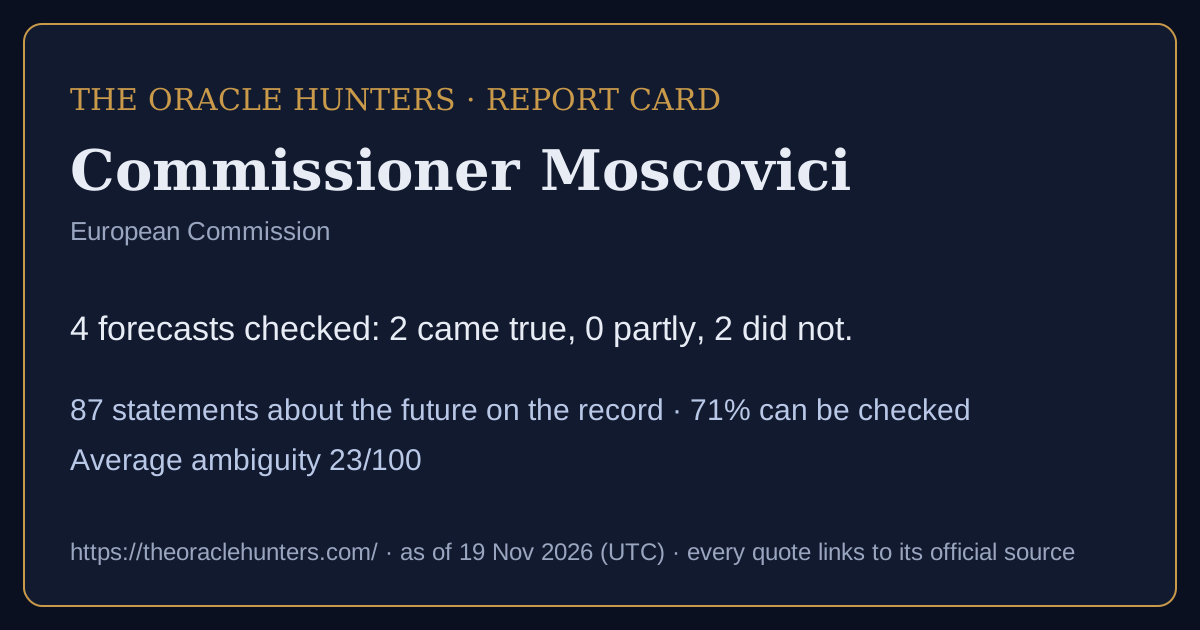
Track record: 4 forecasts checked: 2 came true, 0 partly, 2 did not.
87forecasts & commitments on the record
71%can be checked as stated
23average ambiguity (0-100)
0goalpost moves recorded
0confirmed U-turns
Timeline
came true partly did not not due / being checked / too vague
Calibration score: shown after 10 checked forecasts with a stated likelihood (now 4).
How they speak about the future: based on data 71, stated on authority 13, educated guess 3.
Kinds of claim: forecast 66, mixed claim 19, commitment 2. · Download this report card as a picture
In the nine words
πρόγνωσιςInference from evidence70 · 80%μαντείαInspired knowledge11 · 13%εἰκασίαConjecture3 · 3%προαναγγελίαPublic pre-announcement2 · 2%πρόβλεψιςSeeing the signs1 · 1%
How to read this
Each box is one sentence a public figure or institution said about the future, word for word, with a link to the official text. Can be checked means it names what will happen, by when, and how likely - so it can be compared with official figures later. Too vague to check means it does not. Ambiguity (0-100) is how many different ways the sentence can be read. When the date passes, the forecast is compared with official data and marked came true, partly or did not come true. Labels judge the sentence, never the person. Full guide and glossary.Checked
In the euro area, inflation is projected at 1.2% this year and next and at 1.3% in 2021.
Did not come true. Said: inflation around 1.3% in 2021. Official figure for Euro area: 2.5% (World Bank open data). Missed. Off by 1.2 points. official data · checked 14 Nov 2026 · automatic check against official data (rules v3)
In Spain GDP growth is forecast at 2.1% this year and 1.9% next year.
Did not come true. Said: economic growth around 1.9% in 2020. Official figure for Spain: -10.9% (World Bank open data). Missed. Off by 12.8 points. official data · checked 14 Nov 2026 · automatic check against official data (rules v3)
GDP growth in Germany is forecast to be particularly subdued this year at 0.5%, largely due to the weakness in manufacturing and particularly in the car industry.
Came true. Said: economic growth around 0.5% in 2019. Official figure for Germany: 1.0% (World Bank open data). On target. Off by 0.5 points. official data · checked 14 Nov 2026 · automatic check against official data (rules v3)
In the EU as a whole, real GDP growth is forecast to rise from 1.4% in 2014 to 1.8 % this year and to accelerate further to 2.1% in 2016.
Came true. Said: economic growth around 2.1% in 2016. Official figure for European Union: 1.9% (World Bank open data). On target. Off by 0.2 points. official data · checked 14 Nov 2026 · automatic check against official data (rules v3)
On the record (87)
Similarly, in the EU, debt is expected to decline from 81.9% in 2018 to 78.4% in 2021.
Over the next two years, the euro area deficit is expected to increase only slightly from 0.8% in 2019 to 0.9% in 2020 and 1% in 2021.
In Spain, real GDP growth is expected to continue decelerating from 1.9% this year to 1.5% next year, which is still above the EU and euro zone average.
A positive contribution from net trade this year and moderate growth of household spending next year should help the economy.
Among the largest EU economies, GDP growth in 2020 is expected to be at or above the EU average (of 1.4%) only in Poland at 3.3%, in Spain at 1.5%.
In the euro area, inflation is projected at 1.2% this year and next and at 1.3% in 2021.
Did not come true. Said: inflation around 1.3% in 2021. Official figure for Euro area: 2.5% (World Bank open data). Missed. Off by 1.2 points. official data · checked 14 Nov 2026 · automatic check against official data (rules v3)
Second, the headline budget deficit is projected to decrease further to 0.4% of GDP in 2019 and to 0.1% of GDP in 2020 and public debt is set to retain a downward path.
Amid a challenging external environment, economic activity is not likely to rebound meaningfully before the end of the year.
The country left the technical recession in the first quarter of this year but is expected to have stagnated in the second quarter.
Based on a purely technical assumption of status quo in terms of trading relations between the EU and the UK, GDP is forecast to grow by 1.3% this year and next year.
As a result, our forecast for GDP growth this year has been revised up to 2.3%.
Overall, growth in Germany is expected to reach 0.5% in 2019 and 1.4% in 2020, driven partly by a higher number of working days next year, and predicated on the assumption that global demand will gradually strengthen.
Overall, our forecast for headline inflation in the euro area is slightly revised down from 1.4% in the spring to 1.3% in both 2019 and 2020.
Unfortunately, also for 2019 we forecast a slight worsening in the structural deficit, whereas the Council had recommended a reduction of 0.6% - and the Italian authorities had made a commitment last December to avoid any deterioration.
Moreover, for both this year and 2020, we forecast a significant budgetary surplus and a strongly declining public debt.
Finally for 2020, we forecast a large increase in the deficit both in structural and nominal terms, to 3.5% of GDP, well above the Treaty threshold.
Growth is forecast at 1.3% in both 2019 and 2020.
Italy slipped into a mild contraction in the second half of last year, as the slowdown of global trade and weak manufacturing spread to the domestic economy.It is expected to grow only by 0.1% this year, picking up to 0.7% in 2020.
In Spain GDP growth is forecast at 2.1% this year and 1.9% next year.
Did not come true. Said: economic growth around 1.9% in 2020. Official figure for Spain: -10.9% (World Bank open data). Missed. Off by 12.8 points. official data · checked 14 Nov 2026 · automatic check against official data (rules v3)
However, we expect growth to recover to 1.5% next year, in line with the average for the euro area.
GDP growth in Germany is forecast to be particularly subdued this year at 0.5%, largely due to the weakness in manufacturing and particularly in the car industry.
Came true. Said: economic growth around 0.5% in 2019. Official figure for Germany: 1.0% (World Bank open data). On target. Off by 0.5 points. official data · checked 14 Nov 2026 · automatic check against official data (rules v3)
Overall, euro area headline inflation is now forecast at quite low level of 1.4% in both 2019 and 2020.
For those who don't remember it our forecast for 2019 is not higher than 0.2% growth and this is why we feel this sense of urgency and we want to pinpoint it.
However, this impressive performance is largely thanks to the high growth momentum: Slovenia has posted some of the highest growth rates in the euro area in recent years and is set to continue growing robustly this year, our forecast is at 3.1%.
As such, growth is now forecast to be at 0.2% in 2019 and 0.8% in 2020, reflecting a slight pick-up in growth as of the second half of 2019 as well as more working days next year.
Growth in Germany is expected to slow markedly, but it's not a surprise because it has been adjusted by the German authorities themselves, from 1.5% last year to 1.1% this year, as a result of weakening export growth and disappointing private consumption growth, despite the buoyant employment situation.
Among the largest EU economies, GDP growth in 2019 and 2020 is expected to be at or above the EU average of 1.5% and 1.7% respectively in Poland, Spain and in Netherlands.
And next year, we expect headline inflation to tick up mildly to 1.5%, to only slightly below our autumn forecast (1.6%).
In euro terms, the downward revision of oil prices assumptions compared to the autumn forecast is still more significant, as oil prices are now assumed to be about 20% lower in both 2019 and 2020 than assumed in the autumn.
As far as core inflation is concerned, which excludes energy and unprocessed food prices, this has been relatively muted throughout 2018 and it is expected to rise, but only very gradually in 2020, as favourable labour market developments should remain, as I said, supportive of solid wage growth.
But I hope that the high level group that will report back on the next steps by June 2019 will facilitate progress at last on this important file.
The Investment Stabilisation Function we are proposing today will help Member States in the euro area or in the Exchange Rate Mechanism – currently, Denmark – to absorb such shocks, through the provision of loans of up to 30 billion euros which would be guaranteed by the EU budget.
For both countries, we will reassess compliance with the preventive arm of the Pact on the basis of the ex-post data for 2018, to be notified in Spring 2019.
The first is the common backstop for the single resolution fund, the key features of which I hope we will be able to agree upon already at the next Eurogroup in March, with the goal of having the backstop operational by next year.
On the fiscal front, all institutions now expect Greece to exceed its 2017 primary surplus target of 1.75% by a wide margin.
Finalisation of the review could be done by the first Eurogroup of 2018, the first that you will chair, on 22 January.
Agreement has also been reached on the 2018 budget, which will enable Greece to meet next year's primary surplus target of 3.5%.
This is a fascinating, decisive, important file which concerns our common identity, our cultural heritage, our values and above all, the security of all our citizens and this is why I really hope this proposal will be adopted swiftly and can be implemented as soon as of January 2019.
Some might have doubts about the efficiency of our rules, but the proof of the pudding is in the eating: the deficit is expected to be only 1.4% in the euro area this year and public debt is falling.
After the departure of the United Kingdom from the EU, which will happen – we might regret that but we must respect the will of the British people - the economies of euro area countries will represent 85% of the total GDP of the EU, so we can really speak now of a core Europe.
They could be translated into an agreement on the democratic accountability of the euro area, signed by all of these actors in time for the next European Parliament elections in June 2019.
Now the UK again in June, then Germany, and finally Italy most likely early next year, will shape the political landscape in Europe for half a decade.
In the eurozone, the aggregate fiscal stance and the government debt-to-GDP ratios are expected to fall further in 2017 and 2018.
EU GDP is expected to continue expanding at 1.8% this year and also next year.
The fact that this is an election year must be seen as opening new possibilities: there could be a window of opportunity later this year, after the French and German elections, to move forward decisively and I believe it is essential that we do so.
Moreover, it is now evident that Greece has significantly over-performed its 2016 primary surplus target – likely to achieve a surplus of at least 2% of GDP, compared to the programme target of 0.5%.
As a reminder, the economy is expected to have grown by 0.3% in 2016, compared to initial projections of another year of recession.
And with confidence coming back in Greece, growth should be at 2.7% for this year and around 3% for next year.
The European Commission will set out proposals on the future of the EU at 27 in a white paper which we will publish next month, including ambitious ideas for the deepening of the economic and monetary union.
This will be assessed in the spring: a positive assessment would improve the outlook for the two countries' compliance with the Pact in 2017.
Showing the newest 50 - the ledger has all 87.
Also said - not checkable as stated (12 newest)
Remarks about the future with no date, figure or likelihood that could be checked. They are kept on the record and shown here, but not scored.
I believe this instrument will be a useful addition to our financial toolbox, supporting the investment and reform efforts that we all know need to be pursued.
Pending this opinion, I see no need to speculate further at this stage, neither in the mindset, neither in the markets As always, with all Member States, we are ready to look at new data that could change this analysis.
And the structural deficit, which should have declined by 0.3% according to the Council recommendation, instead widened by 0.1%, meaning there was a gap of 0.4 percentage points to compliance.
There is a consensus that it will support reforms and investments and that there will need to be an element of co-financing by the Member States that should be ensured.
The next Eurogroup is exactly four weeks from today and by that meeting we will need to pull all the different strands of this debate together, in time for the Euro Summit which will take place the following week.
And I am confident that we will get there because I feelplenty of determination, not only on the part of the Commission, but also among the Member States.
As decided by the Leaders in December, the Budgetary Instrument should be fully embedded in the EU budget and there is broad agreement that at least part of the financing should be drawn from the envelope the Commission has proposed for the Reform Support Programme.
We insisted this morning on that fact that this should be and that it is a temporary measure and the Commission will closely follow and monitor the implementation of this measure in the framework of the Enhanced Surveillance Report.
We are going to discuss that next week, also in Washington, in the framework of the IMF meeting.
We must prepare our mindset to any kind of response that might be needed even if I believe the fundamentals of the European economy remains solid.
This meeting has been the occasion to discuss together the last economic developments in Europe and the challenges we need to face in a context where growth is slowing down growth and where downside risks are important.
We are now closer to potential growth and we must take that into account.