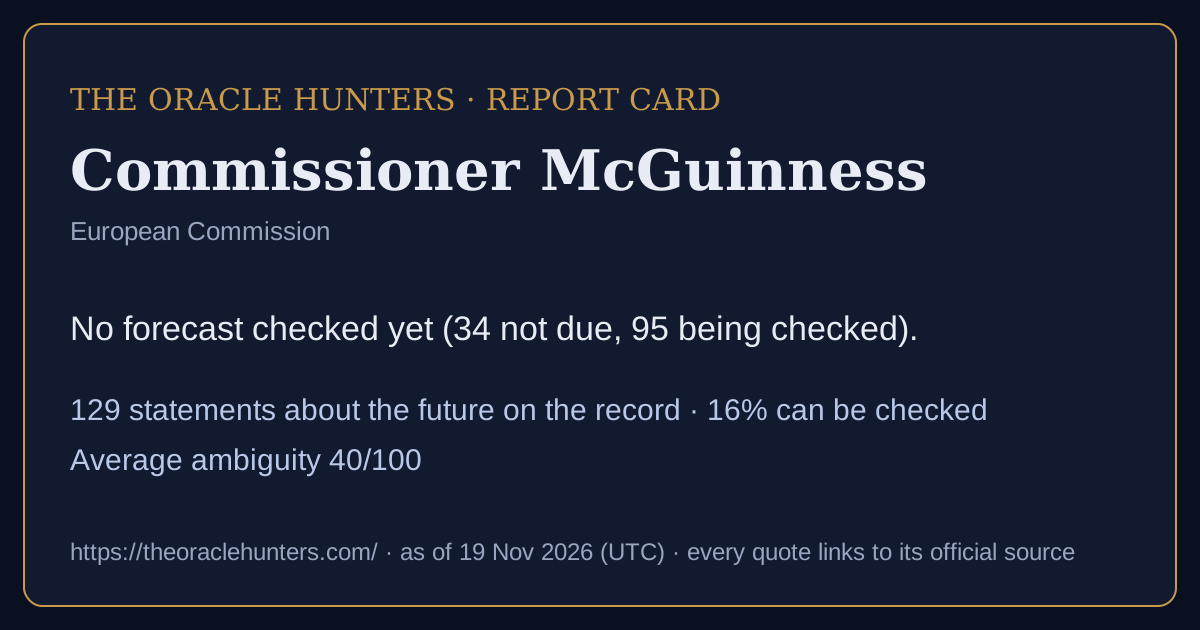
Commissioner McGuinness
European Commission · EU
Track record: No forecast checked yet (34 not due, 95 being checked).
129forecasts & commitments on the record
16%can be checked as stated
40average ambiguity (0-100)
0goalpost moves recorded
0confirmed U-turns
Timeline
came true partly did not not due / being checked / too vague
Calibration score: shown after 10 checked forecasts with a stated likelihood (now 0).
How they speak about the future: stated on authority 67, based on data 54, educated guess 8.
Kinds of claim: forecast 85, mixed claim 36, scenario (if… then) 5, commitment 3. · Download this report card as a picture
In the nine words
μαντείαInspired knowledge64 · 50%πρόγνωσιςInference from evidence54 · 42%πρόνοιαPreparing for the future5 · 4%προαναγγελίαPublic pre-announcement3 · 2%εἰκασίαConjecture3 · 2%
How to read this
Each box is one sentence a public figure or institution said about the future, word for word, with a link to the official text. Can be checked means it names what will happen, by when, and how likely - so it can be compared with official figures later. Too vague to check means it does not. Ambiguity (0-100) is how many different ways the sentence can be read. When the date passes, the forecast is compared with official data and marked came true, partly or did not come true. Labels judge the sentence, never the person. Full guide and glossary.On the record (129)
As you know we will apply these new standards from January 1st of 2025 – but we do that also looking at level playing field issues.
So based on our assessment, the entry into application of the Basel standards in the US is now highly unlikely to take place before January 1st, 2026.
Because this is an important file, and without it, we will remain fragmented and ineffective when it comes to Capital Markets Union.
In practice, the entry of application of the Basel standards in the US is now highly unlikely to take place before January 1st, 2026, at the earliest.
And that's an additional €12 trillion in long-term capital which could be put to work in the EU economy to help boost sustainable growth.
Their estimation is that another 4,400 companies in the EU could raise an extra €470 billion every year on capital markets – if we get there.
If premiums become unaffordable and the supply of insurance limited, then the high cost of climate damage will fall to governments and taxpayers to fund.
And that compares with the OECD projection for global growth of just over 3%.
And for Europe to reach the green and digital transitions, we will need to invest €500 billion a year and private investment will have to cover most of this investment gap because public money will not be enough.
Our spring forecasts project GDP growth of 1% for this year.
We will have a new Commission taking office later this year.
There will be a new European Commission installed towards the end of the year.
But he has already said that in order for Europe to meet these green and digital transitions we will need to invest €500 billion a year to get there, and where will that money come from?
And who knows maybe in the 2029 European election campaign we will be talking about what we did to achieve free movement of capital.
So from early next year, all providers offering standard credit payments in euros will be obliged to offer an instant option.
For crypto, we are fully on track for the Markets in Crypto-Assets Regulation, or MiCA, and that will apply from June of this year.
This year's focus on protecting your money and securing your future will help give young people the tools and information they need for a better relationship with money.
And as inflation comes down, economic growth is forecast to gradually pick up over the course of this year.
Now looking ahead, both the Commission and the ECB expect inflation to come down towards 2pc by 2025.
Now a big admission here: I'm very unlikely to be around to see how things will turn out in 2050, when we should meet our climate goals.
And you as leaders in this area should hold onto that and do your best, because I talk always about financial literacy, because I want to make sure that people understand that if you are vulnerable, if you are poor, you will remain so unless you are given the skills how to do deal with the financial system, how to …
And I look forward to next year, when we will continue to work together and move forward, together.
The requirements for these large non-EU companies will begin in financial year 2028.
Some will know the US will shorten the settlement lifecycle to T+1 next year.
And this is about €3 million, for next year.
On digital reporting, the European Single Access Point will go live by the middle of 2027.
They will only start reporting in 2029, for financial year 2028.
But these standards are likely to be adopted in 2025.
Because frankly, Europe represents 9% of global emissions and our actions alone will not make a dramatic impact, and the real impact will come working with others.
And our hope for COP28 next month, we really do hope that the conversation will drive forward greater global cooperation on climate.
For the solar industry alone, we will need one million skilled workers by 2030.
The US will shorten the settlement lifecycle to T+1 next year, and this will raise some questions for us here in the European Union.
And next month, the Commission will make the first legislative proposals on reducing reporting obligations at the European level by 25 percent.
So it is really encouraging to see the quick progress – and hopefully the legislation will be adopted later this year.
First, DORA, Digital Operational Resilience Act, and these rules will apply in January 2025.
The Council reached its negotiating position in May, and the European Parliament is due to vote early next month.
But I also need to underline the reality that without movement on national issues, national positions, the EU will remain less that it could be when it comes to capital markets.
Without an effective, efficient, competitive, stable banking and financial system we will have nothing else – including we will not have the green and digital transition.
By the end of the year, we will publish a review of the EU's macroprudential framework.
We will need 800,000 skilled workers in the battery industry by 2025.
And later this year, the Commission will propose a legal framework to establish and regulate the essential elements of a digital euro.
If you look at figures from the Bank of International Settlements, 90 percent of central banks were actively engaged in some form of work on digital currencies by the end of 2021.
We in the Commission will publish a legislative proposal this year setting out the principles behind a digital euro.
We will need 800,000 skilled workers by 2025 in the battery industry; 1 million skilled workers by 2030 in the solar industry, twice as many as there are today.
Just next month they will be able to experiment with this technology in a safe environment.
The standards will start applying for the first companies in financial year 2024, for reports published in 2025.
And that clarification, with the regulatory technical standards that come into effect in January of next year, so that's very soon, I think those together will address some of the concerns.
Alongside the initiatives I've mentioned, we will bring forward delegated acts on the CSRD next year.
So in this vein, we are working to address some of these concerns and early next year we will publish a first set of Q&As to try and bring some clarity on specific points.
And these three measures will come before the end of the year.
Showing the newest 50 - the ledger has all 129.
Also said - not checkable as stated (12 newest)
Remarks about the future with no date, figure or likelihood that could be checked. They are kept on the record and shown here, but not scored.
He wrote that there should be a representative of Ireland: “in all the great capitals of Europe and its important commercial centres... to keep Europe acquainted with the truth of the struggle (in Ireland) and to secure a profitable market for Irish goods and produce abroad”.
And I can say right now that we will publish that delegated act in July so that we are in good time and consistent with our decision-making.
And we will actively participate in trilogues with Parliament and Council to ensure that the outcome is a real step forward.
And I got one Facebook question in the last two days, saying, when will we have free banking across Europe that will have more competition?
The Capital Markets Union could be facilitated by a more integrated market for banking services.
The next year, the Single Resolution Mechanism followed.
As we move towards the trilogues, we will engage with the aim of ensuring that the final political agreement represents a real step forward for the Banking Union.
Existing problems in retail markets are likely to persist and this will need to be revisited.
We will adopt this delay by way of a delegated act as soon as possible.
Because this will give the ECB and market players the legal clarity they need to embark on the necessary investments to make the project a success for consumers, businesses and the financial sector.
So I think we need to use the opportunity to speak to citizens, because they will drive change more than it being led just from the top.
Now we just need to translate that support for CMU into support for specific measures that will build it.