Commissioner McGrath
European Commission · EU
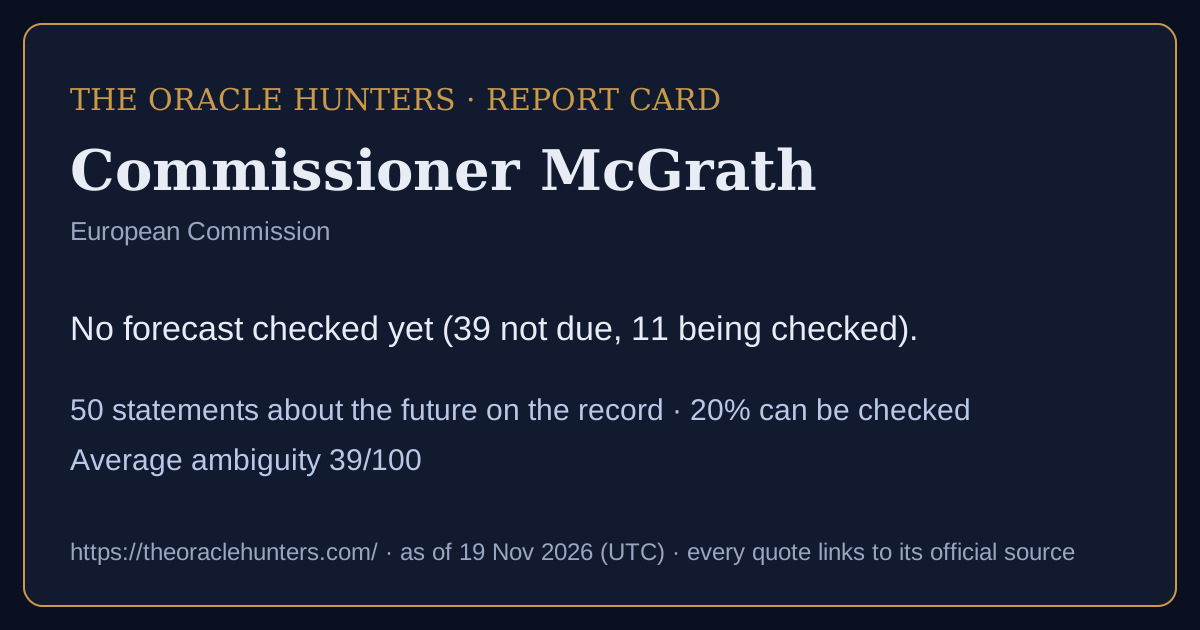
Track record: No forecast checked yet (39 not due, 11 being checked).
50forecasts & commitments on the record
20%can be checked as stated
39average ambiguity (0-100)
0goalpost moves recorded
0confirmed U-turns
Timeline
came true partly did not not due / being checked / too vague
Calibration score: shown after 10 checked forecasts with a stated likelihood (now 0).
How they speak about the future: based on data 27, stated on authority 23.
Kinds of claim: forecast 37, mixed claim 9, commitment 4. · Download this report card as a picture
In the nine words
πρόγνωσιςInference from evidence27 · 54%μαντείαInspired knowledge19 · 38%προαναγγελίαPublic pre-announcement4 · 8%
How to read this
Each box is one sentence a public figure or institution said about the future, word for word, with a link to the official text. Can be checked means it names what will happen, by when, and how likely - so it can be compared with official figures later. Too vague to check means it does not. Ambiguity (0-100) is how many different ways the sentence can be read. When the date passes, the forecast is compared with official data and marked came true, partly or did not come true. Labels judge the sentence, never the person. Full guide and glossary.On the record (50)
The anti-SLAPP Directive, which Member States had to transpose by May 2026, allows courts to dismiss manifestly unfounded claims early and protects those targeted in cross-border cases.
And by 2029, we aim to reduce administrative burden by at least 25% for businesses and 35% for small- and medium-sized enterprises, with expected savings of some 37.5 billion Euro.
Over these two days, discussions will focus on three workstreams from the DigitalJustice@2030 Strategy where we have not yet seen a sufficient level of engagement.
This is why the Commission will present the first-ever EU Anti-Corruption Strategy later this year.
To protect consumers, I will bring forward a Digital Fairness Act later this year.
By 2029, we aim to reduce burden by at least 25% for businesses and 35% for small- and medium-sized enterprises, with expected savings of some 37.5 billion Euro.
And this is why, earlier this year I launched the European Centre for Democratic Resilience – to anticipate and respond to foreign information manipulation, interference, and disinformation across our Union.
This was all about how innovation can enhance participation and engagement and will feed into the launch of the European Civic Tech Hub later this year.
By the end of this year we will deliver a Guide of Best Practices as well as a Commission Recommendation on safety in political life.
The scale of our ambition is clear – by the end of this year alone we expect 15 AI Factories to become operational under the EU's AI Continent Action Plan!
By the end of 2026, a dedicated Civil Society Platform will be up and running, to ensure structured and regular exchanges between the Commission and civil society organisations.
And this is why the Commission has provided both financial and technical support to vetting; and why I am pleased to announce that our assistance project will be extended until the end of March next year, with an addition 5 million Euro.
That is why, by the end of this year, the Commission will adopt the new Strategy on Victims' Rights.
To achieve this, we will continue supporting election observation in the Member States by international organisations that endorse essential international standards – here, the OSCE's role remains crucial.
This year, 27 elections at various levels will take place across 14 EU Member States.
By simplifying regulations and embracing digital solutions, we will help start-ups to focus on innovation and growth.
If we deliver on that ambition in full, European businesses could save up to €37.5 billion per year — resources that should be invested not in paperwork, but in innovation, growth and jobs.
We are now half-way through the Commission's Strategy to strengthen the application of the Charter in the EU, which will run until 2030.
The Judicial Training Strategy focuses on digitalisation, setting the ambition that by 2030 every justice professional in Europe will have the digital skills and knowledge of EU law required to operate confidently in the digital environment.
This is why – next year – the Commission will propose a revision of Eurojust's founding Regulation – to strengthen its mandate.
Following a clear call from business, consumer organisations, policymakers, and national authorities, we will revise the Consumer Protection Cooperation Regulation next year.
These next years will be pivotal for facing these threats and tackling these challenges – and that is why the Shield announces a series of actions that will be rolled out progressively by 2027.
To address the increasing prominence of AI-produced content, we will prepare guidance on the use of AI in electoral processes.
These provisions will have to be transposed by Member States by May next year, and my Services are actively supporting national authorities with this process.
We will revise the Consumer Protection Cooperation Regulation next year.
This Plan is about scaling Europe's public AI infrastructure, and making it accessible – by the end of next year, we expect at least 15 AI Factories to become operational.
This Strategy, which I seek to adopt next month, will not only increase efficiency of justice, but also contribute to growth and competitiveness.
The AI Act, effective since the 1st of August last year, establishes a Single Market for AI across the EU, with a phased application over three years: since February, it bans AI systems with unacceptable risks, since August, it strengthened the rules applicable to General-purpose AI, and from August 2027, these rules will cover high-risk embedded products, such as medical …
By the end of next year, we expect at least 15 AI Factories to become operational.
The Judicial Training Strategy will be adopted later this year, together with the Digital Justice Strategy, and they aim to ensure that practitioners have the knowledge and skills they require to keep pace with developments at both national and European level.
Elements of the AI Act will gradually apply over the course of the next three years: the rules on General-purpose AI – such as risk management – began to apply last month and those on prohibited AI practices will apply from February next year.
And, next month, we will launch the AI Act Service Desk, to help stakeholders navigate the requirements of the AI Act.
We will now conduct an impact assessment and aim to table a proposal as from mid-2026.
First, the Euratom Research and Training Programme, with a budget close to €10 billion, this Programme will enhance nuclear safety and security, as well as waste management, while sustaining critical skills for the sector's development.
Under the Instrument for Nuclear Safety Cooperation and Decommissioning Programme, with a budget of close to €1 billion, we will enhance nuclear safety in Member States and partner countries by combining existing programmes focused on safety cooperation with those focused on decommissioning efforts.
In May this year, we proposed a targeted simplification of the record-keeping obligation in the GDPR, to reduce administrative burden on SMEs, small mid-caps, and organisations with fewer than 750 employees.
This is why the effective implementation of the European Media Freedom Act by this August and the correct and full transposition next year of the anti-SLAPP Directive by the Member States to protect journalists also remain critically important.
As you know Ireland will assume the Presidency of the Council of the European Union in the second half of next year, and I look forward to close cooperation with the Irish Government on the many challenges, andopportunities, that we anticipate over the coming months.
This is an initiative that President von der Leyen has entrusted me to lead, and I will be presenting it later this year.
In this regard, the EU's next budget – the Multiannual Financial Framework that will take effect from 2028 – will also include strong Rule of Law safeguards.
We will complement these actions with our Consumer Agenda 2025-2030 and an action plan on consumers in the Single Market.
The EU's next budget – the so-called Multiannual Financial Framework that will take effect from 2028 – will also include strong Rule of Law safeguards.
This year's report will also be broadened to include a Single Market dimension – looking at issues affecting companies, especially SMEs, operating across borders.
The Regulation on political advertising is another major piece of legislation that fosters transparency online, and this Regulation will become fully applicable in October this year.
According to the World Health Organisation, 12% of adolescents are at risk of problematic gaming and this percentage is rapidly growing.
The Member States are now expected to transpose this Directive into their national law by May 2026.
At the same time several EU rules are now relevant in national electoral contexts and in the context of the changing eco-system of electoral campaigning the Digital Services Act (DSA), the Regulation on political advertising (which will become fully applicable in October this year), the General Data Protection Regulation, the AI Act and the European Media Freedom Act.
This year is marked by several important electoral cycles in Europe, from the federal elections in Germany on the 23rd of February, to presidential elections in Poland and Romania in May, and parliamentary elections in Autumn in Czechia.
President von der Leyen has entrusted me with preparing a Digital Fairness Act to tackle these, but it will take evidence gathering and consultations with on-the-ground stakeholders like yourselves to identify the gaps, avoid duplications, and prevent conflicts in existing legislation to make a legislative proposal a reality next year.
On the substantive side of criminal law, we will launch a new chapter in the Freeze and Seize Task Force for Ukraine, to strengthen the fight against the violation of Union restrictive measures.
Also said - not checkable as stated (12 newest)
Remarks about the future with no date, figure or likelihood that could be checked. They are kept on the record and shown here, but not scored.
This is also why the Commission adopted a Recommendation on the safety of journalists in 2021, and as committed in the European Democracy Shield we will update it to reflect changing realities in the journalistic environment.
The Commission will remain vigilant and committed to defending media freedom and pluralism, as well as the rule of law in all Member States, including in Czechia.
The Commission will continue to closely follow developments on media freedom and pluralism in all Member States, including in Czechia.
We will engage constructively with national authorities and use all relevant tools at our disposal to uphold media freedom, media pluralism and the rule of law across the Union.
Cross-border cooperation remains slower and harder than it should be, and citizens and businesses do not get the quality of service they increasingly expect.
And as Artificial Intelligence develops at remarkable speed, its impact on the justice sector will be profound, making it all the more important that we guide this transformation responsibly.
I am not talking about the next few months but about the next seven-year period, up to 2034.
These developments should be welcomed, while being absolutely clear that AI must never replace the independent judgment of judges.
The use of AI in justice must always be human-centred, transparent, secure, and fully aligned with our European values and fundamental rights,
As underlined by the European Council in its latest conclusions, it is essential to maintain both speed and ambition throughout the upcoming negotiations, with a view to reaching an ambitious agreement by the end of 2026.
The coming weeks will be decisive in determining whether we can deliver on that ambition.
And we must be clear: a European corporate framework that simply reproduces existing national complexities will not deliver the transformation that Europe's businesses need.