Commissioner Lahbib
European Commission · EU
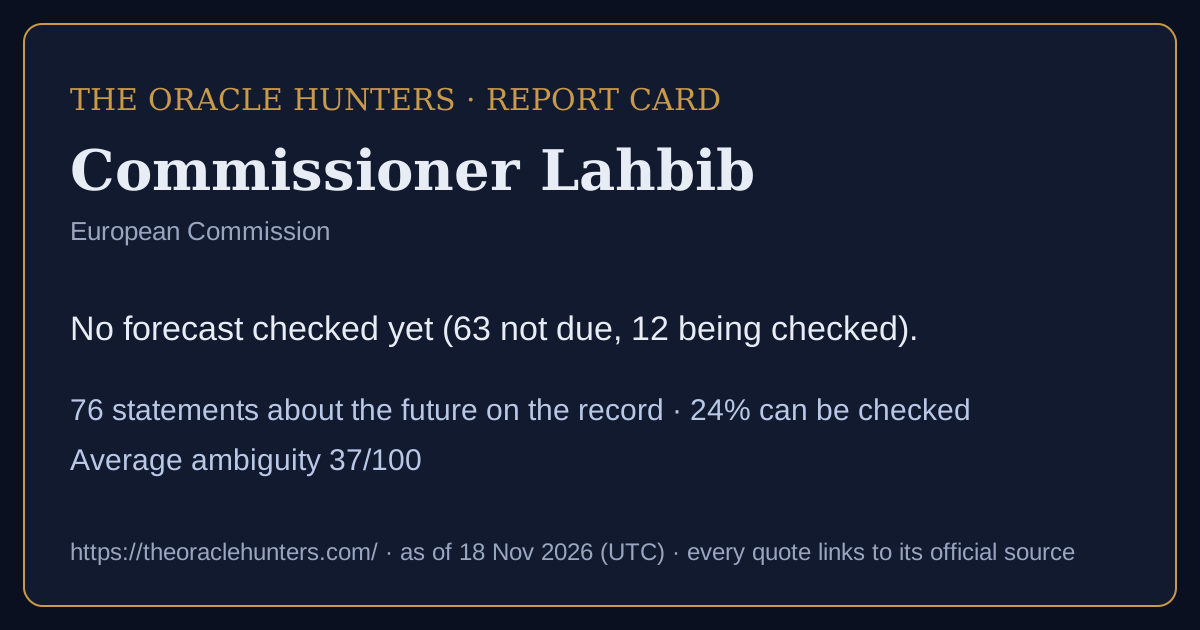
Track record: No forecast checked yet (63 not due, 12 being checked).
76forecasts & commitments on the record
24%can be checked as stated
37average ambiguity (0-100)
0goalpost moves recorded
0confirmed U-turns
Timeline
came true partly did not not due / being checked / too vague
Calibration score: shown after 10 checked forecasts with a stated likelihood (now 0).
How they speak about the future: based on data 38, stated on authority 36, educated guess 2.
Kinds of claim: forecast 42, mixed claim 29, commitment 3, scenario (if… then) 1, speculation 1. · Download this report card as a picture
In the nine words
πρόγνωσιςInference from evidence36 · 47%μαντείαInspired knowledge32 · 42%προαναγγελίαPublic pre-announcement3 · 4%πρόβλεψιςSeeing the signs3 · 4%εἰκασίαConjecture1 · 1%πρόνοιαPreparing for the future1 · 1%
How to read this
Each box is one sentence a public figure or institution said about the future, word for word, with a link to the official text. Can be checked means it names what will happen, by when, and how likely - so it can be compared with official figures later. Too vague to check means it does not. Ambiguity (0-100) is how many different ways the sentence can be read. When the date passes, the forecast is compared with official data and marked came true, partly or did not come true. Labels judge the sentence, never the person. Full guide and glossary.On the record (76)
Next year, the Commission will present a European Care Deal.
Floods and wildfires, war on our borders, hybrid and cyber-attacks, sabotage, health emergencies, and who knows what Artificial Intelligence will bring.
Later this year, we will give people practical guidance on how to cope for at least 72-hours in an emergency.
Later this year, we will publish our Comprehensive Risk and Threat Assessment.
We will also strengthen implementation of the Disability Employment Package, helping employers remove barriers to hiring, adapt workplaces, and give people the chance to build a career.
Next year, we will also launch an initiative on accessibility in higher education.
This year's Integrated Resolve exercise will test how Europe responds to a major hybrid crisis cutting across sectors and institutions, including at the highest political level.
Early next year, EU staff will take part in NATO's 2027 Crisis Management Exercise.
Later this year, we will give people practical guidance on how to manage for at least 72 hours during an emergency.
Our European Vaccine Hub, backed by €100 million, will also play its role in meeting the 100-days ambition.
We will continue investing in new vaccines with partners like CEPI, with over €73 million in 2026 and 2027.
The Refugee Response Plan will end this year.
In May, we strengthened our EU Disability Strategy through 2030.
Later this year, we will publish practical guidance so families, not just ministries, know how to prepare.
Production of our 12 rescEU firefighting planes is on track, with the first delivery expected in early 2028.
That is why the Commission will present a new European Climate Resilience Framework later this year to embed resilience across EU policies, improve risk awareness, and support smarter planning.
We will increase our funding, with a target of 25% localisation by 2027.
This year, for the first time, fire behaviour experts will join our wildfire support team.
We will soon present a new Communication “Enhancing the Strategy for the Rights of Persons with Disabilities up to 2030” with new actions to support independence, participation, and equal rights.
By 2050, more gender equality could increase EU GDP per capita by almost 10% and create more than ten million jobs.
From this year, at least 25% of our humanitarian funding will go to local organisations because they are the ones who can reach people everywhere, even where others cannot.
Next month I will chair the humanitarian segment of the Ministerial on Sudan in Berlin.
That is why we will publish our Minimum Preparedness Requirements this year.
This year we will also propose a Climate Adaptation Plan with practical tools, from mapping flood zones to early warning systems for heatwaves and wildfires.
They will be fully in place by 2028, and they will make free movement real for millions of people.
We are reviewing how Member States apply sanctions under the Directive and, where necessary, we will strengthen them.
Later this year, we will launch a partnership with UNESCO to reinforce anti-racism education.
The 2027 transposition deadline may seem far way, but the work needs to start now.
We will also strengthen support to traceability of critical minerals in the region, to bring a gradual shift from trafficking to trade, in line with the EU Great Lakes Strategy.
An estimated 33.7 million people — two thirds of the country's population — are expected to need aid this year.
That is why later this year, the EU will adopt a Communication setting out how we will step up humanitarian diplomacy, with real tools and clear accountability.
This year, we will provide initial humanitarian support of over €150 million for Ukraine and Moldova, more than double our initial support in 2024.
If we closed this gap over the next decade, global growth could double.
The World Bank tells us that closing the gender gap in employment and entrepreneurship could boost global GDP by more than 20%.
By 2050, stronger gender equality could raise EU GDP per capita by up to 10%.
Later this year, we will launch a joint project with UNESCO to strengthen anti-racism education.
We will propose the next concrete steps of this integrated approach in our upcoming Communication on Humanitarian Aid, planned for the second quarter of this year.
Next year, we plan to provide €10 million to push forward supply chain reform.
We will meet again next year to assess our progress and continue these important reforms.
Next year, we will involve young people directly through Erasmus+ and the European Solidarity Corps.
UN Emergency Response Coordinator Tom Fletcher asks us to focus on the lifesaving needs of only 115 million people at the highest risk, but even this will stretch the system to its limits.
We will deliver on our roadmap for localisation, which I announced at the European Humanitarian Forum in May to ensure that 25% of all EU humanitarian funding is delivered as directly as possible to local partners by 2027, which is double compared to today.
Ahead of International Women's Day, we will adopt the Gender Equality Strategy 2026–2030.
Next year, we will keep up the momentum.
The Roadmap will now guide the actions in our Gender Equality Strategy for the next five years, which we plan to adopt in March next year.
The EU Risks and Threat Assessment — to be completed by the end of 2026 — will offer a comprehensive picture of today's risks.
These lived experiences will also help shape our new Gender Equality Strategy, planned for March next year.
If we extended this equality beyond the boardroom, Europe's GDP per capita could grow by nearly 10% by 2050.
Next year, humanitarian aid will be one of the European Commission's top priorities.
Next year, the ICRC and six partner countries will organise a High-Level Meeting to Uphold Humanity in War, and the EU stands ready to contribute.
Showing the newest 50 - the ledger has all 76.
Also said - not checkable as stated (12 newest)
Remarks about the future with no date, figure or likelihood that could be checked. They are kept on the record and shown here, but not scored.
For the first time, we will bring the full picture together: security threats, natural hazards, technological risks, and health threats that cross borders.
First, we will soon publish our Comprehensive Risk and Threat Assessment.
Second, we will propose EU Minimum Preparedness Requirements, a common foundation for every country's readiness.
These requirements will help countries identify gaps and where they need to invest.
The first edition should take place next year, and I am counting on all of you to bring it to life.
We will keep holding out that hand for the next 25 years.
We need to spot danger earlier, act before it is too late, and work together across borders and sectors.
Our joint project “Addressing Racism in and through Education” launched this year.
When the next health emergency hits, Europe and Canada will face it together, and we will be ready.
We will also align our plans for medical countermeasures against chemical, biological, radiological and nuclear threats.
Where it makes sense, we will coordinate our investments, so that every euro and every dollar goes further.
We will meet regularly at senior level to check our progress and agree on the next steps.