Commissioner Kyriakides
European Commission · EU
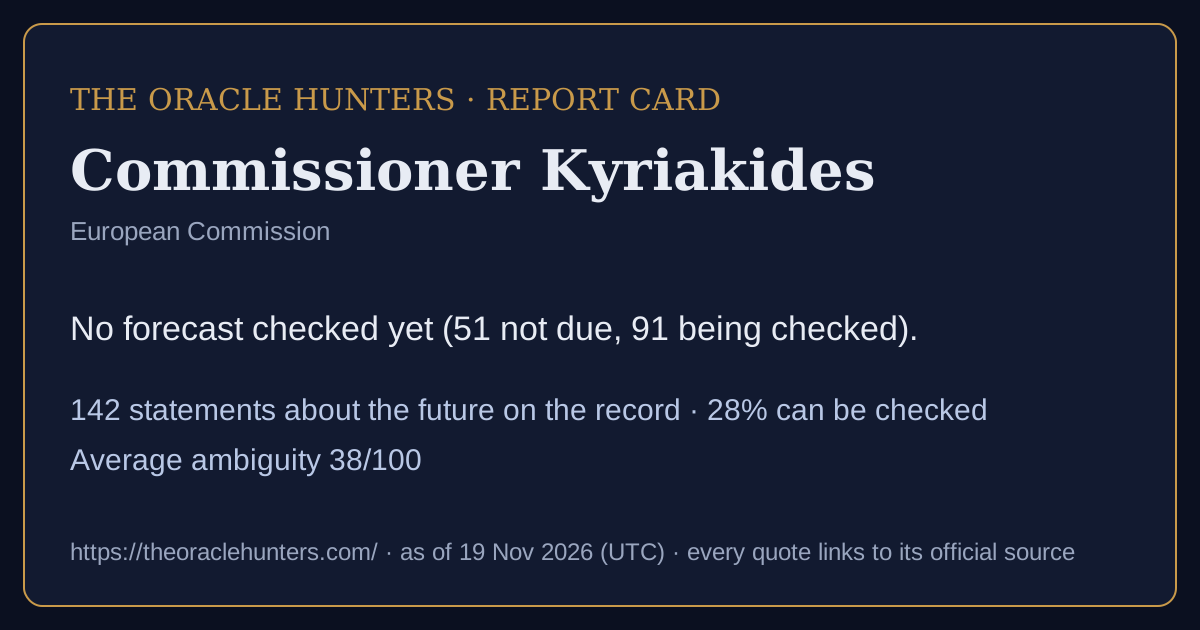
Track record: No forecast checked yet (51 not due, 91 being checked).
142forecasts & commitments on the record
28%can be checked as stated
38average ambiguity (0-100)
0goalpost moves recorded
0confirmed U-turns
Timeline
came true partly did not not due / being checked / too vague
Calibration score: shown after 10 checked forecasts with a stated likelihood (now 0).
How they speak about the future: based on data 91, stated on authority 51.
Kinds of claim: forecast 81, mixed claim 49, commitment 12. · Download this report card as a picture
In the nine words
πρόγνωσιςInference from evidence85 · 60%μαντείαInspired knowledge44 · 31%προαναγγελίαPublic pre-announcement12 · 8%πρόβλεψιςSeeing the signs1 · 1%
How to read this
Each box is one sentence a public figure or institution said about the future, word for word, with a link to the official text. Can be checked means it names what will happen, by when, and how likely - so it can be compared with official figures later. Too vague to check means it does not. Ambiguity (0-100) is how many different ways the sentence can be read. When the date passes, the forecast is compared with official data and marked came true, partly or did not come true. Labels judge the sentence, never the person. Full guide and glossary.On the record (142)
I can announce today that the European Commission will support the setting up of this panel in 2025, with €2.5 million.
We are firmly determined to keep this momentum up, and this year will see us present measures on tackling exposure to ultraviolet radiation, including from sunbeds.
Training programmes will be expanded to 100 cancer centres in at least 15 Member States in the next year;
To achieve this, we will set up a Critical Medicines Alliance starting in early 2024.
By April next year we will be determining the measures needed to build the resilience of the medicines in this list.
In parallel we have accelerated work on the Union list of critical medicines, and we will be presenting an initial list before the end of this year.
We are committed to deliver on our ambitious commitment under the Cancer Plan to ensure that 90% of people in the EU who qualify for breast, cervical and colorectal screenings are offered such screening by 2025.
Because unless we act now, cancer will become the leading cause of death in the EU by 2035.
And we will propose additional funding under the 2023 EU4Health programme.
These additional doses will be available for delivery before the end of the year.
Unless we act now, cancer will become the leading cause of death in the EU by 2035.
In the months to come, we trust that the ACT-A leading agencies will revisit, as necessary, the strategic plan and make limited adjustments so that implementation continuity can be guaranteed into 2023 as we transition to longterm COVID-19 control.
Reflections like these and experiences gained from the past years will also feed into the EU's new Global Health Strategy, which we plan to adopt by the end of this year.
On secondary prevention, the new EU-supported Cancer Screening Scheme will help to ensure that 90% of the EU population who qualified for colorectal cancer screening are offered screening by 2025.
A call for proposals for stakeholders will be launched in July this year on cardiovascular diseases and diabetes.
20% of the EU4Health programme's budget will be allocated to health promotion and disease prevention.
We will come forward shortly with a Communication on EU preparedness and response to the pandemic, looking ahead to autumn and winter next year.
To offer high-quality care for all, we will create an EU Network of National Comprehensive Cancer Centres by 2025.
This year we will also set up the European Cancer Imaging Initiative to develop an EU “atlas” of cancer-related images, making anonymised images accessible to all stakeholders.
This year we will maintain the momentum, focusing on prevention and diagnosis with over EUR 100 million to address key health determinants, health promotion, and primary cancer prevention, knowing that 40% of cancers are preventable.
A series of country cancer profiles will be published this year, followed by an overall report on the state of cancer prevention and care in the EU by 2023.
Last year we already launched 16 major initiatives, and this year many more will come, in particular actions focusing on prevention and diagnosis.
This year we will pursue our work to update the European Code against Cancer and to revise the Council Recommendation on cancer screening.
This year's EU4Health work programme will support children and young people, displaced persons, and migrants.
We have strengthened the mandate of the ECDC, and therefore we will be able to support epidemic and outbreak responses and establish a more structured cooperation with public health actors in Africa.
This important step will help us to improve the protection of more than 1 million workers in the EU.
The second area that concerns prevention and where we will be working intensively this year is to update the Recommendation on cancer screening.
At the G20 Global Health Summit, President von der Leyen has announced a Team Europe initiative on manufacturing and access to vaccines, medicines and health technologies in Africa which will be funded with at least €1 billion from the EU budget.
Overall last year, we launched 12 action grants and 4 joint actions under the EU4Health programme and a significant number of actions will come this year.
According to the OECD, by 2050 AMR could cause 2.4 million deaths every year in Europe, North America and Australia, at a cost of over 3 billion euros to healthcare services.
By the end of 2022, we will adopt a proposal for Council Recommendations on AMR, and propose provisions addressing AMR as part of the revision of the EU's pharmaceutical legislation.
In addition, this year we will carry out audits on both livestock vessels and on the transport of unweaned calves by road.
And the EU4Health programme will add more than 5 billion in health preparedness and resilience over the next 6 years.
Finally, as part of the Pharmaceutical Strategy for Europe, later this year, we will propose a comprehensive reform of the Union's pharmaceutical legislation, which will speed up and improve access to affordable medicines.
Up to three new therapies may still be authorised by the end of the year.
This year in May, we presented the EU COVID-19 Therapeutics Strategy.
A call for tender will be published in 2022 under HERA for an amount of EUR 160 million.
Although this exercise will conclude next year, from the information already available to us, we can see weaknesses in the design, implementation, compliance and enforcement of the current legislation.
As a result, Team Europe has collectively exceeded the target to share at least 250 million doses by the end of 2021.
HERA will rely on a budget of EUR 6 billion from the current EU budget, including from the EU4Health programme.
The EU4Health Programme will invest €5.3 billion in health in the coming years.
A call for evidence will be launched this year, giving Digestive Cancers Europe and other participants today the opportunity to share their perspective.
One major initiative is the update of the Council Recommendation on cancer screening, on which work has already started and will be presented next year.
The conclusions will then be discussed with the Steering Group on Promotion and Prevention as well as relevant stakeholders, in the end of next year.
If appropriate, we will revise our policy framework for rare diseases in 2023, in addition to the upcoming reform of the legislation on medicines for rare diseases and for children expected for the end of 2022.
The EU will contribute EUR 750 000 to this effort and the deadline to submit proposals is February 2022.
Both are expected at the end of next year.
One of the first deliverables on a flagship initiative is the political agreement on the Regulation on Health Technology Assessment, which is expected to be endorsed next month.
EU-level targets will give us a clear direction of travel and cement our commitment to reaching the Sustainable Development Goal: halving global food waste and reducing food losses along the production and supply chains by 2030.
This important work will continue next year, under the Platform's new mandate, including a clear focus on tackling consumer food waste.
Showing the newest 50 - the ledger has all 142.
Also said - not checkable as stated (12 newest)
Remarks about the future with no date, figure or likelihood that could be checked. They are kept on the record and shown here, but not scored.
And to recognise the right to be forgotten across the EU, we will bring forward the first EU code of conduct on fair access for cancer survivors to financial services in the coming months in Brussels.
We will bring forward a range of actions in other important areas as well, including for personalised cancer medicines, digital technologies, palliative care for children and health literacy.
We will also work with Member States to anticipate in a coordinated way elements from the pharmaceutical reform.
It will focus on the most critical medicines from the Union list and will provide tailored responses to the vulnerabilities identified in their supply chains.
With our world-pioneering European Health Data Space we will make better use this potential to produce better treatments for patients.
Digital health solutions in all care settings will improve accessibility, effectiveness and resilience.
We are funding seven projects that will deliver training programmes for health professionals, focusing on digital skills.
A pandemic that is a constant reminder that there is still much more we should do – both within our healthcare systems in Europe, and between our systems at European level.
This is why we will make sure we give strong incentives for innovation, especially for unmet medical needs.
We will also support patients so they can all access the benefits of this innovation equally – this is a long-standing request from Austria and other Member States.
This is why we will reward those who go the extra mile to provide EU-wide access.
Shortages and withdrawals will have to be notified earlier.