Commissioner Kadis
European Commission · EU
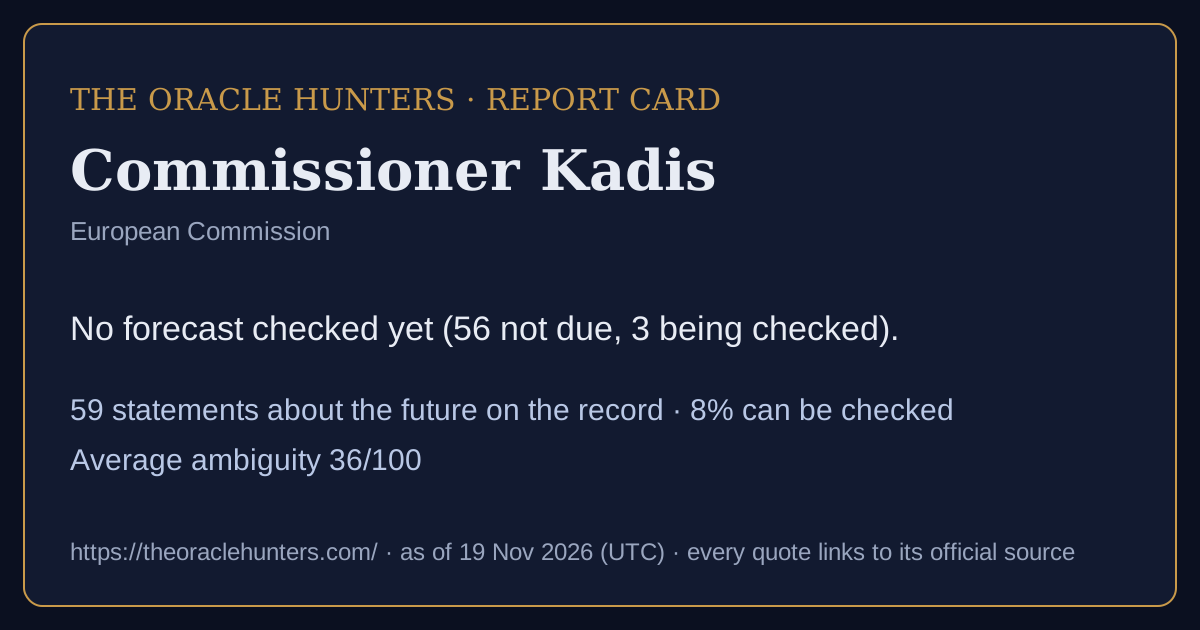
Track record: No forecast checked yet (56 not due, 3 being checked).
59forecasts & commitments on the record
8%can be checked as stated
36average ambiguity (0-100)
0goalpost moves recorded
0confirmed U-turns
Timeline
came true partly did not not due / being checked / too vague
Calibration score: shown after 10 checked forecasts with a stated likelihood (now 0).
How they speak about the future: based on data 45, stated on authority 14.
Kinds of claim: forecast 38, mixed claim 18, commitment 3. · Download this report card as a picture
In the nine words
πρόγνωσιςInference from evidence44 · 75%μαντείαInspired knowledge12 · 20%προαναγγελίαPublic pre-announcement3 · 5%
How to read this
Each box is one sentence a public figure or institution said about the future, word for word, with a link to the official text. Can be checked means it names what will happen, by when, and how likely - so it can be compared with official figures later. Too vague to check means it does not. Ambiguity (0-100) is how many different ways the sentence can be read. When the date passes, the forecast is compared with official data and marked came true, partly or did not come true. Labels judge the sentence, never the person. Full guide and glossary.On the record (59)
On this basis, we will develop the Commission's Vision 2040 for fisheries and aquaculture, which will include the External Action Strategy and the Energy Transition Roadmap, in the early autumn.
The new governance framework supporting these aims will be established in the European Ocean Act that we will propose by the end of this year.
It will be followed by the Ocean Research and Innovation Strategy later this year, ensuring our policies are grounded in the best available science.
This dialogue will guide our next steps, particularly through the Vision 2040 for fisheries and aquaculture, expected in September.
We have taken decisive steps to strengthen Europe's maritime sector - from boosting industrial competitiveness and port resilience, to preparing for the future of fisheries and aquaculture through our CFP evaluation that will be followed by the long-term Vision for 2040.
We will deliver the European Ocean Act by 2027.
These important topics will be addressed in the follow-up to the evaluation of the Common Fisheries Policy Regulation, including in the preparation of the Vision 2040 for fisheries and aquaculture, planned for this Autumn.
It will be presented by the end of this year and will align with the revision of the Marine Strategy Framework Directive to ensure complementarities.
Later this year, the Commission will present the Ocean Research and Innovation Strategy.
By 2030, this tool will allow us to predict how the ocean responds to climate pressures, test policies before they are implemented, and make evidence-based decisions faster than ever before.
This report is also complementary to the ongoing evaluation of the Common Fisheries Policy Regulation, which will form the basis for developing the upcoming Vision for fisheries and aquaculture with a 2040 perspective, including a strategy for fisheries external action.
As the fight against illegal, unreported and unregulated fishing remains a top priority, we will also pursue the implementation of the new digital certification system for fisheries products entering the EU, CATCH, while boosting synergies between the Common Fisheries Policy, trade and international partnerships.
To make these tools more effective, the Commission will present the Ocean Research and Innovation Strategy by the end of this year.
Set for completion by 2030, it will provide real-time modelling to predict and mitigate climate impacts.
The European Ocean Act, our legislative proposal, will be ready by the end of this year.
To boost the blue economy, besides the recent adoption of the Ports and Industrial Maritime Strategies, the forthcoming Tourism Strategy will promote sustainable tourism and the evaluation of the Common Fisheries Regulation and the forthcoming Vision 2040 for fisheries and aquaculture together with the energy transition roadmap will address the challenges affecting the sector.
Another key element of the European Ocean Pact is the Ocean Research and Innovation Strategy, which we will launch later this year.
The European Ocean Research & Innovation Strategy, expected later this year, will articulate precise research objectives and instruments.
I am confident our exchange today will help shape Vision 2040 into a path for a sustainable and prosperous future.
Building on the evaluation, the Vision 2040 for fisheries and aquaculture will address the challenges affecting the sector, while the energy transition roadmap will promote energy solutions that preserve our ecosystems, protect the sector from future energy shocks, and stimulate the blue economy.
Many of the elements we are likely to see feed into the Vision 2040 for fisheries and aquaculture are already in place, in no small part due to the European Ocean Pact which the Commission adopted last year.
The Energy Transition Roadmap is and will be also a key part of the Vision 2040 for EU fisheries and aquaculture, which will build on the European Ocean Pact and place the focus clearly on stakeholder engagement to deliver real sustainability and competitiveness.
We will launch the Ocean Observation initiative in the first half of 2026, on which I will work closely with Commissioner Zaharieva.
In addition, we will soon be launching a call for expression of interest for the establishment of the Ocean Board, and its launch in the first quarter of 2026.
We are also on the cusp of a new era with the launch of EMODnet's Vision 2035 – a community-driven roadmap that will shape the network's evolution over the next decade.
Looking ahead to 2026, several new EU strategies will further support Outermost Regions development.
Looking ahead, the evaluation of the Common Fisheries Policy regulation will be finalised in spring 2026 and will guide the 2040 Vision for EU fisheries and aquaculture.
Scheduled for completion in Spring 2026, this evaluation will determine if the CFP remains suited to the current challenges.
Finally, I am convinced that the new 2028-2034 budget proposal, will benefit the small-scale fisheries sector, with its framework that is more integrated, flexible and impactful.
At the same time, we are already working on defining a common vision for the fisheries and aquaculture sector into 2040, which will enable us to define, together, what the sector should look like by then.
The Blue Generational Renewal Strategy announced in the European Ocean Pact for 2027, will further develop the path chartered with the Vision 2040.
The findings of the evaluation, enriched by all the discussions I have had with stakeholders since the beginning of my mandate, including during my visits to coastal communities, will be the basis for developing the Vision for a resilient and competitive fisheries and aquaculture sector in a 2040 perspective.
On my initiative, next year we will launch the process towards a new MedFish4Ever Declaration to guide GFCM through the following decade.
This year, like last year, we will rely on a compensation scheme that will enable fishing while promoting sustainable fishing practices.
By the end of 2026, these efforts will culminate in the European Ocean Act, providing an integrated legislative framework for sustainable ocean management.
By 2050, ocean energy could provide clean electricity to roughly 35–40 million European households.
The European Commission remains committed to supporting the region, with a new agenda for the Mediterranean, focusing on security, energy, and investments, to be presented in the coming months.
By 2027, the Commission will introduce the EU Blue Bioeconomy Innovation Partnership (BlueBIP), a collaborative engine designed to accelerate innovative and regenerative uses of algae and other underused marine biomass.
It will be presented at a high-level conference in February 2026 in Brussels.
It will provide a good basis to make informed decisions as regards the future of the CFP, including its revision where necessary, and on how to develop our long-term vision for a resilient, competitive and sustainable fisheries and aquaculture sector with a 2040 perspective.
Let me also say a few words on various priorities under the Ocean Pact, which I know this committee follows very closely and which will require our full attention over the coming weeks and months: the situation in the Baltic Sea and the Mediterranean, the evaluation of the CFP Regulation, the Vision 2040 and the energy transition roadmap.
For next year's fishing opportunities proposal, we will again take into account all available management tools, including the compensation mechanism, to improve gear selectivity and area closures.
Regarding the UK, Member States appreciate that the May agreement securing continued reciprocal access to waters until 30 June 2038 was an incredibly important achievement.
Other significant milestones will be the comprehensive evaluation and possible revision of the Common Fisheries Policy, as well as the Vision 2040 for fisheries and aquaculture, with a particular emphasis on small scale fishers.
We will also launch an EU Ocean Observation Initiative, to be underpinned by a European Ocean Research and Innovation Strategy, and make the Digital Twin of the Ocean operational by 2030.
The comprehensive evaluation of the Common Fisheries Policy and its possible revision, as well as the Vision 2040 for fisheries and aquaculture, which will put particular emphasis on small scale fishers, will be important milestones.
We will propose an “Ocean Act” by 2027 that will ensure that existing targets linked to the ocean are identifiable under one roof.
To strengthen EU ocean diplomacy and international ocean governance, among others, we will push for the swift ratification and entry into force of the BBNJ agreement as well as step up our fight against illegal, unreported and unregulated fishing, through the mandatory implementation of the digital IUU catch certification scheme, as of January 2026.
We will also operationalise the Digital Twin of the Ocean by 2030.
These will be supported further, by a new EU Ocean Research and Innovation strategy, to be presented next year.
Showing the newest 50 - the ledger has all 59.
Also said - not checkable as stated (12 newest)
Remarks about the future with no date, figure or likelihood that could be checked. They are kept on the record and shown here, but not scored.
We will work with Brazil, the host of COP30, with France, and with the other members of the Challenge to highlight the ocean's vital role in global climate action.
Our next rendez-vous will be the United Nations climate change conference - COP 31.
Blue diplomacy needs to be our new reality, because the challenges ahead have no borders.
This is why we will embed dual-use and security-by-design considerations from the outset of technology development.
We will improve our coordination and move towards a more strategic approach to ocean observing in Europe.
For this purpose, we will setup an International Alliance to support GOOS.
And we will establish a strategic partnership with the Intergovernmental Oceanographic Commission of UNESCO, which is the intergovernmental body that coordinates GOOS.
To that extent, we will amongst others launch the New European Bauhaus Ocean, Coastal and Island Communities Lab.
The CFP Regulation contains provisions to manage these challenges, but we will need to look into how scientific advice is used.
Based on this diagnosis, we will now need to take political decisions as to the follow up, including on whether addressing the challenges and shortcomings identified in the evaluation require any amendment to the legislation, and to which extent.
The follow-up we will propose, will also depend on whether you, the European Parliament, Member States and other stakeholders, share our diagnosis.
the Ocean Act, which aims to strengthen coherence across ocean-related policies, and which we plan to present by the end of the year;