Commissioner Hoekstra
European Commission · EU
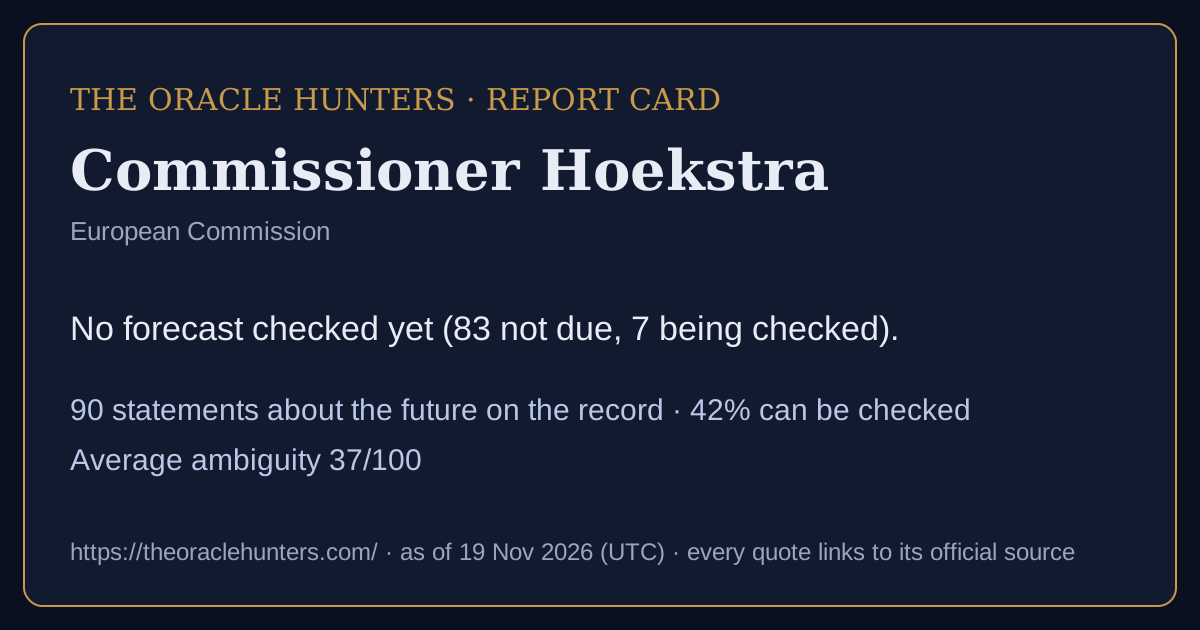
Track record: No forecast checked yet (82 not due, 7 being checked).
89forecasts & commitments on the record
42%can be checked as stated
37average ambiguity (0-100)
0goalpost moves recorded
0confirmed U-turns
Timeline
came true partly did not not due / being checked / too vague
Calibration score: shown after 10 checked forecasts with a stated likelihood (now 0).
How they speak about the future: based on data 70, stated on authority 15, educated guess 4.
Kinds of claim: forecast 48, mixed claim 29, commitment 6, scenario (if… then) 6. · Download this report card as a picture
In the nine words
πρόγνωσιςInference from evidence66 · 74%μαντείαInspired knowledge11 · 12%προαναγγελίαPublic pre-announcement6 · 7%πρόνοιαPreparing for the future6 · 7%
How to read this
Each box is one sentence a public figure or institution said about the future, word for word, with a link to the official text. Can be checked means it names what will happen, by when, and how likely - so it can be compared with official figures later. Too vague to check means it does not. Ambiguity (0-100) is how many different ways the sentence can be read. When the date passes, the forecast is compared with official data and marked came true, partly or did not come true. Labels judge the sentence, never the person. Full guide and glossary.On the record (89)
In July this year, we presented our Electrification Action Plan, which will make sure we double the number that we have today towards 2040.
This year is the second edition of ‘Mind the Gap' report will come with concrete actions to be taken.
The Commission's Tax Simplification Package could save roughly 8 billion euros a year, freeing money for growth rather than red tape.
We will also need them until 2040, 2050 and beyond.
By 2024, our Global Gateway strategy had already mobilised more than EUR 300 billion, with half of the flagship projects targeting climate and energy.
Estimates are that by 2040, the EU could be forced to import over 70% of its total aviation fuel needs, depending on the decline of refining capacity.
Later this year, we will propose a new EU Climate Resilience Framework.
Other measures will support industry such as a new Industrial Decarbonisation Bank aiming for EUR 100 billion in funding to deploy low-carbon solutions in energy intensive sectors.
We will offer more flexibility to cut emissions in the most effective way across different sectors, while also scaling up carbon removals.
This will create space for emissions in 2040 and beyond.
First, the ETS linear reduction factor will be set as a contribution to the agreed economy-wide 2040 target to reduce greenhouse gas emissions by 90% by 2040, with up to 5% from international credits.
In the fourth quarter of this year, we will be coming up with a new package for adaptation.
It will stay in place for two years, refunding allowances paid in 2026/2027.
Second, we had a very good conversation on the post-2030 framework — the Commission will come with this later this year.
By the end of this year, we will come up with our European plan to tackle this together while at the same leaving Member States space to decide how they tackle the challenges.
The demand, unfortunately, is insufficient, and we thought it was wise to add additional flexibility, which will ease their compliance with the 2030 target.
This additional flexibility will help carmakers to comply with the 2030 objectives while at the same time preserving overall ambition.
In the shorter term, we propose a compliance regime that will apply over several years to make sure we help meet the 2030 target, just like we did last year for the 2025 target.
That is because the 10% remaining emissions will be compensated by the use of low-carbon steel and by e-fuels and biofuels put on the market.
With the reduction of the 2035 target to 90%, still the overwhelming part of the market and the percentage, of course, plug-in hybrids, range extenders, mild hybrids, and internal combustion engine vehicles may still play a role beyond 2035.
Just to be clear, this is an interim solution for two years before we can implement longer-term solutions based on the ETS review, which we will kick off this year.
There will be a review in 2035 to ensure we're on track to meet our 2050 climate neutrality goal.
This means that the share of electric cars, but also the share of plug-ins and range extenders, operated by large corporates, will have to increase as of 2030.
We will extend the compliance period for the next step to three years, from 2030 to 2032.
We will provide breathing space for vans in 2030.
The remaining 10% of emissions will have to be compensated by either clean steel made in the EU or by sustainable renewable fuels.
The fleet-wide CO2 emission target for 2035 will require a 90% decrease in emissions, abiding by the principle of technological neutrality.
The discussions on aligning all the financial flows of the Paris Agreement Goals will in substance continue even though its under a new name and the review will take place in 2028.
I am confident that we will either land at or extremely close to the proposal the Commission has put on the table for a 90% emissions reduction target by 2040, and also the range that we have displayed earlier in the conversations that we had at the UN.
With China where we were with a number of Commissioners earlier this year and who we also had over in Brussels, and with whom we are going to have the MoCA conference in just a couple of days.
Those of you who are in the details of this you probably acknowledge that a lot of the market predictions that are more extreme have been very much driven by the fact that these experts took into account in this whole thing would come to an end in 2030.
We are going to empower additional price stability and predictability, with the reserve's earlier and smoother intervention in case of lower market liquidity through gradual injections of allowances into the market by adding a buffer to the lower threshold.
We will enhance price stability and predictability, by strengthening the mechanism to release allowances if market prices exceed €45/t CO2 equivalent, with a top-up to double the volume of allowances to be released in the market.
As you are aware, a significant group of Member States have shared with us their concerns about the new emissions trading system framework for road transport, buildings and additional sectors, knowingly abbreviated as ETS2 which will start in 2027.
We are going to expand the liquidity and long-term predictability, by keeping in the reserve all allowances that are not released by the end of 2030.
The EU and its Member States remain the largest providers of public climate finance, and we will continue to financially support international climate action.
And if you then add climate change and the fact that temperatures will continue to rise, we'll see more pressure on the international system, more friction over resources and many changes shaping the world today.
That is why next year, the European Commission will propose a European Climate Adaptation Plan, to support Member States, in preparedness and planning and ensure science-based risk assessments.
At the end of next year, we will be rolling out a European Climate Adaptation Plan to ensure adapting to extreme weather events is at the heart of everything we do.
We'll deal with the other parts hopefully later on this year given how critically important they will be for climate policy and competitiveness.
That's important for deriving a 2035 target which will need to have successful global negotiations at the COP in Belem.
Next month will mark three years since Russia's unlawful and unjustified invasion of Ukraine.
With these funds and this structure, we are confident we will reach the 1,3 trillion objective.
Let me close by saying that the European Union remains deeply committed to climate action and that we will continue to demonstrate leadership in the years ahead.
The International Energy Agency projects we need 25 million kilometres of new and improved grid lines by the end of this decade.
Meeting these targets would cut global greenhouse gas emissions by 10 billion tonnes by the end of this decade — to put it into perspective that is more than the European Union's total emissions over three years.
Europe is and will continue to be the world's largest provider of climate finance, with over 31 billion dollars in public finance in 2023.
The assessment is that global demand for these minerals is set to triple by 2030, and for some, like lithium, demand could increase fortyfold by 2040.
Yet if you take a more global look you will find emissions still rose by 1.3% last year.
For the European Union, it means that we have to and will upload our commitment to reach climate neutrality by 2050.
Showing the newest 50 - the ledger has all 89.
Also said - not checkable as stated (12 newest)
Remarks about the future with no date, figure or likelihood that could be checked. They are kept on the record and shown here, but not scored.
What we need to do, and I think three out of four countries across the globe are fossil fuel importers, is to get rid of this.
We will have to work decisively on broadening the base of contributors.
When it comes to access to finance, resources need to reach the most climate-vulnerable countries and communities.
We need to make sure the energy transition continues to accelerate.
And that is a trajectory we will be continuing in full in the years ahead of us.
Unfortunately, if we look back in another ten years, we will likely find that even though we know that the summer was the hottest on record so far, by then it will have been one of the cooler ones.
A more coherent set of rules will make life easier for firms operating across borders.
And tax administrations will be receiving real-time data to make things more efficient.
In our view, it will be very useful in stepping up the assessment of tax gaps and efficiency of tax collection across the EU.
This is what I will continue to work towards as European Commissioner for tax, along with our Member States, and you – the business community.
It's much more likely that we run over it and then we should do our utmost to get under it again.
More of it will need to be made on European soil.