Commissioner Hansen
European Commission · EU
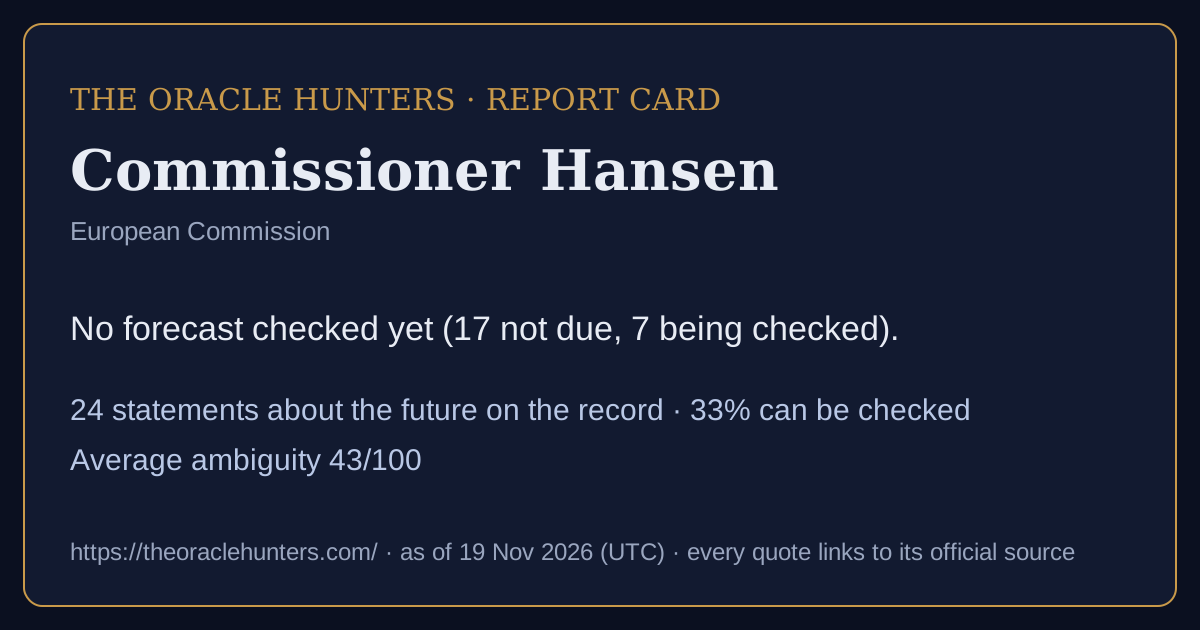
Track record: No forecast checked yet (17 not due, 7 being checked).
24forecasts & commitments on the record
33%can be checked as stated
43average ambiguity (0-100)
0goalpost moves recorded
0confirmed U-turns
Timeline
came true partly did not not due / being checked / too vague
Calibration score: shown after 10 checked forecasts with a stated likelihood (now 0).
How they speak about the future: based on data 17, stated on authority 7.
Kinds of claim: forecast 21, mixed claim 2, commitment 1. · Download this report card as a picture
In the nine words
πρόγνωσιςInference from evidence17 · 71%μαντείαInspired knowledge6 · 25%προαναγγελίαPublic pre-announcement1 · 4%
How to read this
Each box is one sentence a public figure or institution said about the future, word for word, with a link to the official text. Can be checked means it names what will happen, by when, and how likely - so it can be compared with official figures later. Too vague to check means it does not. Ambiguity (0-100) is how many different ways the sentence can be read. When the date passes, the forecast is compared with official data and marked came true, partly or did not come true. Labels judge the sentence, never the person. Full guide and glossary.On the record (24)
The agreement will remove 95% of the high Mexican tariffs currently affecting European agri-food exports.
This is why AgRI 2040 and Food 2040, as presented in a joint communication, will work together into a single strategic approach.
The CAP will continue supporting forest holders and sustainable forest management also in the next programming period, 2028-2034.
I am glad to announce that I will participate in the Forest Europe Ministerial Conference in June this year in Stockholm and I am looking forward to the discussions which will take place there.
It is also the context in which the Commission will launch the European Food campaign (with a budget of €35 million) across our 27 Member States.
In 2026, the Commission will dedicate the highest budget ever for this policy, with €205 million allocated to information and promotion activities, for European agri-food products.
Some actors speak about a biomass gap which could occur in 2040 or 2050.
In addition, the Commission will continue to support research and innovation, e.g. in the CBE-Joint undertaking, which leverages 2 billion Euro, or the newly proposed European Competitiveness Fund, with a 22.6 billion Euro window dedicated to bioeconomy, agriculture, biotech and health.
Rural means energy: you might have heard me talking about energy-farmers: 78% of our untapped renewable energy potential is in rural areas.
The novelty is that the price adjustment will be corrected for actual inflation forecast rate whenever actual inflation forecast is lower than 1% or higher than 3%.
In practical terms, the annual price adjustment will be equal to 2% whenever EU inflation is between 1% and 3%.
The Commission will present this important strategy for agriculture early next month.
By developing this sector further, we could create up to 400,000 new highly skilled jobs by 2035, mostly in rural and coastal areas.
I will now mention some of the main projects for this year, but the delivery or conclusion of a lot of other, important initiatives will come in 2026 or even 2027.
On the bioeconomy: we are committed to develop its potential for contributing to new business models for sustainable economic growth, innovation and competitiveness.
A further simplification package will come end of this year, focusing on other policy areas.
Next month, the Commission will present a comprehensive simplification package of current agricultural legislation.
By developing this sector further, we could create up to 400,000 new highly skilled jobs by 2035, mostly in rural areas.
Also, the reserve of at least EUR 1 billion announced in the context of the EU-Mercosur agreement in the next MFF will play an important role.
We have just opened a public consultation and a call for evidence that will be open until end of May 2025.
A third simplification package will come end of this year, focusing on other policy areas.
Other elements affecting the position of farmers in the supply chain may be subject to discussion in the context of the upcoming proposal on the CAP, later this year.
Six Member States are already applying it while the rest will follow as of next year (2025).
DG AGRI is currently carrying out a study on this mechanism; we will assess the findings to enrich our reflections on the next CAP (post 2027).
Also said - not checkable as stated (12 newest)
Remarks about the future with no date, figure or likelihood that could be checked. They are kept on the record and shown here, but not scored.
This is why we will continue working closely with our Mexican partners to address Sanitary and PhytoSanitary issues and ensure that these new market opportunities translate into real business opportunities.
And this is precisely the ambition behind the Modernised Global Agreement and the Interim Trade Agreement, which we signed here in Mexico City on 22 May.
The European Union will continue to uphold its high food safety, animal and plant health standards.
Once Mexico completes its own procedures, the Interim Trade Agreement will enter into force on the first day of the second month that follows.
We will work with Member States to expand risk-management tools for droughts, floods, heatwaves and other extreme weather events.
We do not know if we will be using a cell phone or driving a car in twenty years, but we know that we will have to feed ourselves.
We have clear priorities for the next year: water, risk management and innovation!
We need to focus much more on value-chain projects.
But when we discuss European security, we should not ask only: Can Europe defend itself?
We need to work on our economic security and strategic autonomy if we want to maintain farming in Europe for decades to come.
To this end, we will strengthen the link between Horizon Europe and the CAP to reinforce each other and bring innovation faster from research to the field, as we cannot innovate for farmers without farmers.
In the coming months, we will also launch an EU-wide survey on access to finance, helping Member States prepare future National and Regional Partnership Plans.