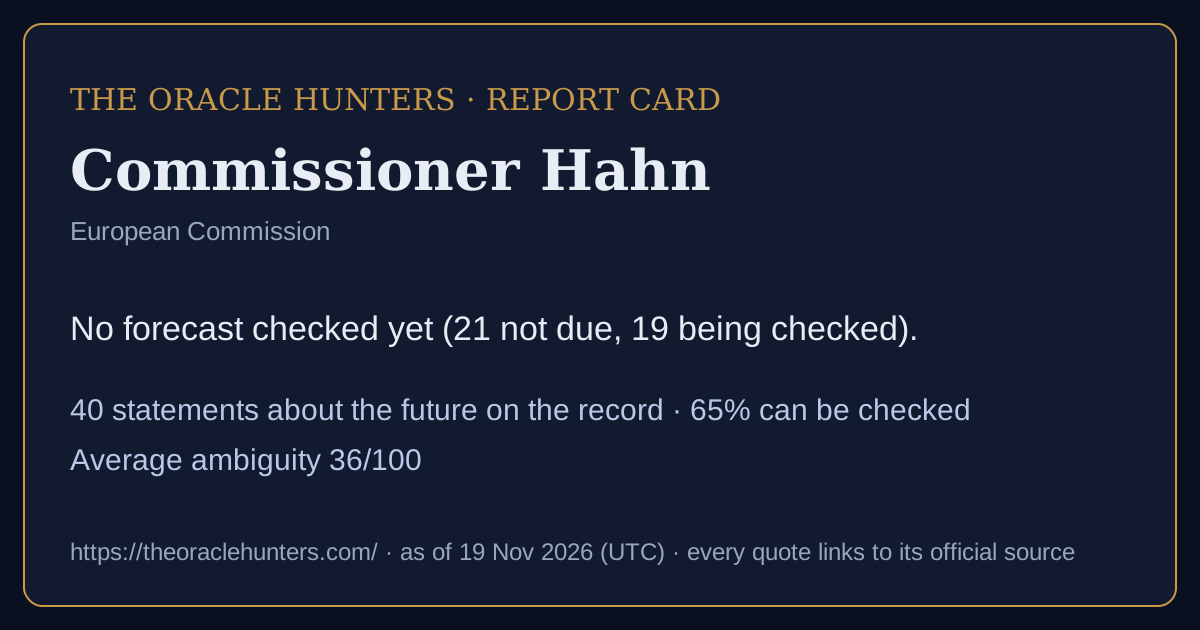
Commissioner Hahn
European Commission · EU
Track record: No forecast checked yet (21 not due, 19 being checked).
40forecasts & commitments on the record
65%can be checked as stated
36average ambiguity (0-100)
0goalpost moves recorded
0confirmed U-turns
Timeline
came true partly did not not due / being checked / too vague
Calibration score: shown after 10 checked forecasts with a stated likelihood (now 0).
How they speak about the future: based on data 37, stated on authority 3.
Kinds of claim: forecast 27, mixed claim 10, commitment 2, scenario (if… then) 1. · Download this report card as a picture
In the nine words
πρόγνωσιςInference from evidence34 · 85%μαντείαInspired knowledge3 · 8%προαναγγελίαPublic pre-announcement2 · 5%πρόνοιαPreparing for the future1 · 2%
How to read this
Each box is one sentence a public figure or institution said about the future, word for word, with a link to the official text. Can be checked means it names what will happen, by when, and how likely - so it can be compared with official figures later. Too vague to check means it does not. Ambiguity (0-100) is how many different ways the sentence can be read. When the date passes, the forecast is compared with official data and marked came true, partly or did not come true. Labels judge the sentence, never the person. Full guide and glossary.On the record (40)
Europe's future starts now: In less than 1000 hours almost 360 million Europeans are called to vote on their future by electing the European Parliament, followed by a new College which will present a new budget architecture leading into the next decade.
We will also reinforce these instruments except for cohesion policy by €10 billion, thus increasing their firepower.
With the Ukraine Facility with a volume of €50 billion over four years, we will establish a constant and predictable financing of Ukraine's most pressing needs.
Let me add some words on the specific situation in Ukraine and the role of the EU budget: the situation of the war in Ukraine today is different from what we have assumed in May of this year: the realities on the ground are that we are facing a prolonged situation of turmoil without a clear end date.
Almost 40% of NGEU's spending fuels climate measures and this investment will pay manifold returns:
With up to 250bn EU green bonds issued for NGEU we will further develop this market.
For example, energy efficiency and clean power projects – key to securing European independence from Russian fossil fuels in the long run – will receive respective investments in excess of €64.4 billion and €26.7 billion under the existing approved plans.
Almost 40% of the spending is allocated to climate measures and this investment will pay manifold returns:
Under our upcoming funding plan for the second half of 2022, which will be published in the coming days, we will provide to the market guidance on our expected NGEU issuances as well as a comprehensive overview of the total funding needs, included expected issuances for our Macro Financial Assistance and SURE programmes.
The other third will be subject to a proposal in 2023.
This own resources will contribute, according our calculations, between €2.5 and €4 billion per year (2018 prices) to the EU budget every year.
Once up and running, this own resource will contribute €12.5 billion (2018 prices) to the EU budget annually.
This is not the end of the story as we have today communicated our intention to present the second basket of new own resources already in 2023 (in the Interinstitutional Agreement we have committed to do it in 2024) but with this we will ensure that the full repayment of NextGenerationEU will be possible from the new own resources.
If we add everything together, we can expect revenue of around €15.8 until €17.3 billion per year (in 2018 prices) at least for the years 2026 until 2030 when we expect that the revenue flow will arise at cruising speed.
When in place, we will be able, according to our calculations, to generate €0.8 billion (2018 Prices) per year for the EU budget.
In this spirit, more than 50% of the multiannual financial framework and NextGenerationEU will go to new priorities, such as research and innovation, space, health – strengthening also our strategic sovereignty.
Our stimulus package has already shown the power of Europe as a learning Union: While it took 8 years to recover from the previous crisis, we expect all countries to be at or above pre-pandemic growth levels by the end of next year.
The tracking of these expenditures will be done by using EU climate coefficients, where expenditures are assigned a score (0%/40%/100%) based on their contribution to the green transition.
With a total investment of almost 1.2 (80% co-funded by the ERDF), this project facilitates the use of public administrations reaching more than 3.3 million people in 2023 (40% of the population).
Therefore, we will spend 30% of the EU funds to fight against climate change, the highest share ever of the largest European budget ever.
By the end of 2021, the Commission expects to raise some €80 billion in bonds, to be complemented by short-term EU-Bills, as per the funding plan published in June 2021.
Together with the EUR 78 billion of expected NGEU payments – corresponding to the annual amount of borrowing, almost EUR 250 billion will be available to boost the recovery of the EU economy in 2022.
The numbers do not yet incorporate the effects of NextGenerationEU, which could add a growth impulse of up to 2% in the longer run.
It will provide €672.5 billion in loans and grants to Member States to support reforms and investments over the next three years.
In our ‘Winter forecast', we predict a solid pick-up of growth in the second half of this year.
Overall, we expect a recovery of the Union economy of 3.7% in 2021 and of 3.9% in 2022 - which means a return to pre-pandemic GDP levels in 2022.
The Just Transition Fund, with a total budget of 17.5 billion Euros [2018 prices], will make sure the transition to climate neutrality works for all.
Moroever, 30% of the EU funds will be spent to fight climate change, the highest share ever and a key priority of this Parliament while the “do not harm principle” applies to the whole of the EU budget.
Unprecedented circumstances call for unprecedented responses, that is why, once adopted, the new long-term budget and NextGenerationEU will represent the largest package ever financed by the EU budget with a total of €1.8 trillion.
If we issue up to €100 billion, as foreseen via SURE, this will result in the social bond market tripled.
We will issue over €900 billion in bonds over the period to end-2026 – with most of it heavily concentrated in the period 2021-2024.
These will provide a powerful fiscal stimulus (7% of GDP) to the EU economy in 2021 and support an investment-led recovery.
We will issue nearly €1 trillion in bonds over the period to end 2026, volumes comparable to the largest sovereign issuers in Europe.
Under heading 3, Natural resources and environment, the European Agricultural Guarantee Fund (EAGF) and the European Agricultural Fund for Rural Development (EAFRD) measures will continue in 2021 under the rules of 2014-2020 [so-called transitional arrangements for 2021], but with the new amounts adjusted to the new MFF for 2021. [This is why Next Generation EU top-up for rural development will …
Next Generation EU will boost the financial firepower of the EU budget with €750 billion [or €809 billion in current prices].
It is in all of our interests to reach a swift agreement on the MFF, which will allow for a smooth adoption of the draft budget – so that we can implement programmes as of 1 January 2021.
The 2021 Budget will benefit from that firepower.
After all the crises measures taken in 2020, 2021 should be the year of recovery and the draft budget together with Next Generation EU will provide the much needed boost.
I very much hope it will be signed in the spring and concluded in the autumn so that it can enter into force early next year.
Of course, we will continue to assist you in this effort, both before and beyond June 2016.
Also said - not checkable as stated (12 newest)
Remarks about the future with no date, figure or likelihood that could be checked. They are kept on the record and shown here, but not scored.
We will need to be innovative to make our next long-term budget fit for the future.
That means: Only if we make the right budget choices today, we will have good policy choices tomorrow.
Unfortunately, we will be missing Prime Minister Tusk who is sick and whom we wish a speedy recovery.
We will assess what works for our industries and adapt.
Futureproofing of expenditure is key: Our climate and digital ambitions should run like a red thread in every programme, because our European budget works as seed financing – triggering European added value, for example, by supporting cross-border or cross-regional projects.
And finally, there need to be sufficient resources to stabilise exposed regions and partner countries such as the Western Balkans and Moldova which will also help to contain migration waves.
To facilitate the access of companies to the programmes, we will install a one stop shop, where we will provide guidance for the use of these instruments.
Therefore we will propose a special instrument, exclusively to cover interest costs overrun.
- a targeted approach by which we reinforce crucial policy areas which will strengthen the EU's competitiveness at global level and respond to the needs of Ukraine as well as external challenges, including migration.
By scaling-up key green technologies, we will make our energy cheaper, cleaner and safer.
Because only if we make the right budget choices today, we will have good political choices tomorrow.
And we will also emerge stronger now: indeed as a geopolitical Europe.