Commissioner Gentiloni
European Commission · EU
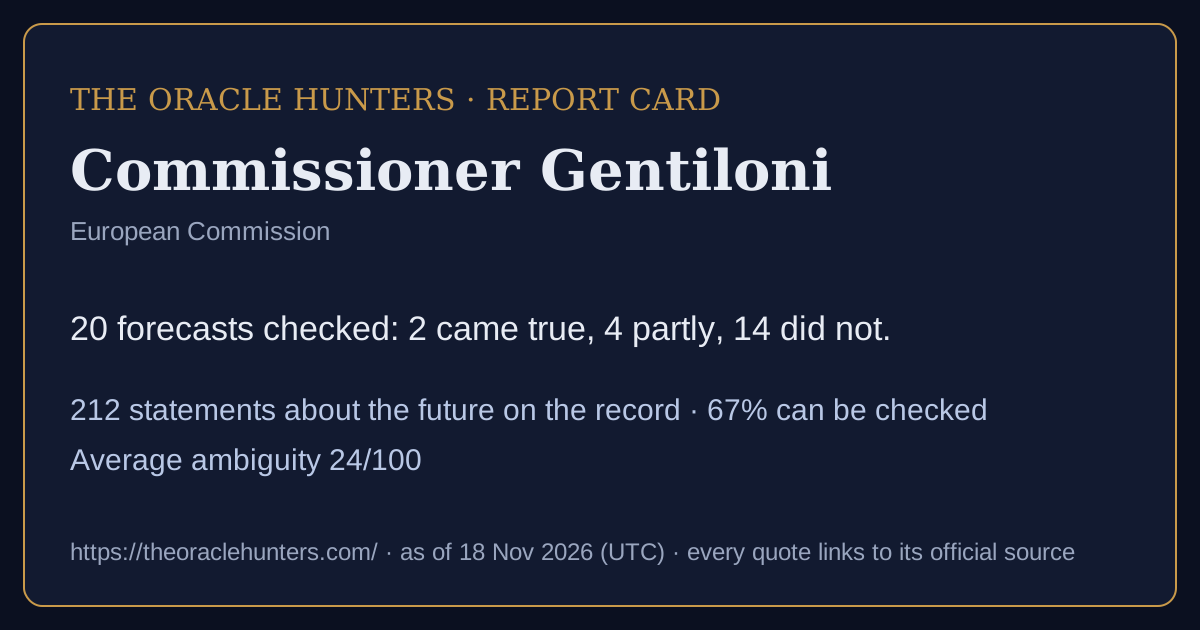
Track record: 20 forecasts checked: 2 came true, 4 partly, 14 did not.
212forecasts & commitments on the record
67%can be checked as stated
24average ambiguity (0-100)
0goalpost moves recorded
0confirmed U-turns
Timeline
came true partly did not not due / being checked / too vague
Calibration (Brier score, 0 is perfect, 0.25 is a coin toss): 0.36 over 20 checked forecasts.
How they speak about the future: based on data 178, stated on authority 34.
Kinds of claim: forecast 165, mixed claim 42, commitment 5. · Download this report card as a picture
In the nine words
πρόγνωσιςInference from evidence175 · 83%μαντείαInspired knowledge30 · 14%προαναγγελίαPublic pre-announcement5 · 2%πρόβλεψιςSeeing the signs2 · 1%
How to read this
Each box is one sentence a public figure or institution said about the future, word for word, with a link to the official text. Can be checked means it names what will happen, by when, and how likely - so it can be compared with official figures later. Too vague to check means it does not. Ambiguity (0-100) is how many different ways the sentence can be read. When the date passes, the forecast is compared with official data and marked came true, partly or did not come true. Labels judge the sentence, never the person. Full guide and glossary.Checked
Today's forecast lowers the projections for inflation in the EU this year – to an average of 3.0%, from 3.5% in the Autumn Forecast.
Partly came true. Said: inflation around 3% in 2024. Official figure for European Union: 2.4% (World Bank open data). Close: outside the margin, but within one more half point. Off by 0.6 points. official data · checked 14 Nov 2026 · automatic check against official data (rules v3)
In France, annual real GDP is expected to increase by 2.4% in 2022 and by 1.4% in 2023.
Came true. Said: economic growth around 1.4% in 2023. Official figure for France: 1.4% (World Bank open data). On target. Off by 0.0 points. official data · checked 14 Nov 2026 · automatic check against official data (rules v3)
In Germany, real GDP is expected to increase by 1.4% in 2022 and 1.3% in 2023.
Did not come true. Said: economic growth around 1.3% in 2023. Official figure for Germany: -0.9% (World Bank open data). Missed. Off by 2.2 points. official data · checked 14 Nov 2026 · automatic check against official data (rules v3)
On an annual basis, inflation in the euro area is projected to reach 6.1% in 2022, before falling to 2.7% in 2023.
Did not come true. Said: inflation around 2.7% in 2023. Official figure for Euro area: 5.9% (World Bank open data). Missed. Off by 3.2 points. official data · checked 14 Nov 2026 · automatic check against official data (rules v3)
GDP in the EU is now expected to increase by 4.0% in 2022 and 2.8% in 2023.
Did not come true. Said: economic growth around 2.8% in 2023. Official figure for European Union: 0.4% (World Bank open data). Missed. Off by 2.4 points. official data · checked 14 Nov 2026 · automatic check against official data (rules v3)
In Germany, after growing by 2.8% last year, real GDP is expected to increase by 3.6% in 2022 and 2.6% in 2023.
Did not come true. Said: economic growth around 2.6% in 2023. Official figure for Germany: -0.9% (World Bank open data). Missed. Off by 3.5 points. official data · checked 14 Nov 2026 · automatic check against official data (rules v3)
For Italy, real GDP growth is expected to reach 5.0% this year and 4.2% in 2022.
Partly came true. Said: economic growth around 4.2% in 2022. Official figure for Italy: 4.8% (World Bank open data). Close: outside the margin, but within one more half point. Off by 0.6 points. official data · checked 14 Nov 2026 · automatic check against official data (rules v3)
In France, annual real GDP is expected to increase by 6.0% in 2021 and by 4.2% in 2022.
Did not come true. Said: economic growth around 4.2% in 2022. Official figure for France: 2.7% (World Bank open data). Missed. Off by 1.5 points. official data · checked 14 Nov 2026 · automatic check against official data (rules v3)
In Germany, real GDP is expected to increase by 3.6% this year and 4.6% in 2022.
Did not come true. Said: economic growth around 4.6% in 2022. Official figure for Germany: 1.8% (World Bank open data). Missed. Off by 2.8 points. official data · checked 14 Nov 2026 · automatic check against official data (rules v3)
In the euro area, GDP growth is forecast at 4.3 this year and 4.4% next year.
Partly came true. Said: economic growth around 4.4% in 2022. Official figure for Euro area: 3.7% (World Bank open data). Close: outside the margin, but within one more half point. Off by 0.7 points. official data · checked 14 Nov 2026 · automatic check against official data (rules v3)
Overall, inflation in the euro area is expected to increase from 0.3% last year to 1.4% in 2021 and 1.3% in 2022.
Did not come true. Said: inflation around 1.3% in 2022. Official figure for Euro area: 8.5% (World Bank open data). Missed. Off by 7.2 points. official data · checked 14 Nov 2026 · automatic check against official data (rules v3)
Overall, EU GDP is now forecast to grow by about 3.7% this year and 3.9% in 2022 after a contraction estimated at 6.3% last year.
Came true. Said: economic growth around 3.9% in 2022. Official figure for European Union: 3.6% (World Bank open data). On target. Off by 0.3 points. official data · checked 14 Nov 2026 · automatic check against official data (rules v3)
Reflecting these developments, the EU unemployment rate is expected to increase from 6.7% in 2019 to 7.7% in 2020 and 8.6% in 2021.
Did not come true. Said: unemployment around 8.6% in 2021. Official figure for European Union: 7.0% (World Bank open data). Missed. Off by 1.6 points. official data · checked 14 Nov 2026 · automatic check against official data (rules v3)
Overall, EU GDP is forecast to contract by 7.4% this year, before growing 4.1% in 2021 and 3.0% in 2022.
Did not come true. Said: economic growth around 4.1% in 2021. Official figure for European Union: 6.4% (World Bank open data). Missed. Off by 2.3 points. official data · checked 14 Nov 2026 · automatic check against official data (rules v3)
Overall, EU inflation should reach 0.6% this year and 1.3% next year.All EU economies are expected to shrink this year, and all are also forecast to growth in 2021 and 2022.
Did not come true. Said: inflation around 1.3% in 2021. Official figure for European Union: 2.6% (World Bank open data). Missed. Off by 1.2 points. official data · checked 14 Nov 2026 · automatic check against official data (rules v3)
For the EU as a whole, the economy is forecast to contract by 8.3% in 2020 and grow by 5.8% in 2021.
Partly came true. Said: economic growth around 5.8% in 2021. Official figure for European Union: 6.4% (World Bank open data). Close: outside the margin, but within one more half point. Off by 0.6 points. official data · checked 14 Nov 2026 · automatic check against official data (rules v3)
Overall, euro area headline inflation is forecast to average 0.3% in 2020 and to increase to 1.1% in 2021.
Did not come true. Said: inflation around 1.1% in 2021. Official figure for Euro area: 2.5% (World Bank open data). Missed. Off by 1.4 points. official data · checked 14 Nov 2026 · automatic check against official data (rules v3)
In the EU, inflation is forecast to reach 0.6% this year and 1.3% next year.
Did not come true. Said: inflation around 1.3% in 2021. Official figure for European Union: 2.6% (World Bank open data). Missed. Off by 1.2 points. official data · checked 14 Nov 2026 · automatic check against official data (rules v3)
Overall, inflation in the euro area is projected at 0.2% this year and 1.1% in 2021.
Did not come true. Said: inflation around 1.1% in 2021. Official figure for Euro area: 2.5% (World Bank open data). Missed. Off by 1.4 points. official data · checked 14 Nov 2026 · automatic check against official data (rules v3)
The EU unemployment rate is expected to increase from 6.7% last year to about to 9% this year.
Did not come true. Said: unemployment around 9% in 2020. Official figure for European Union: 7.1% (World Bank open data). Missed. Off by 1.9 points. official data · checked 14 Nov 2026 · automatic check against official data (rules v3)
On the record (212)
The RRF will help to fill that investment gap, at least until its expiry in 2026.
By the end of this year, our expectation is that over half of all milestones and targets will have been reached.
Criticism of the RRF points to the fact that yes, there was a strong post-Covid rebound, but growth has slowed down. 11 Member States saw negative growth last year and we only expect an acceleration of economic activity in the second half of this year.
The EU's public investment ratio is expected to rise to 3.5% of GDP in 2025, up from 3.0% in 2019.
It is providing the firepower that will allow our investment gap to be filled, at least until 2026 when the programme is set to expire.
We have estimated at €650 billion the annual additional investment needs up to 2030 for the green and digital transition, and neither of them of course will be over by that date.
Our latest Economic forecast expects growth to pick up moderately in the second half of this year and to accelerate somewhat in 2025, even though we are talking about relatively modest figures: 0.8% in 2024 and 1.5% in 2025 for the euro area.
Our simulations indicate that these investments could boost the level of Spanish GDP by up to 3.5% in 2025.
In 2024 and 2025, growth is projected to accelerate to 2.7% and 3.2%, respectively.
Economic activity is forecast to expand by 0.7% in 2024 (0.2 less than in Autumn) and to accelerate to 1.2% in 2025.
GDP is expected to grow by 0.9% (0.3 less than in Autumn) in 2024 and 1.3% in 2025, driven by private consumption, thanks to rising real wages, and by recovering investment.
At the cut-off date of this forecast, futures gas prices based on the TTF benchmark were around 45% in 2024 and 30% in 2025 lower than assumed in autumn, reflecting also very high gas inventory levels and subdued demand.
Global trade growth (excluding the EU) is expected to rebound by 3.5% in 2024 and 3.7% in 2025 after the low growth rates seen in 2023.
Today's forecast lowers the projections for inflation in the EU this year – to an average of 3.0%, from 3.5% in the Autumn Forecast.
Partly came true. Said: inflation around 3% in 2024. Official figure for European Union: 2.4% (World Bank open data). Close: outside the margin, but within one more half point. Off by 0.6 points. official data · checked 14 Nov 2026 · automatic check against official data (rules v3)
These funds will ensure that our investment gap is filled, at least until 2026 when the RRF is set to expire.
And even though we are expecting growth to pick up this year and in 2025, there are concerns that this gap will only widen further, for a number of reasons.
But Europe's investment challenges will not end with the planned conclusion of the RRF in 2026 and InvestEU in 2027.
Our latest Economic Forecast, which I presented last week, sees GDP expanding by 0.6% this year and then pick up at 1.3% next year.
But as our economies continue to grapple with still high – albeit declining – inflation, with increased public debt, with higher interest rates, a more restrictive fiscal stance is warranted for next year.
Energy prices, headline inflation and now also core inflation have been falling, though at 6.1% in May, headline inflation remains high.
GDP is expected to expand at a similar rate next year, by 1.1%, thanks to a recovery in consumption, while the contribution from investments and external demand slows down.
The economy is expected to gain momentum in 2024, reaching 1.4% growth thanks mainly to higher consumption.
GDP is forecast to grow by a subdued 0.2% in 2023, led by net exports, before accelerating to 1.4% growth next year, led by investment and especially consumption.
Overall annual GDP growth is projected for 2024 at 1.7% in the EU, 1.6% in the euro area.
In the first quarter of this year, GDP grew by 0.3% in the EU, which is slightly above the projection in our Winter Forecast.
Over the forecast horizon, absorption of RRF grants is set to increase from 0.3% of GDP in 2022 to around 0.4% of GDP in both 2023 and 2024.
As we noted in our Winter Forecast last month, the euro area economy entered this year on a slightly better than expected situation than expected a few months ago.
Well, the outlook is different: We can now be confident that the euro area will avoid a recession this year.
Energy prices remain well above the levels seen in recent years and may remain volatile, while supply shortages might re-emerge in the coming months.
Next year, the Commission will propose a single set of tax rules for doing business in Europe – we call it BEFIT, which stands for Business in Europe: Framework for income Taxation.
Next month we will put forward a proposal on this.
Unemployment remains at a historic low, but the outlook for next year has weakened significantly.
The Autumn Economic Forecast I presented two weeks ago sees the EU economy growing by only 0.3% in 2023 before a progressive recovery to 1.6% in 2024.
This will result in a fiscal impulse of around 2% of GDP for this year.
In the first quarter of 2023, we will also provide guidance for 2024, reflecting, among others, our orientations for a reform of the EU fiscal framework, provided a sufficient degree of convergence across Member States is achieved by that time.
This figure may seem significant, but it is actually less than half of the amounts – roughly 100 billion – paid by Europe every year for Russian energy.
We have estimated that reducing our reliance on Russian fossil fuels will require about 210 billion euros of additional investments by 2027, or roughly 42 billion euros per year.
The IMF's latest World Economic Outlook published on Tuesday expects global growth to slow from 6.0 percent in 2021 to 3.2 percent in 2022 and 2.7 percent in 2023.
The euro area is forecast to shrink in the final months of this year, but overall growth for 2022 should come in at 3.1%, compared to 1.6% in the U.S. The picture for next year is set to be markedly less benign, with euro area growth at just 0.5% according to the IMF.
And we are actively working with our Member States to reach an agreement by the end of the year, to enable the disbursement of the remaining €3 billion.
Of that amount, €1 billion was disbursed over the summer and a further €5 billion will be paid out by the end of the year, starting this month, and then in November and December.
And we will be assessing the upcoming draft budgetary plans of the Member States for 2023 also from this perspective.
Of course, we expect this figure to rise substantially before the end of the year because these kinds of measures are being taken by the day.
But the latest sentiment indicators and the global overall situation, figures on prices, inflation, energy, all point to slowing economic momentum in the coming months.
The Commission will continue to discuss these issues with Member States and the ECB as we work to prepare a balanced legislative proposal for 2023.
In Italy, growth is expected to reach 2.9% in 2022 and to decelerate to 0.9% in 2023.
In France, annual real GDP is expected to increase by 2.4% in 2022 and by 1.4% in 2023.
Came true. Said: economic growth around 1.4% in 2023. Official figure for France: 1.4% (World Bank open data). On target. Off by 0.0 points. official data · checked 14 Nov 2026 · automatic check against official data (rules v3)
In Germany, real GDP is expected to increase by 1.4% in 2022 and 1.3% in 2023.
Did not come true. Said: economic growth around 1.3% in 2023. Official figure for Germany: -0.9% (World Bank open data). Missed. Off by 2.2 points. official data · checked 14 Nov 2026 · automatic check against official data (rules v3)
Overall, real global GDP (excluding the EU) is now expected to grow by 3.0% in 2022 and 3.3% in 2023.
One could say the European economy is moving from a phase of slowing growth to one of putting on the brakes.Growth next year is now projected at 1.5%, 0.8 pps lower compared to the Spring Forecast.
Showing the newest 50 - the ledger has all 212.
Also said - not checkable as stated (12 newest)
Remarks about the future with no date, figure or likelihood that could be checked. They are kept on the record and shown here, but not scored.
Later today, we will hear many more stories of transformative projects made possible by the RRF.
We will be discussing this very topic at this Friday's ECOFIN Council in Luxembourg.
While we strive to reach an agreement on a broad package of reforms, we should not underestimate the contribution that could come from the finalisation of some legislative proposals that are already on the table.
As we look ahead, Europe must think about setting common objectives and common projects that will be financed jointly.
We will not win the race for competitiveness with regulations alone.
Over the course of today, we will hear many stories of how these investments are transforming the country.
Just as important will be to enhance coordination among authorities at all levels and to improve the communication of funding opportunities.
The European economy returned to its pre-pandemic output level by the third quarter of 2021 – sooner than expected.
And we should bear in mind that these estimates do not include the positive impact of structural reforms, so the overall boost to growth should be still larger over the long term.
And the choices we will make in the coming months will be decisive.
Europe should therefore keep its long-term ambition, as we have done with our proposal for the 2040 climate targets which we put forward just this week.
We must frame the Green Deal as a project to promote strong, sustainable economic growth and the competitiveness of Europe's industry.