Commissioner Dombrovskis
European Commission · EU
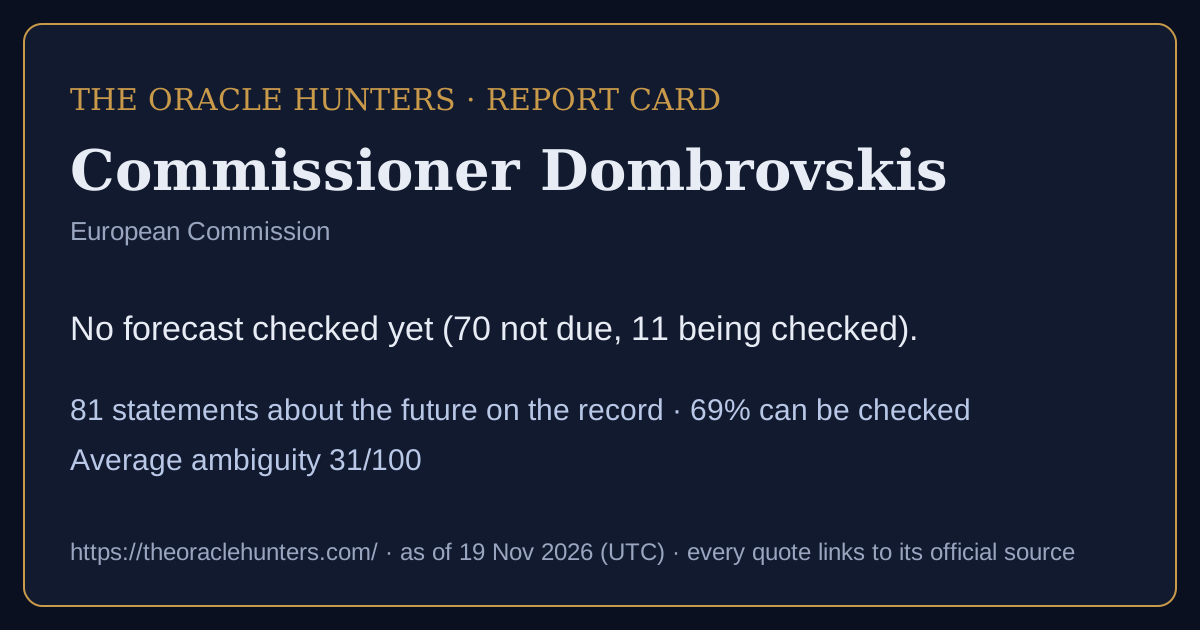
Track record: No forecast checked yet (70 not due, 11 being checked).
81forecasts & commitments on the record
69%can be checked as stated
31average ambiguity (0-100)
0goalpost moves recorded
0confirmed U-turns
Timeline
came true partly did not not due / being checked / too vague
Calibration score: shown after 10 checked forecasts with a stated likelihood (now 0).
How they speak about the future: based on data 60, stated on authority 19, educated guess 2.
Kinds of claim: forecast 62, mixed claim 9, commitment 8, scenario (if… then) 2. · Download this report card as a picture
In the nine words
πρόγνωσιςInference from evidence59 · 73%μαντείαInspired knowledge12 · 15%προαναγγελίαPublic pre-announcement8 · 10%πρόνοιαPreparing for the future2 · 2%
How to read this
Each box is one sentence a public figure or institution said about the future, word for word, with a link to the official text. Can be checked means it names what will happen, by when, and how likely - so it can be compared with official figures later. Too vague to check means it does not. Ambiguity (0-100) is how many different ways the sentence can be read. When the date passes, the forecast is compared with official data and marked came true, partly or did not come true. Labels judge the sentence, never the person. Full guide and glossary.On the record (81)
The results of this Fitness Check will inform the upcoming Digital Transformation Package, scheduled for the second quarter of next year.
Private consumption growth is projected to decelerate from 1.6% in 2025 to 1.3% this year and 1.1% in 2027.
Looking beyond Europe, global growth – excluding the EU – is now projected at 3.2% this year.
Euro area inflation is expected to follow broadly similar dynamics, averaging 3.2% this year and 3.1% next year.
Overall, headline inflation in the EU is expected to peak above 4% between the end of this year and the beginning of 2027.
And we expect growth to continue, at 1.4% in 2027 and 1.5% in 2028.
The EU economy is holding up better than expected this year, with growth expected to reach 1.4% in 2026.
Spending is projected to rise further to €454 billion in 2026, reflecting Member States' continued efforts to strengthen Europe's defence capabilities and readiness.
Early next year, the Commission will launch AGILE.
And our €7.3 billion European Defence Fund is supporting companies across the EU develop projects that will deliver innovative and interoperable defence technologies and equipment.
Latvia, our host for today, is at the forefront of this collective effort, with its defence spending set to reach 5% of GDP next year.
We expect NextGenerationEU to have raised EU real GDP by 1.4% in 2026 compared to a scenario without the RRF.
And we will assess the remaining before the end of the year.
A new electricity interconnection with the EU market will soon diminish that vulnerability and further strengthen Moldova's energy security, even if, as we know, it will not make global price shocks disappear.
We will, therefore, reduce unnecessary overlaps and reporting costs, bring MREL closer to TLAC, streamline the macroprudential toolkit, and review the output floor, unrated corporates, software assets and remuneration framework to strengthen banks' competitiveness.
Overall, GDP growth in the EU is projected to be 1.1% in 2026, before edging up in 2027 to 1.4%.
Private consumption growth is projected to decelerate sharply to 1.1% in 2026, before picking up to 1.3% in 2027.
Inflation in the euro area is expected to follow a similar pattern, reaching 3.0% this year, before easing to 2.3% next year.
All in all, headline inflation in the EU is projected to reach 3.1% this year, before easing to 2.4% next year.
Energy inflation is expected to rise further in May and June in both the EU and euro area [peaking above 11% year on year in the second quarter] and remain elevated until early next year.
However, even by the end of 2027, prices will remain at around 20% above the levels expected by markets before the conflict's outbreak.
You might be surprised to learn that the EU produces 22% of global AI research journal articles, compared to 17% by researchers based in the US.
Those 12 areas, ranging from the free movement of goods and services to housing and permitting, for instance, will be examined with priority in 2026 and 2027.
Our ‘regulatory deep cleaning' will come on top of the simplification proposals already foreseen for this year in areas such as energy products, taxation and citizens' rights.
We will prioritise reviewing 12 areas in 2026 and 2027 – ranging, from the free movement of goods and services to housing and permitting, to give some examples.
And we will deliver a further €90 billion this year and next, which will include support for Ukraine's energy sector.
On trade, the EU will remain an open market that plays by the rules.
If supply disruptions prove more substantial and longer-lasting, the negative consequences for growth could be even higher.
Inflation in this case could be up to 1 percentage point higher.
The growth could be up to 0.4-0.6 points lower and inflation up to 1.1-1.5 points higher in both 2026 and 2027.
The analysis undertaken by the Commission found that EU growth this year could be around 0.2-0.4 percentage points lower than projected in the Autumn Economic Forecast, under a short-lived disruption scenario.
And inflation could be up to 1 percentage point higher.
In such a scenario, our analysis suggests that EU growth in 2026 could be around 0.4 percentage points lower than projected in our Autumn Economic Forecast.
Growth could be up to 0.6 percentage points lower in both 2026 and 2027.
By the end of 2029, we will stress test the entire body of the EU acquis.
These include the Security Action for Europe, or SAFE instrument, through which the EU budget will provide up to €150 billion in loans to Member States to support defence investments.
Growth is projected to be 1.4% this year and 1.5% next year.
The Readiness 2030 agenda will mobilise up to €800 billion for defence spending, including €150 billion through the new SAFE instrument.
Together with the EIB Group, we will already mobilise €10 billion today.
The EU will also invest in 2026 €20 million in AI- and data-driven tools that enable earlier diagnosis, better risk prediction and more personalised prevention.
We will also modernise the rules on tobacco control in 2026.
So, we have made a good start towards reaching the overall target of €37.5 billion in annual administrative cost savings by the end of this Commission's mandate in 2029.
This represents around one-fifth of the overall target of €37.5 billion in annual administrative cost savings by the end of this Commission's mandate in 2029.
However, thanks to the 1.5% of GDP cap on additional expenditure, the impact will remain contained.
Looking beyond 1 January 2026, maintaining discipline and sustaining the momentum for positive reforms will reinforce and amplify the benefits that membership of the euro area provides.
This includes the EU's new €150 billion SAFE instrument, which will finance investments in key areas such as missile defence, drones, and cyber security.
On public finances: Bulgaria has one of the lowest levels of public debt in the European Union standing at just 25% of GDP, while its budget deficit for this year is expected to remain below 3%.
But, at the same time looking ahead, the growth outlook for 2026 has softened somewhat compared with our spring projections.
This year, the euro area economy is in slightly better shape than we had expected in the spring.
In 2026, the euro area will welcome its 21st member, Bulgaria.
Showing the newest 50 - the ledger has all 81.
Also said - not checkable as stated (12 newest)
Remarks about the future with no date, figure or likelihood that could be checked. They are kept on the record and shown here, but not scored.
And the Commission will support this, with practical transposition guidance, best-practice toolkits, and AI-assisted tools that spot unnecessary national additions early.
And we will apply “simplicity by design” throughout the policy cycle – from design to application, monitoring and enforcement.
We will also keep stress-testing our rules and extend this to the entire EU acquis by the end of the mandate.
Wherever we find inconsistencies, duplication or fragmentation, we will come forward with concrete proposals – to simplify, codify, or repeal.
At the same time, we will continue our stress-testing efforts, extending them to the entire EU acquis by the end of the mandate.
And we will apply “simplicity by design” throughout the policy cycle: from design to application, monitoring and enforcement.
Priority areas for work on simplification will include banking, transport, housing and digital rules, as well as the acceleration of permitting procedures.
We are determined that they will not succeed.
By the end of the year, we aim to sign the EU-Ukraine Defence Industry Pact.
But also how we will approach lawmaking and regulation in future.
And if so, what are the available options, their expected costs, benefits and trade-offs?
We will continue to analyse these impacts.