Commissioner Dalli
European Commission · EU
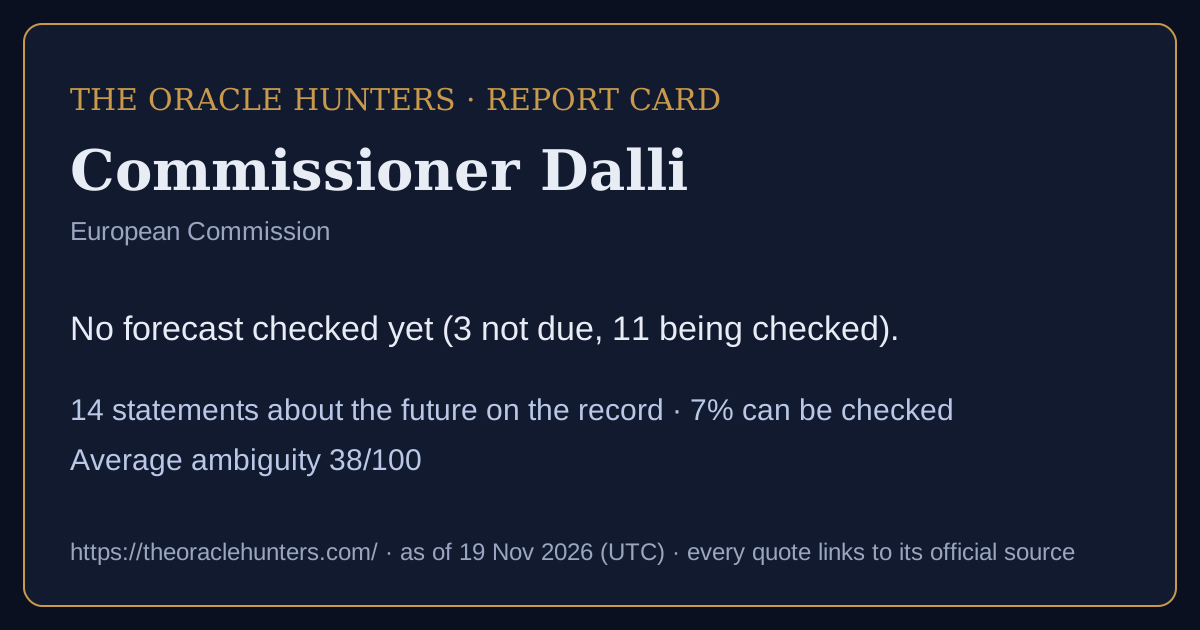
Track record: No forecast checked yet (3 not due, 11 being checked).
14forecasts & commitments on the record
7%can be checked as stated
38average ambiguity (0-100)
0goalpost moves recorded
0confirmed U-turns
Timeline
came true partly did not not due / being checked / too vague
Calibration score: shown after 10 checked forecasts with a stated likelihood (now 0).
How they speak about the future: based on data 8, stated on authority 6.
Kinds of claim: forecast 9, mixed claim 3, commitment 1, scenario (if… then) 1. · Download this report card as a picture
In the nine words
πρόγνωσιςInference from evidence6 · 43%μαντείαInspired knowledge6 · 43%πρόνοιαPreparing for the future1 · 7%προαναγγελίαPublic pre-announcement1 · 7%
How to read this
Each box is one sentence a public figure or institution said about the future, word for word, with a link to the official text. Can be checked means it names what will happen, by when, and how likely - so it can be compared with official figures later. Too vague to check means it does not. Ambiguity (0-100) is how many different ways the sentence can be read. When the date passes, the forecast is compared with official data and marked came true, partly or did not come true. Labels judge the sentence, never the person. Full guide and glossary.On the record (14)
The Commission will also present by 2024 a European Quality Framework for Social Services of Excellence for persons with disabilities.
By 2023, the Commission will issue guidance to Member States, recommending improvements on independent living and inclusion in the community.
Besides, we will adopt a Strategy on Combatting Anti-Semitism by the end of this year.
We will hold another European Anti-racism Summit next year – hopefully not online – which will be an important moment to reflect on the actions taken after today's discussion, and a marking of our continued commitment to tackle racism in our Union.
But if the report shows a pay difference of 5% or more in any category of workers that cannot be justified by objective gender-neutral criteria, the employer will be required to carry out a joint pay assessment together with the workers' representatives.
A European resource centre, AccessibleEU, will be launched next year.
By 2022, the Commission will put forward any legislation required, which may include the reinforcement of the role of equality bodies.
To tackle discrimination on the ground of sexual orientation, the Commission will ensure rigorous application of the Employment Equality Directive and will report on the Directive's implementation in 2021.
With the targets that we have laid out in the Strategic Framework today, we expect to make real progress by 2030.
The inclusion of clear targets for each of these areas is new and ambitious, but clearly necessary to ensure that in ten years we will have clearly focused on delivering for the 6 million Roma within our Member States.
And the binding measures will be issued by the end of the year after we have consulted with social partners.
Importantly, we need to seem connected because we will see other strategies coming out by the end of this year: LGTBI+ Strategy, a Strategy for Roma inclusion, next year there will be a new Strategy on disability.
The Commission's upcoming initiative will also reflect the results of previous stakeholder consultations, such as the high-level conference organised in cooperation with the Finnish Presidency in September of last year, the Eurobarometer results, and the results of the second LGBTI survey of the Fundamental Rights Agency - which will be presented next month.
To help bring this gap down, I will introduce binding pay transparency measures before the end of the year.
Also said - not checkable as stated (12 newest)
Remarks about the future with no date, figure or likelihood that could be checked. They are kept on the record and shown here, but not scored.
We will work with Member States to support full electoral participation and accessibility of the European elections.
And we will support stakeholders to address and alleviate the burden that COVID-19 imposes on mental health.
The Strategy is our joint tool to achieve that change and at today's high-level conference, we will chart the way forward.
The EU will support national, regional and local authorities in delivering deinstitutionalisation through EU funding and Member States' Recovery and Resilience Plans.
I therefore call on all Member States to adopt national anti-racism action plans by the end of 2022.
Member States have the duty to ensure that EU law is fully transposed and properly applied at national levels, and we will need strong political commitment from all the stakeholders to step up efforts to eradicate racism.
We will implement new actions to promote diversity and ensure a discrimination-free and an inclusive workplace for all people, irrespective of their racial or ethnic origin or skin colour.
All employers, regardless of their size, will have to provide the pay information to individual workers.
Employers will also need to report on any gender pay gap in each category of workers doing the same or equal work.
As for any EU directive, Member States will have to ensure that the results intended with the provisions are achieved.
Job applicants will receive information about the initial pay level for a job before they go to an interview.
The tools or methodologies may include gender-neutral job evaluation and classification systems.