Commissioner Avramopoulos
European Commission · EU
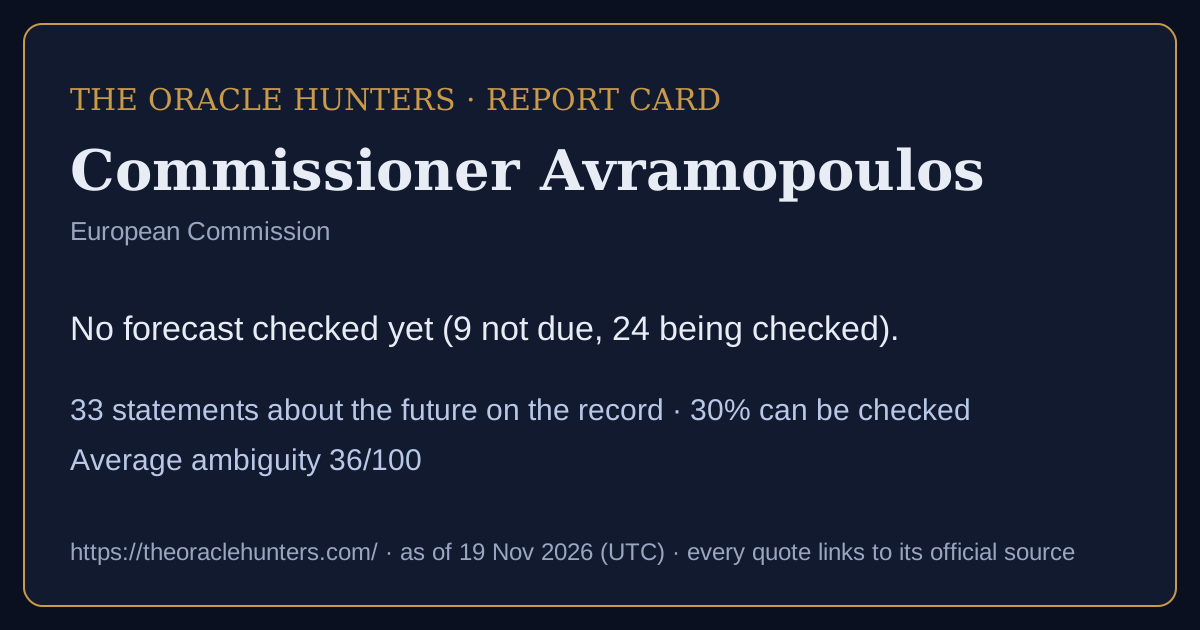
Track record: No forecast checked yet (9 not due, 24 being checked).
33forecasts & commitments on the record
30%can be checked as stated
36average ambiguity (0-100)
0goalpost moves recorded
0confirmed U-turns
Timeline
came true partly did not not due / being checked / too vague
Calibration score: shown after 10 checked forecasts with a stated likelihood (now 0).
How they speak about the future: based on data 22, stated on authority 11.
Kinds of claim: forecast 22, mixed claim 7, commitment 3, scenario (if… then) 1. · Download this report card as a picture
In the nine words
πρόγνωσιςInference from evidence19 · 58%μαντείαInspired knowledge10 · 30%προαναγγελίαPublic pre-announcement3 · 9%πρόνοιαPreparing for the future1 · 3%
How to read this
Each box is one sentence a public figure or institution said about the future, word for word, with a link to the official text. Can be checked means it names what will happen, by when, and how likely - so it can be compared with official figures later. Too vague to check means it does not. Ambiguity (0-100) is how many different ways the sentence can be read. When the date passes, the forecast is compared with official data and marked came true, partly or did not come true. Labels judge the sentence, never the person. Full guide and glossary.On the record (33)
And the EU's Regional Trust Fund for Syria has delivered over 75 projects worth more than €1.6 billion, focused on areas including education, livelihoods, health, and socio-economic support.
It will include the immediate obligation to insert alerts on terrorism, and is expected to be adopted next month.
Between 2021 and 2027, the Agency's budget will be beefed up to a total of almost €11.3 billion.
We will establish a standing corps of 10,000 operational EU staff by 2020.
We will propose a genuine European Border Police and set up a standing corps of 10,000 European Border guards by 2020 already.This will notably allow the Agency to boost its support to all Member States at all times.
The EU will do some further budgetary gymnastics to pitch in an extra €145 million now.
As you may remember, we also plan to reinforce the European Border and Coast Guard Agency with up to 10,000 staff by 2027 with an additional €12 billion approximately.
In Turkey, the EU is well on track to contract the €3 billion under the Facility for Refugees by the end of 2017.
We have delivered on our promise: almost 23,000 people will be resettled by the end of the year.
I would like to commend in particular Sweden that despite the high number of asylum seekers it received over the past years, will most probably manage to relocate more than 60 % of its allocation within 1 and a half months.
I have called on the Ministers today to find an agreement on these proposals with the European Parliament as soon as possible, so that the development of these systems could start still this year.
More than 650 persons will work in the Greek asylum service by the end of the year, compared to 350 in September.
First of all, a significant number of irregular migrants (about 60,000) still remains in Greece and could potentially move onwards to other Member States, if internal border controls are removed.
We equip them with what they need to bring the border management to a new level: By 2020, the Agency will include 1,000 staff members and will manage a budget of more than €320 million.
Let me be clear: our ultimate purpose is lifting all internal border controls no later than the end of the year – even if this may require in the meantime that we allow the extension of temporary border controls at specific points within the EU.
Finally, the evaluation of the operation and use of the Schengen Information System is ongoing and will be finalised by April 2016.
At the same time, we are also working to deliver on other issues: A modified proposal on Smart Borders will be presented by March 2016, as promised.
And as regards the fight against migrant smuggling, the Commission will propose to strengthen the existing legal framework later this year.
We will do so by strengthening the role of Frontex and by developing EU-wide standards, and we will also table a proposal for a European Border and Coast Guard by the end of the year.
I am hopeful that with further work the Council and Parliament will be able to reach an agreement by the end of the year.
That is why, as announced by President Juncker in his state of the Union Speech, the Commission will come with proposals to reinforce our border control policy by the end of the year.
That is why the Commission will put forward later this year a proposal for a fixed emergency system, to address future emergencies.
The remaining 7,744 will be allocated by December 2015.
We will propose for 2016 a higher dedicated budget of €16.2 million to make sure the Agency plays a key role in increasing the return of illegal migrants.
We will provide more than 8 million euros in financial support.
While the working age population in the European Union will decline by 17.5 million, foreign skilled workers that can complement our own will be important to support Europe’s economic development.
The numbers for 2015 show that even that peak may be mild in comparison to the one we will record this year. 70,000 asylum applications are already lodged every month in the EU since the beginning of 2015.
With the United Nations High Commissioner for Refugees, we want to bring safely and legally to the EU territory 20.000 refugees from third countries, and we will finance this action with 50 million euros.
We will strengthen Frontex so that migrants, who have no right to stay on European soil, will be repatriated.
Therefore, doing more and better to counter smuggling is a priority for the European Commissionand it will also be one of the main pillars of the European Agenda on Migration that we will adopt in May this year.
As part of my portfolio, this year, I will be presenting a European Agenda on Security in May.
A new Agenda for European Security will be presented in the coming months for the years 2015-2020.
Europe is an ageing continent and, without migration, the EU's working age population will decline by 15 million this decade alone (2010-2020).
Also said - not checkable as stated (12 newest)
Remarks about the future with no date, figure or likelihood that could be checked. They are kept on the record and shown here, but not scored.
Because here we have to be honest too: the phenomenon of migration will be with us for some time to come.
Do you remember how I was right here on this podium in May 2015, explaining what we would do to address the challenges of the emerging migration and refugee crisis?
Almost 63,000 refugees have been effectively resettled to the EU, and Member States have pledged another 30,000 resettlements for next year.
We therefore need to build on these positive results, and create a migration and asylum system that works for all.
Today, we will send off the joint European Border and Coast Guard Teams to be deployed as of tomorrow for the first time in a non-EU Member State.
The only way to effectively address migration and security challenges we are facing today and those we may be confronted with in the years to come is by working closer together, as neighbours and as partners.
Together with Albanian border guards, European Border and Coast Guard teams will be able to perform border checks at crossing points and perform border surveillance to prevent unauthorized border crossings and counter cross-border criminality.
European Border and Coast Guard Teams may only perform tasks and exercise powers in the Albanian territory under instructions from and, as a general rule, in the presence of border guards of the Republic of Albania.
The European Border and Coast Guard Status Agreement and its implementation will allow us to better work together in all these areas.
I also want to thank all Member States who have contributed with staff and the personnel who will be part of this first deployment of European Border and Coast Guard teams in a neighbouring country.
But no matter how secure and protected our external borders are, Europe will still have to uphold its duty to provide assistance to those fleeing war or persecutions.
Europe will still need to better manage migration within Europe, both of those staying legally and irregularly.