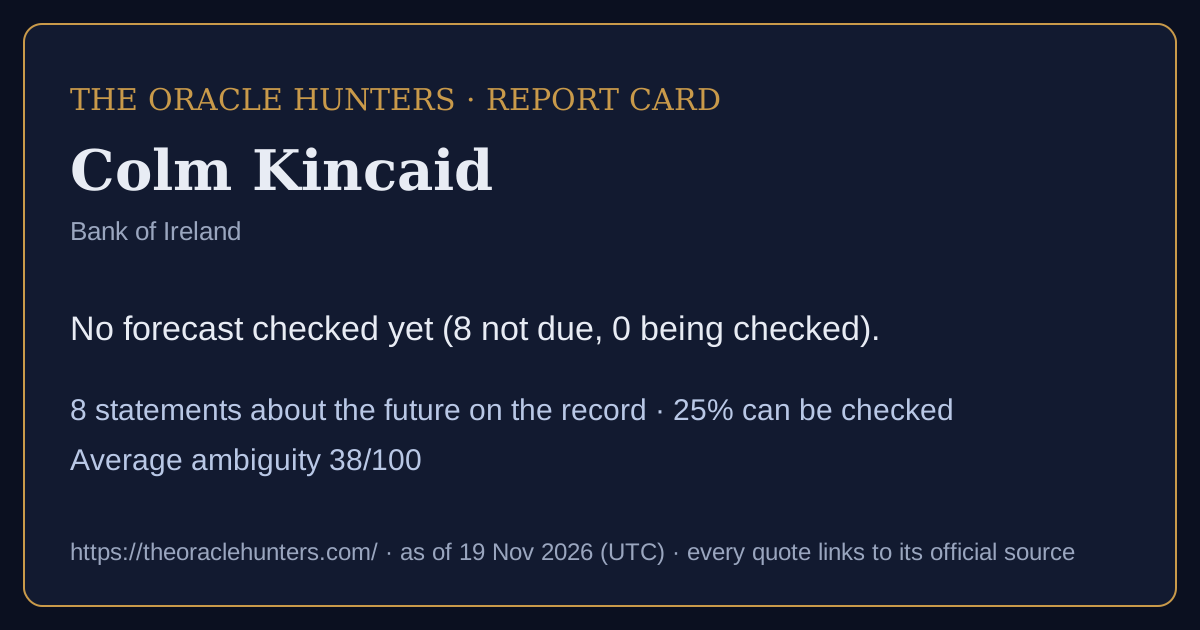
Colm Kincaid
Bank of Ireland
Track record: No forecast checked yet (8 not due, 0 being checked).
8forecasts & commitments on the record
25%can be checked as stated
38average ambiguity (0-100)
0goalpost moves recorded
0confirmed U-turns
Timeline
came true partly did not not due / being checked / too vague
Calibration score: shown after 10 checked forecasts with a stated likelihood (now 0).
How they speak about the future: based on data 5, stated on authority 3.
Kinds of claim: forecast 5, mixed claim 2, commitment 1. · Download this report card as a picture
In the nine words
πρόγνωσιςInference from evidence5 · 62%μαντείαInspired knowledge2 · 25%προαναγγελίαPublic pre-announcement1 · 12%
How to read this
Each box is one sentence a public figure or institution said about the future, word for word, with a link to the official text. Can be checked means it names what will happen, by when, and how likely - so it can be compared with official figures later. Too vague to check means it does not. Ambiguity (0-100) is how many different ways the sentence can be read. When the date passes, the forecast is compared with official data and marked came true, partly or did not come true. Labels judge the sentence, never the person. Full guide and glossary.On the record (8)
This year we will commence a cross-sectoral review of certain intermediary commission arrangements to understand how they are designed and managed to secure consumers' best interests.
And yes, the Central Bank will support credit unions in their implementation of the Code as we did for its coming into force for other sectors in March of this year.
As outlined in updated figures we published last week and have shared with the Committee the Irish (PDH) residential mortgage market comprises 698,445 loan accounts provided by a range of competing firms - banks (85.1%), non-bank lenders (5.3%) and firms who service existing mortgages but do not themselves lend, who I will call 'non-lending firms' (9.6%).
In 2026, this will include a joint meeting of that Working Party and FinCoNet to further advance our thinking on this and other aspects of financial consumer protection, education and inclusion.
At domestic level, the Central Bank of Ireland will bring a modernised Consumer Protection Code into force in March 2026.
The backdrop to today's event is the Central Bank of Ireland's new Consumer Protection Code. 4 It will come into force in March next year and contains modernised provisions on consumer vulnerability.
We will continue to arrange engagements such as this as we head towards the go-live date on 24 March 2026 and beyond.
face problems we will either solve together as a society or not at all (fraud, digital safety, climate change, increased complexity in how financial services are provided and used, geopolitical uncertainty - the list goes on).
Also said - not checkable as stated (12 newest)
Remarks about the future with no date, figure or likelihood that could be checked. They are kept on the record and shown here, but not scored.
We will need to leverage AI for data literacy, critical thinking, verification, service design, and cyber security.
We will need people who can build AI tools, people who can navigate them, and leaders who can traverse this intersection in a way that enhances productivity responsibly.
We will need to preserve the core human capabilities of context, empathy, judgement, that AI can support but should not own.
A strategy should express a view of the world, define the outcomes that matter and make choices about where the organisation will concentrate its attention and capability.
It should be clear enough to guide decisions when circumstances change, as they invariably will.
People will need to renew their skills more often.
It must also be fit for purpose for the times we are in, and the challenges we can anticipate.
We will also commence a review of how firms identify and treat customers in vulnerable circumstances - recognising vulnerability is not always a static, innate or permanent characteristic and that certain customers at certain times will require additional support.
Our Consumer Protection Code now includes specific provisions on how firms must manage the risk this inevitably brings that a consumer will purchase an unregulated product or service thinking it to be regulated.
Shortly, we will commence a review to ensure this new provision has been implemented properly.
Technology is increasing the pace at which consumers demand to receive services, the quality of the information they expect and the range of places they go to get advice about their finances (including via social media and AI).
And we will work to ensure that these requirements are properly implemented by the firms we regulate, who have a critical role to play in promoting financial literacy.