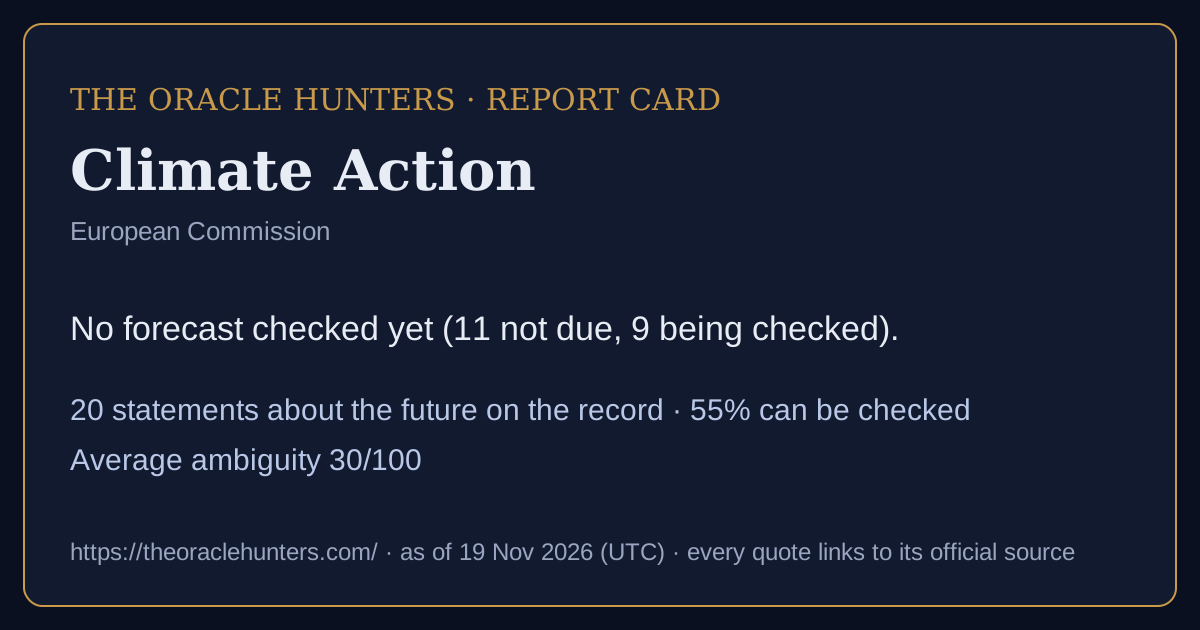
Climate Action
European Commission · EU
Track record: No forecast checked yet (11 not due, 9 being checked).
20forecasts & commitments on the record
55%can be checked as stated
30average ambiguity (0-100)
0goalpost moves recorded
0confirmed U-turns
Timeline
came true partly did not not due / being checked / too vague
Calibration score: shown after 10 checked forecasts with a stated likelihood (now 0).
How they speak about the future: based on data 16, stated on authority 4.
Kinds of claim: forecast 16, mixed claim 4. · Download this report card as a picture
In the nine words
How to read this
Each box is one sentence a public figure or institution said about the future, word for word, with a link to the official text. Can be checked means it names what will happen, by when, and how likely - so it can be compared with official figures later. Too vague to check means it does not. Ambiguity (0-100) is how many different ways the sentence can be read. When the date passes, the forecast is compared with official data and marked came true, partly or did not come true. Labels judge the sentence, never the person. Full guide and glossary.On the record (20)
The strategy will take a holistic look at the transitions necessary in key sectors of the economy, with the energy system – which is responsible for around 75% of Greenhouse Gas emissions - playing a central role.
Funding will be conditional on Member States meeting certain conditions, including that they do not fall below their 2020 renewables targets throughout the programming period.
But they could also include plans for renewables assets that reach the end of life before 2030.
This will serve as the architecture for the Energy Union and mechanism for achieving the Union's 2030 objectives, with Member States being required to outline a national strategy and submit national plans on how to achieve these targets.
The share of electricity in EU energy demand could go up to 27% in 2030 and close to 50% in 2050.
To put this into perspective for the power market, we expect that this would result in around 55% of electricity from renewables by 2030.
Moreover, with a contribution of €4.1 billion from the European Commission, the instrument called "External Investment Plan" is expected to leverage more than €44 billion of sustainable investments in Africa and the European neighbourhood by 2020.
With our Energy Union Strategy we bring forward a comprehensive and coherent policy framework up to 2030 that will deliver on our Paris commitments.
We are close to finalising all key legislation that will allow us to reach our target of cutting EU greenhouse gas emissions by at least 40% by 2030.
Regarding project financing, projects approved in the field of energy – with a priority on energy efficiency, renewable energy and energy infrastructure – represent already 24% of the total financing approved by the European Fund for Strategic Investments (EFSI).
I am glad to confirm that next year's Clean Energy Ministerial meeting will take place in Europe, and will be organised by the Nordic countries in cooperation with the European Commission.
Also because by the end of the year we will adopt the post 2020 emission standards for cars and vans and, there, we are considering options to set a dedicated target for zero and/or low emission vehicles.
According to our estimates, the 30% energy efficiency target will increase Europe's GDP of €70 billion, create about 400,000 new jobs – especially among SMEs - and reduce our gas imports by 12% by 2030.
The European Structural and Investment Funds (ESIF) will invest € 17 billion in energy efficiency during the period 2014-2020.
Unlocking that potential will be central to our strategy on Heating and Cooling which the Commission will propose next month.
And it is important for us to be clear about that when you consider that - overall - as much as $13.5 trillion of investment in clean energy technologies and energy efficiency will be needed to implement the INDCs.
Our proposals later this year will focus on increased regional co-operation for support schemes and ensuring that Europe stays world leader in clean energy innovation and research.
It is now more than 10 years that the EU put in place a price on carbon as an important part of the policy framework and we will continue to work this year with the co-legislators to make sure the reform of the ETS increases incentives for further deployment of renewable energy.
Furthermore, before the summer we will put forward a proposal for a revised effort sharing decision, setting 2030 emission targets for each Member State which will further incentivise energy efficiency and decarbonisation in those sectors not covered by the Emissions Trading System.
Later this year we will put forward our proposals on a new electricity market design to help embed renewables at the heart of our system.
Also said - not checkable as stated (9 newest)
Remarks about the future with no date, figure or likelihood that could be checked. They are kept on the record and shown here, but not scored.
We will need Ministerial leadership to achieve comprehensive, balanced, effective results that are consistent with the spirit of Paris.
We see the next two days as an opportunity for deeper and more detailed peer-to-peer conversations on the political differences that we will need to resolve if we are to ensure a successful conclusion to COP 24.
In addition, through the Talanoa Dialogue, the High Level Ministerial Dialogue on Climate Finance, and the stocktake on pre-2020 action, Parties should be prepared to share our achievements and the lessons we have learned so far, and on how we can advance action and raise ambition from now into the future.
This will include an update on the agreement of EU climate policies necessary for us to achieve our NDC, preparations for a new long term strategy to put us on track towards the Paris goals, and an EU Talanoa Dialogue, launched last week with the involvement of 600 stakeholders from across the EU and around the world.
Each of these recent developments in the EU shows that in addition to raising headline targets, ambition can emerge from the bottom-up: if we strengthen our policies, renewables and energy efficiency in this case, we should be able to achieve deeper cuts in our overall emissions.
It will ensure that we will not be locked in high polluting technologies and enable us to achieve our decarbonisation objectives.
I am confident that together we will achieve the goals of the Paris Agreement.
This is well beyond the capacity of the public sector, so private capital will also need to play its part.
In this context, I attach a lot of importance to two main elements: first, preserving the consistency between the different proposals of the Package and second, ensure that the legislation that we will adopt will be enforceable.