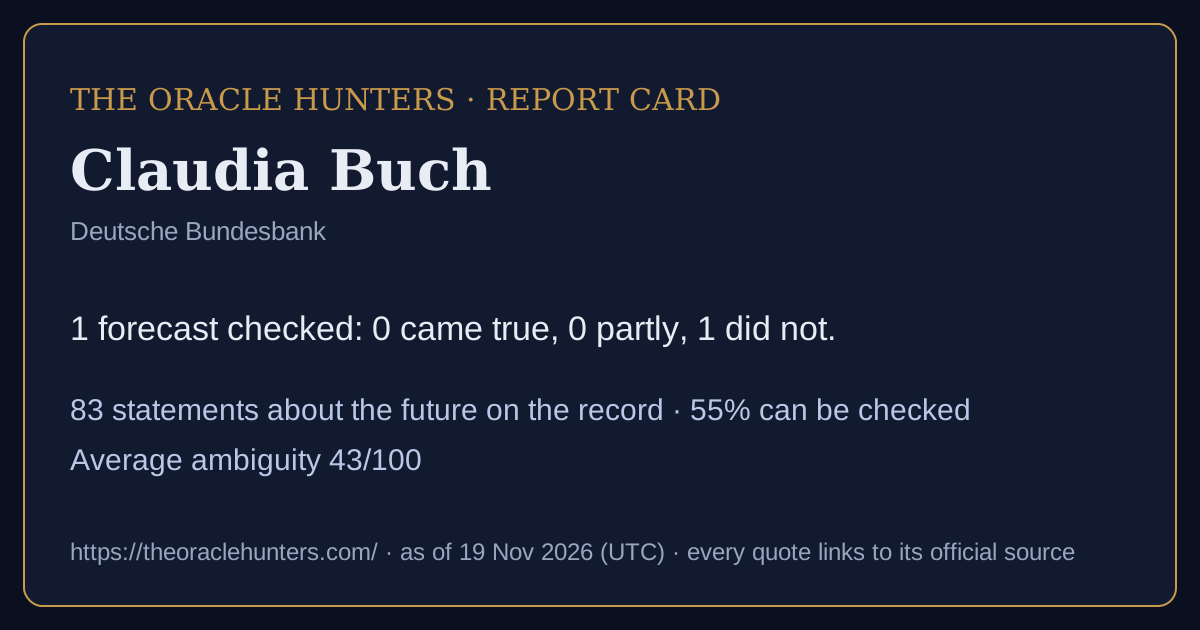
Claudia Buch
Deutsche Bundesbank
Track record: 1 forecast checked: 0 came true, 0 partly, 1 did not.
83forecasts & commitments on the record
55%can be checked as stated
43average ambiguity (0-100)
0goalpost moves recorded
0confirmed U-turns
Timeline
came true partly did not not due / being checked / too vague
Calibration score: shown after 10 checked forecasts with a stated likelihood (now 1).
How they speak about the future: based on data 61, educated guess 16, stated on authority 6.
Kinds of claim: forecast 63, scenario (if… then) 14, mixed claim 6. · Download this report card as a picture
In the nine words
πρόγνωσιςInference from evidence61 · 73%πρόνοιαPreparing for the future14 · 17%μαντείαInspired knowledge6 · 7%εἰκασίαConjecture2 · 2%
How to read this
Each box is one sentence a public figure or institution said about the future, word for word, with a link to the official text. Can be checked means it names what will happen, by when, and how likely - so it can be compared with official figures later. Too vague to check means it does not. Ambiguity (0-100) is how many different ways the sentence can be read. When the date passes, the forecast is compared with official data and marked came true, partly or did not come true. Labels judge the sentence, never the person. Full guide and glossary.Checked
The economy is projected to grow strongly this year, by over 9%.
Did not come true. Said: economic growth above 9% in 2022. Official figure for Germany: 1.8% (World Bank open data). Missed. Off by 7.2 points. official data · checked 14 Nov 2026 · automatic check against official data (rules v3)
On the record (83)
The German Council of Economic Experts anticipates potential growth of no more than 0.4% for the next decade.
For Germany, the Bundesbank expects inflation rates of 3.1% and 2.7% for 2024 and 2025 respectively, figures that are still above the euro area's inflation target.
At the same time, however, the good labour market situation is supporting households' debt sustainability. In addition, around 40% of private real estate loans have an interest rate fixation period of at least ten years and will not need to be refinanced for roughly another five years. This reduces interest rate risk for households — and shifts these risks onto …
We expect a slight decline in GDP (Gross Domestic Product) of 0.3% this year, while the global and euro area economy sees growth.
Finally, assessing the implications of the macrofinancial environment can benefit greatly from the interaction between public authorities, academia, and the private sector. | thus look forward to the macroprudential conference next year, which will be hosted by the Bundesbank.
A baseline and an adverse scenario will be examined over the period from 2023 to 2025.
We will also participate in the events to mark the 10th anniversary of the Single Supervisory Mechanism next year.
From the banks' perspective, the share of relatively weak firms might indeed look smaller: according to risk weights derived from banks' internal models, the share of firms with a below-average creditworthiness was around 30% at the end of 2021 [Figure 3].
Moreover, stricter regulatory requirements for interest rate risk will enter into force in the EU (European Union) this year.
And even if banks stand to benefit from rising interest rates in the longer term, interest margins could narrow initially.
Germany's GDP is expected to record a slight increase of 0.4% in 2023.
This year, stricter regulatory requirements for interest rate risk will enter into force in the EU.
By some estimates, less than 5% of crypto-asset entrepreneurs are women. Women are also less likely to invest in crypto-assets than men: in the United States, only 26% of crypto-asset holders are women.
Banks have to comply with these rules by 1 January 2025, and implementation will establish reporting requirements for banks.
Inflation remains well above the ECB (European Central Bank)'s medium-term target of 2%, and a high degree of uncertainty persists around future output growth.
And even if actual inflation rates decline, perceived inflation - notably in terms of higher energy prices - will remain at an elevated level.
ECB (European Central Bank), inflation will return to target only by the year 2025.
Releasing buffers prematurely could weaken banks' resilience if distributions subsequently go up.
5 According to the Bundesbank Online Panel - Households, at the beginning of 2022 only 2% of German households were expecting real estate prices to fall, compared with just under 20% in September.
The Financial Stability Review analyses a scenario in which energy exports from Russia to the EU come to a complete halt, energy prices remain high and real GDP declines significantly next year.
A slight recession has been forecast for 2023. 2 To gauge the future stability of the financial system, we look particularly closely at very negative developments.
It would certainly be good news if we could say this time next year that there was no need to release the buffers to deal with a crisis situation.
Bundesbank staff are expecting real GDP (gross domestic product) to decline markedly in the fourth quarter of 2022 and the first quarter of 2023, driven by weaker foreign demand as well as subdued private consumption and corporate investment (Deutsche Bundesbank 2022a).
While baseline scenarios project a comparatively mild recession of -0.3 to -0.4% in 2023 (BMWK 2022, IMF (International Monetary Fund) 2022a), adverse scenarios such as a rationing of gas supplies during the winter could lead to a significantly larger contraction of economic activity (Deutsche Bundesbank 2022b).
According to recent forecasts for the euro are, real GDP (gross domestic product) growth is expected to fall from 3.1% in 2022 to 0.9% in 2023 (ECB (European Central Bank) 2022a).
The IMF (International Monetary Fund) expects the world economy to grow by 3.2% in 2022, and the global growth outlook for the year 2023 has been lowered to 2.7% ( IMF (International Monetary Fund) 2022a).
In Germany, the increases in consumer prices reached levels that have not been seen in decades: Inflation stood at 8.8% in August and 10.9% in September; according to the Bundesbank's experts, double-digit inflation is likely to persist in Germany over the next few months (Deutsche Bundesbank 2022a).
In the euro area, inflation rates are at their highest level since the introduction of the euro: inflation is projected to peak at 8.1% this year, before falling to 5.5% next year and 2.3% in 2024, according to ECB (European Central Bank) forecasts (ECB (European Central Bank) 2022a).
If global emissions continue at the current pace over the next decade, global warming will accelerate even more quickly.
However, banking reforms helped reducing the number of non-performing loans to just 1.4% of total loans by the end of 1998.
Rightly so, because it is well above the European Central Bank's medium-term target of 2%.
Nevertheless, like many other countries, Estonia is facing challenges: As we speak, Estonia is experiencing one of the highest inflation rates in the euro area - it is expected to average above 10% in 2022.
To compare this to the current situation in Germany: between May 2021 and May 2022, petrol prices increased by roughly 35%, while the price of diesel rose by more than 50%. ·
The growth rate, which is currently forecast to be 2.8% for the euro area in 2022, could drop, in a downside scenario, to 1.3%.
The economy is projected to grow strongly this year, by over 9%.
Did not come true. Said: economic growth above 9% in 2022. Official figure for Germany: 1.8% (World Bank open data). Missed. Off by 7.2 points. official data · checked 14 Nov 2026 · automatic check against official data (rules v3)
At the same time, market participants may underestimate macroeconomic risks going forward: Although GDP contracted by about 5% in 2020, corporate insolvencies have actually declined during the pandemic.
If banks try to maintain capital buffers required by markets or regulators, lending to the corporate sector might decline.
Starting from an exceptionally low figure, the number of corporate insolvencies filed could rise by more than 35% by the first quarter of 2021 (Deutsche Bundesbank 2020).
In the corporate sector as a whole, insolvencies could increase to more than 6,000 per quarter in the first few months of 2021.
If the reforms are having an impact, we would expect to see the profitability of G-SIBs fall relative to other banks, all other things equal.
If the reforms are having an impact, we would expect to see the profitability of G-SIBs fall relative to other banks, all other things equal.
Housing loans in particular increased by more than 5% by the end of 2019, reaching a 19-year high.
Households are expecting less pronounced price rises in rural areas than in big cities, and they expect smaller annual increases in prices per year over a period of fi ve years than over one year: While households expect prices to rise by 6.7% in big cities and 3.7% in rural areas over a one-year time horizon, they expect annual growth …
According to Bundesbank estimates, property prices in German cities are likely to stand around 15% to 30% above the values that would be aligned with fundamentals. ·
If the economy is successfully navigated towards a steeper growth path, general interest rates will pick up, too.
- The Bundesbank estimates that potential growth - that is, trend growth with cyclical effects stripped out - will drop to just under 1% during the course of the 2020s. ·
- The euro area in fl ation rate is projected to rise from 1.1% this year to 1.6% in 2022. ·
However, our experts believe the export slump will ease gradually over the course of this year.
- The path towards that goal will also see the EU raise its climate targets for 2030, by which time greenhouse gas emissions would be cut from 1990 levels by at least 50%. ·
In 2021 and 2022, German economic output could then increase once more, at rates of just under 1.5%.
Showing the newest 50 - the ledger has all 83.
Also said - not checkable as stated (12 newest)
Remarks about the future with no date, figure or likelihood that could be checked. They are kept on the record and shown here, but not scored.
What impact has this sharp rise in interest rates, which barely anyone could have predicted, had in the financial system? | would like to highlight three aspects.
For another, banks' interest expenditure is likely to increase.
While these will require political decisions, we will contribute with our perspective and expertise.
As Chair, I will work to simplify and streamline this process - cooperating closely with the European Banking Authority (EBA) and liaising with the European Parliament.
This means: S trong supervision must ensure that banks are well governed and have sufficient capital and liquidity buffers.
The stressed banks had weak internal control mechanisms, poor governance, and preexisting conditions. Moreover, supervisors could have taken more forceful action and escalated critical findings more rapidly.
Banks may lose one of their main competitive advantages over other financial institutions: access to relatively stable and relatively cheap funding through retail deposits.
Weaknesses in this area may imply that banks might not be able to capture their overall exposure to a specific counterparty or country and respond to heightened risks in a timely manner.
At the end of June 2023, a provisional agreement on amendments to the Capital Requirements Regulation and the Capital Requirements Directive has been agreed, which needs to be confirmed by the Council and Parliament to come into effect in 2025.
In this sense, faithful implementation of Basel III will yield long-term gains in terms of stronger growth and greater stability: impact assessments by the Basel Committee show that higher capital requirements are not associated with weaker growth or a decline in bank lending.
Looking ahead, banks will have to operate in a much more volatile and risky environment.
Firms that are heavily reliant on foreign trade will have to diversify supply chains more and reduce dependencies.