Claire Perry
Department for Transport · GBR
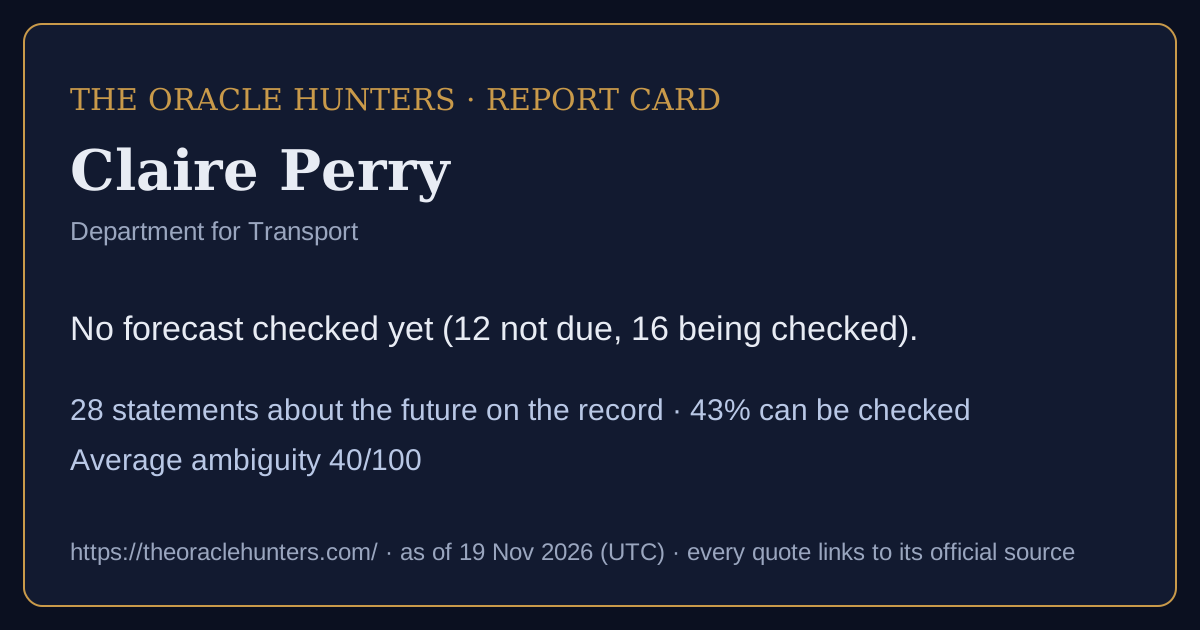
Track record: No forecast checked yet (12 not due, 16 being checked).
28forecasts & commitments on the record
43%can be checked as stated
40average ambiguity (0-100)
0goalpost moves recorded
0confirmed U-turns
Timeline
came true partly did not not due / being checked / too vague
Calibration score: shown after 10 checked forecasts with a stated likelihood (now 0).
How they speak about the future: based on data 23, stated on authority 3, educated guess 2.
Kinds of claim: forecast 15, mixed claim 9, scenario (if… then) 2, commitment 2. · Download this report card as a picture
In the nine words
πρόγνωσιςInference from evidence21 · 75%πρόνοιαPreparing for the future2 · 7%μαντείαInspired knowledge2 · 7%προαναγγελίαPublic pre-announcement2 · 7%εἰκασίαConjecture1 · 4%
How to read this
Each box is one sentence a public figure or institution said about the future, word for word, with a link to the official text. Can be checked means it names what will happen, by when, and how likely - so it can be compared with official figures later. Too vague to check means it does not. Ambiguity (0-100) is how many different ways the sentence can be read. When the date passes, the forecast is compared with official data and marked came true, partly or did not come true. Labels judge the sentence, never the person. Full guide and glossary.On the record (28)
If you look at the Clean Growth Strategy, we’re looking at what hydrogen pathway looks like, what increased electrifications looks like; there are radical changes coming forward that will hugely impact the investment decisions we take.
That cap will be in place by the end of this year.
So later this year, we will be conducting a formal review to mark 5 years since this introduction, asking some key questions:
That is why we were clear in our Clean Growth Strategy about our big R&D investment, hopefully to show that government is making the largest investment of public funds ever into R&D and £2.5 billion of that will do into clean tech.
Where government can help we will use all the tools at our disposal to support clean growth and low carbon innovation in our economy, including market design, taxation and regulation, as well as the funding of £2.5 billion we are providing.
…we will establish an industrial energy efficiency scheme to help large companies cut their bills…
The most recent research shows that the UK’s low carbon economy could grow over 10 to 12 per cent per year up to 2030 – four times faster than the growth of the UK economy as a whole.
… we will work towards our aspiration that every home in the country will be rated Energy Performance Certificate as Band C by 2035…
…we will invest around £3.6 billion to upgrade around a million homes through the Energy Company Obligation by 2020, and extend that support to 2028…
For businesses, the largest pool of contributors to emissions, we will help them improve how they use their energy, aiming to increase their energy productivity by at least twenty per cent by 2030, saving businesses £6 billion…
The new class 700 trains for Thameslink, for example, will be 20% lighter than the existing fleet and will use a third less energy.
And next month, customers with a smart card registered account travelling on Essex’s C2C rail services who suffer a delayed journey, even for only a few minutes, will receive compensation automatically.
And next year we start building HS2 — a project that will do for the country what Crossrail is doing for London.
So if we accept the status quo, we will find ourselves excluded from one of the UK’s most important growth industries, and the industry itself will lack the people we need to get the work done.
And looking ahead, we will open Crossrail and start HS2, before beginning a new round of investment projects that will take us up to 2025 and beyond.
In 2017, the National College for High Speed Rail will open at campuses in Birmingham and Doncaster.
The timing for this year’s conference could hardly be better.
With a commitment that over the next 5 years we will invest £100 billion.
We will enshrine in law our commitment to create 3 million apprenticeships by 2020, many of which will serve infrastructure.
But today’s report means new opportunities for British businesses, because it’s estimated that the driverless vehicles industry will be worth £40 billion globally by 2030.
That means if Southeastern doesn’t meet customer satisfaction targets, it will face financial penalties of up to £4 million.
Then the earliest the work could get under way is in 2019.
In the 5 years to 2019, Network Rail will be spending over £38 billion to run and improve the rail network.
We will receive the rail industry’s advice in 2016, so we can take a decision in 2017 or 2018.
So 2015 could be the year of the driverless or highly automated car and truck in the UK.
I recently approved the next phase of research and know that work will be getting underway in 2015.
The department is currently reviewing the responses received and will publish its report by the end of 2014.
They will last between 18 and 36 months - and we hope to announce the competition winners next month.
Also said - not checkable as stated (12 newest)
Remarks about the future with no date, figure or likelihood that could be checked. They are kept on the record and shown here, but not scored.
But we will be working closely to ensure that these go beyond ‘business-as-usual’ and deliver the framework that we need to move us to this future.
The review has sparked a debate, a vibrant debate if I might say, about how we actually get to an energy market where active consumers, not producers, are central; where the pyramid of supply and distribution is turned upon its head; where we realise the potential of the investments we’ve been making now for many years in new clean energy …
Understanding and answering these questions will help simplify the system in line with Dieter’s recommendations, whilst maintaining robust energy security and delivering on our triple test.
What is exciting about the past few months is that not only have we put forward 15 policies of how we will get our own carbon budgets, we’ve put that firmly in front of the way in which we want business and government to work together.
You will see in there some of the highlights of sector deals and examples of how we will work together going forward.
There is a role for nuclear at the right cost going forward, we will continue to investigate the scientific truisms of fracking, does it make sense to frack, does it deliver what we want, can it be done in the right way?
This is just the first stage, and we are inviting feedback from all users – including you, I hope – on how we can expand and perfect the information we provide in time for launching the final site at our Green Britain Week, an annual event that we will be launching to happen every October, where we will be showcasing …
…and we will demonstrate international leadership in carbon capture, usage and storage, that we need to decarbonise and improve how we do business, including substantial new investment in leading edge innovation.
And I don’t agree with those who say that because some stretches of our rail network are not currently being electrified, we will never have a rail network without diesel trains.
From now on, they will form an important part of all future rail franchises.
So any operator who wants to run a rail franchise in this country must show how over the lifetime of the franchise they will deliver a better service for customers.
In the future, anyone who bids to operate a rail franchise will need to show plans to offer smart ticketing that meets customers’ needs.