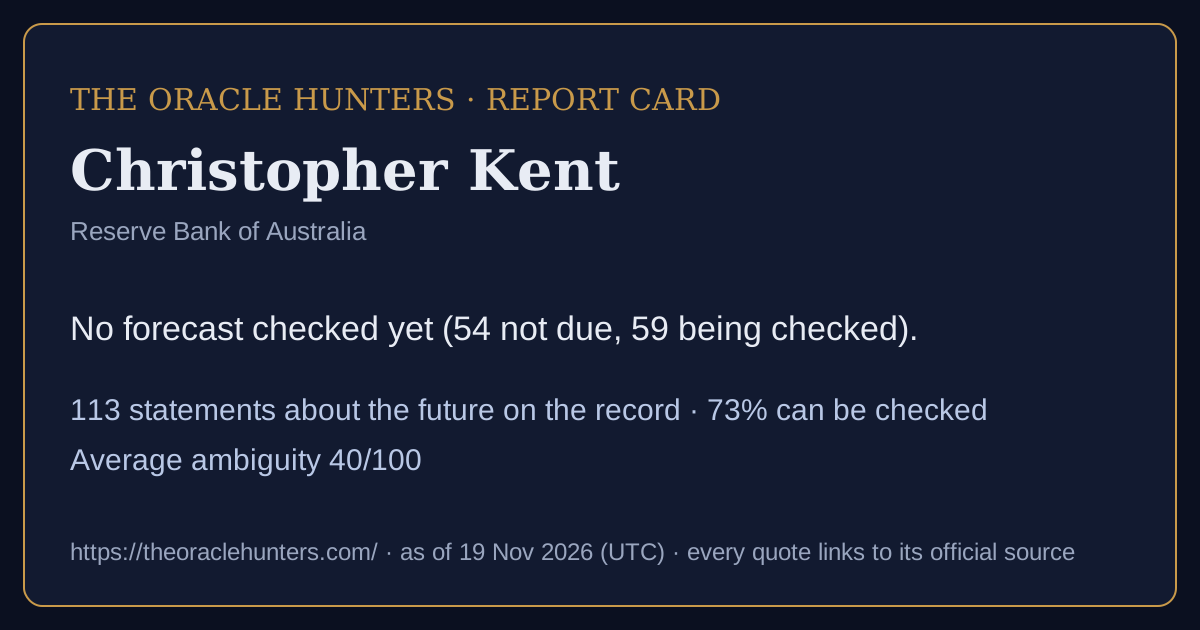
Christopher Kent
Reserve Bank of Australia
Track record: No forecast checked yet (54 not due, 59 being checked).
113forecasts & commitments on the record
73%can be checked as stated
40average ambiguity (0-100)
0goalpost moves recorded
0confirmed U-turns
Timeline
came true partly did not not due / being checked / too vague
Calibration score: shown after 10 checked forecasts with a stated likelihood (now 0).
How they speak about the future: based on data 84, stated on authority 19, educated guess 10.
Kinds of claim: forecast 89, scenario (if… then) 13, mixed claim 7, commitment 4. · Download this report card as a picture
In the nine words
πρόγνωσιςInference from evidence75 · 66%μαντείαInspired knowledge17 · 15%πρόνοιαPreparing for the future13 · 12%προαναγγελίαPublic pre-announcement4 · 4%εἰκασίαConjecture3 · 3%πρόβλεψιςSeeing the signs1 · 1%
How to read this
Each box is one sentence a public figure or institution said about the future, word for word, with a link to the official text. Can be checked means it names what will happen, by when, and how likely - so it can be compared with official figures later. Too vague to check means it does not. Ambiguity (0-100) is how many different ways the sentence can be read. When the date passes, the forecast is compared with official data and marked came true, partly or did not come true. Labels judge the sentence, never the person. Full guide and glossary.On the record (113)
In short, the three cash rate increases earlier this year are having their intended effects and in time will start to encourage more saving and discourage spending.
Some of the downturn in the established housing market is what we would expect following the cash rate increases earlier this year.
Growth in private demand is projected to moderate over the remainder of the year as several headwinds weigh on activity, including the tightening in monetary policy earlier this year.
As President Williams from the Federal Reserve Bank of New York noted in May this year, an AI investment boom should result in an increase in desired investment relative to desired savings, boosting real interest rates.
In the case of the TFF, stronger-than-expected economic conditions and higher policy rates resulted in a financial cost to the RBA of around $9 billion.
More broadly, when interest rates are already low, the MPB may have less tolerance for inflation falling below the 2 to 3 per cent target.
If we assume that market participants expect full employment and inflation in the middle of the 2-3 per cent target band in three years, the expected cash rate at that horizon provides an approximation to the short-run neutral rate.
We will continue to assess the countervailing forces operating on the economy, including any tightening of financial conditions, or increase in inflation expectations associated with the conflict, so that the Board can set monetary policy to achieve low and stable inflation and full employment over the medium term.
The red shaded area in Graph 8 shows projections for inflation and unemployment if the cash rate was 50 basis points higher or lower than the August SMP baseline. !!
As a result, underlying inflation was expected to gradually return towards the midpoint of the 2—3 per cent target range.
For instance, if the cash rate was 50 basis points higher (all else equal), inflation would be expected to fall below 2.5 per cent and be declining by late 2027, while unemployment would be expected to be around 4.5 per cent and rising.
A key issue is that at a price of 5 basis points above the cash rate target, meeting a large increase in the demand for funds at OMO might impair, at least at the margin, the health of other private money markets.
This suggests that underlying reserves could be anywhere between $100 and $200 billion. 3 An advantage of our full-allotment system in the face of such uncertainty is that the transition to ample reserves can occur without us needing to know the level of banks' underlying demand ahead of time.
- We will increase the price of all new OMO repos from 5 basis points to 10 basis points over the cash rate target. 5
In line with recommendations from the Review of the RBA, we will be publishing a framework for additional monetary policy tools next year. !13] The broader set of lessons learned from the combined use of a range of unconventional monetary policies will be considered as part of that framework.
In May, the median estimate among market economists implied that the cash rate was around 1 percentage point above the nominal neutral rate. In short, these estimates imply that monetary policy is restrictive and so it is continuing to bring aggregate demand into better balance with aggregate supply, as intended.
Also, most of the remaining low fixed-rate loans from the pandemic era will expire this year, which will add around 20 basis points to the average outstanding mortgage rate.
- In principle, they could have lent earlier if borrowing cash overnight from the RBA was treated similarly to leaving cash on deposit with the RBA - after all, the pricing of both was symmetric, at 25 basis points away from the cash rate target.
Banks with a shortage of reserves could borrow them overnight from the RBA at a rate that was 25 basis points above the target.
In Australia, banks with surplus reserves could leave them on deposit with the RBA at the ES rate, which used to be 25 basis points below the cash rate target.
The RBA will use repurchase agreements to supply reserves, which as of February this year are based on a floating rate (as a spread to the cash rate target), thereby removing interest rate risk for the RBA.
ES balances will decline further when the remaining $96 billion of the TFF is repaid by the middle of this year, and as the RBA's bond portfolio continues to decline.
As a result, despite increases in Australian interest rates from May 2022, the Australian dollar has depreciated by just a little more than 2 per cent on a trade-weighted basis since then.
Recent Bank model estimates imply that the 4 percentage point increase in the cash rate might contribute to business investment being around 4 per cent lower than otherwise after two to three years.
Since last May, required household mortgage payments - interest plus scheduled principal repayments - have risen from around 7 per cent of household disposable income to almost 10 per cent.
Since May 2022, Australian banks have passed on about 75 per cent of the increase in the cash rate to deposits, which is in line with past phases of rising interest rates.
Since May 2022, the Reserve Bank has raised the cash rate target by 400 basis points with the goal of bringing inflation back into its target range of 2-3 per cent.
Even if markets remain strained for a time, Australian banks' issuance will continue to benefit from the strength of their balance sheets.
Since last May, the average outstanding mortgage rate across all loans has increased by around 110 basis points less than the cash rate.
Estimates of how much further scheduled mortgage payments will rise as fixed-rate borrowers roll off their loans this year are provided in Graph 4.
While QT will contribute to a moderate decline in our balance sheet over the next few years, the roll-off of the Bank's Term Funding Facility (TFF) will lead to a sizeable reduction in our balance sheet this year and next (Graph 1).
Hence, only about 45 per cent of the rise in the cash rate to date had passed through to total scheduled mortgage payments at the end of 2022, though slightly more will have passed through in the early months of this year.
The blue dashed line provides an estimate of how much further scheduled mortgage payments will rise based on the current cash rate: around 1.5 percentage points further by the end of 2024, with the bulk of that flowing through by the end of this year.
A rough rule of thumb from our models suggests that the level of the Consumer Price Index (CPI) will be higher by only around 0.2 per cent in total over the course of a few years.
If market expectations for policy rates pan out, then by the first part of next year the average policy rate will have increased by an amount comparable to the rise seen through the mid-2000s - but while that increase occurred over four years, this increase will have taken just four quarters.
Maturities will then step up again to be more sizeable from 2024.
The first major maturities from the Bank's portfolio will be about $2 billion worth of the July 2022 Australian Government bond,
The decline in our bond holdings will be gradual over this year and next.
The program was introduced at a time when the unemployment rate was close to 7 per cent and expected to rise even higher.
By April 2024, about $47 billion worth of bonds purchased in support of the yield target and market functioning will have matured.
Indeed, most of the market economists that we regularly survey were forecasting that underlying inflation would remain well below 2 per cent until at least the end of 2022.
The next BIS triennial survey in 2022 will contain more questions on settlement methods and many central banks -
We anticipate that the bulk of funding available under the facility will be taken up, and so the scheme will be providing a substantive source of low-cost funds for the next 3 years.
The Board's assessment is that these conditions are unlikely to be met until 2024 at the earliest.
We anticipate that will be a gradual process, with inflation unlikely to be sustainably within the target range of 2-3 per cent until 2024 at the earliest.
Any firms that have not done this will, on the 1 January 2022, be facing the prospect of significant disruption to their contracts and operations.
For the most widely used USD LIBOR tenors, Ice Benchmark Administration will continue publishing these rates until 30 June 2023, but not beyond that.
On 1 January 2022, these rates will not be published - they will not exist.
In short, by the end of 2021, institutions must have already transitioned to alternative reference rates, and for existing contracts where that's not possible, robust fallback provisions must be in place to make clear what the replacement rate will be when LIBOR ends.
Similarly, late last year, non-financial companies had built up cash buffers that could cover nearly 6 months' worth of expenses, an increase of around 30 per cent compared with before the pandemic.
Showing the newest 50 - the ledger has all 113.
Also said - not checkable as stated (12 newest)
Remarks about the future with no date, figure or likelihood that could be checked. They are kept on the record and shown here, but not scored.
All else equal, these changes will tend to reduce the extent to which monetary policy needs to constrain the growth in aggregate demand to help bring inflation back to the RBA's target.
Aboriginal and Torres Strait Islander peoples should be aware that this website may contain the names, images and voices of people who are now deceased.
Hence, as with the cash rate target, settings for alternative monetary policy tools will need to be revisited as conditions evolve.
A key system-wide risk is that a lot of banks may need to replace this type of funding at the same time, which could create pressures in private funding markets.
- Second, the expected benefits should be reasonable relative to the potential costs.
Such a response may reduce the need to rely on alternative tools.
It must judge the level of the cash rate that will deliver financial conditions consistent with those goals.
Each of these elements are influenced by the cash rate and its expected path as part of the standard monetary policy transmission process.
At that point, demand and potential supply will be in balance, with full employment and inflation at target.
If not, it implies that the Board might need to consider a different path for the cash rate than that implied by market pricing.
However, this outlook is subject to considerable uncertainty, and we will continue to reassess it in light of what the incoming data mean for the economic outlook and evolving risks.
I will emphasise the growing footprint of superannuation funds in Australia's capital flows and the importance of these and other 'buyside' firms of adopting best practices in FX markets. [ 1] [ 2]