Christopher J Waller
Federal Reserve
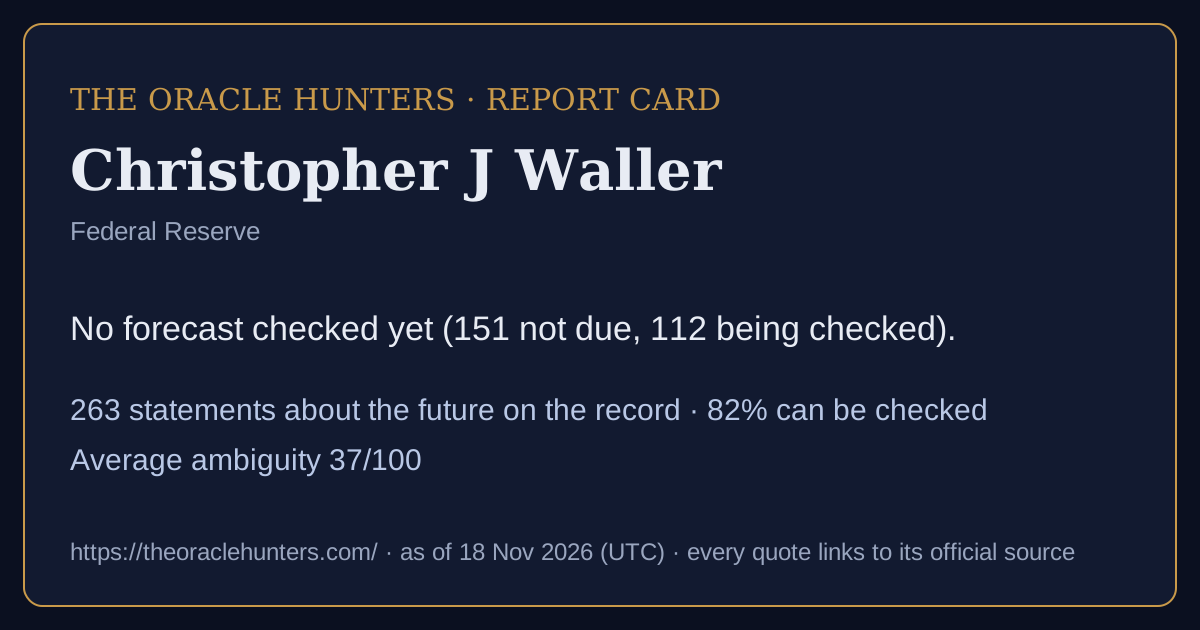
Track record: No forecast checked yet (151 not due, 112 being checked).
263forecasts & commitments on the record
82%can be checked as stated
37average ambiguity (0-100)
0goalpost moves recorded
0confirmed U-turns
Timeline
came true partly did not not due / being checked / too vague
Calibration score: shown after 10 checked forecasts with a stated likelihood (now 0).
How they speak about the future: based on data 198, stated on authority 43, educated guess 22.
Kinds of claim: forecast 181, mixed claim 58, scenario (if… then) 20, commitment 3, speculation 1. · Download this report card as a picture
In the nine words
πρόγνωσιςInference from evidence184 · 70%μαντείαInspired knowledge40 · 15%πρόνοιαPreparing for the future20 · 8%εἰκασίαConjecture8 · 3%πρόβλεψιςSeeing the signs7 · 3%προαναγγελίαPublic pre-announcement3 · 1%φρόνησιςPractical wisdom1 · 0%
How to read this
Each box is one sentence a public figure or institution said about the future, word for word, with a link to the official text. Can be checked means it names what will happen, by when, and how likely - so it can be compared with official figures later. Too vague to check means it does not. Ambiguity (0-100) is how many different ways the sentence can be read. When the date passes, the forecast is compared with official data and marked came true, partly or did not come true. Labels judge the sentence, never the person. Full guide and glossary.On the record (263)
To recap my economic outlook, economic activity is strong, the labor market is stable, but inflation is too high, well above the FOMC's 2 percent goal.
If, however, the hikes are not carried out, markets will reduce expectations of rate hikes and rates will immediately fall, which would loosen monetary policy in an undesirable way.
But if the October CPI inflation data out later today are similar to the past two monthly readings—with core CPI inflation around 0.3 percent or even higher—then a stronger policy move may be needed.
This means that even if, as I expect, the monthly rate of inflation improves in October, I am leaning toward supporting an increase in our policy rate of 25 basis points at the FOMC's December meeting.
Their analysis suggests that, especially if oil prices were to remain elevated, these pressures could be larger than previously though and persist well into 2027.
The projections submitted at the September meeting showed that a large majority of FOMC participants believe it will be appropriate to raise rates at least once more this year.
What I have in mind is that policymakers could signal that the policy rate will likely be hiked 75 basis points over some time interval—say, the next six months.
Second, policymakers could use a strong form of forward guidance and communicate their support for raising the policy rate, let's say, every other meeting by 25 basis points until a total of 75 basis points worth of hikes has been enacted.
It gets a little complicated reading the dots for the full year of 2027, since they may reflect hikes early in the year and then cuts later in the year, but eight participants expect that rates will be 50 basis points higher at the end of 2027 than they are today.
First, hopes for a quick ending to the Middle East conflict faded, and experts warned that low inventories and damaged infrastructure could keep oil prices high through 2027.
Between the SEP and policymakers' outlook speeches that encompass their interpretation of additional economic data, markets have interpreted that the Committee is likely to raise the policy rate 50 basis points in the coming months.
Many are worried that AI could increase the volume and sophistication of cyberattacks.
But they are an important backdrop for the part of the outlook that is my focus right now, inflation, and my judgment about how much the current stance of policy is working to return inflation to 2 percent.
To set the stage before we talk, let me give you a sense of my thinking, as of today, about the economic outlook and the implications for monetary policy.1 The short version is that, while inflation remains meaningfully above the Federal Open Market Committee's (FOMC) 2 percent goal, recent data suggest we are finally seeing some signs of disinflation.
Combining the various pieces of the economy, I expect real GDP to grow a bit more than 2 percent this year, a respectable outcome considering the uncertainties I mentioned.
The direct effect of high petroleum prices until recently has been a big reason for this surge, and the good news is that, if the lower oil prices of the past few weeks are sustained, they will lower headline inflation in the coming months.
And, despite some concerns on Wall Street about whether AI demand will continue its fast growth, I expect that AI-related investment will continue at a strong pace in the near term and most likely next year as well.
But I am concerned about the equally plausible case that data in the coming weeks will show that inflation will remain at its elevated level or even trend higher, requiring tighter monetary policy in the near term.
And no matter how you cut it, or what measure you want to use, inflation is up this year: Even accounting for the likely temporary direct effects of the oil price shock, it is running at levels inconsistent with the FOMC's 2 percent objective.
But, at this point, I am concerned about the elevated pace of core inflation this year, which has steadily moved up—as measured by the 12-month personal consumption expenditures (PCE) rate—from 3 percent in December 2025 to 3.4 percent in May.
I would be very pleased to see a lower reading on core inflation, but after its escalation over the first half of this year, I will need to see several months of lower readings to feel that inflation is moving in the right direction.
Fortunately, the labor market seems to have stabilized in recent months, and while it could be negatively affected by higher prices, unless it dramatically deteriorates, I do not expect it to be a major factor driving my view of the appropriate stance of monetary policy in the near term.
So, based on observing three heads in a row, you would put more than a 50 percent probability weight on a coin turning up heads on the next flip and your expected winnings would go up, not stay at zero.
If people know that each shock in a sequence of price shocks is transitory, then why might they expect average inflation to increase in the future when observing this sequence of shocks?
So I anticipate the three-month average of payroll gains will be revised to near zero in the annual revision early next year.
Oil market traders are betting that most of this reversal will occur by the end of the year.
If this comes to pass, I expect that the boost to energy prices in headline inflation will fade over the medium term and that expectations of future inflation will remain anchored.
But, ultimately, this series of shocks pushed up inflation to near 9 percent by one measure, longer-range inflation expectations started to move up, and the Federal Reserve took action.8 Learning from that experience, I will be cautious when faced with a sequence of transitory shocks.
When we combine this information with producer price data, estimates suggest March PCE inflation will come in even higher, standing around 3.5 percent for headline and 3.2 percent for core.
Supporting this view is the fact that economic policy uncertainty indexes have risen to quite elevated levels in recent days.6 While futures prices in general seem too optimistic, I note that the tail of the distribution of oil prices at the end of this year is skewed toward the higher prices that I see as more likely than what markets …
Even after the failure of peace talks last week, futures prices have Brent falling to $82 per barrel by the end of 2026 and $75 per barrel by the end of 2028, consistent with the view that markets will return to something close to normal in a reasonable length of time.
Here, abstracting from the effects of tariffs and energy, I see a forecast in which underlying inflation would continue to move toward 2 percent, leaving me cautious about rate cuts now and more inclined toward cuts to support the labor market later this year when the outlook is more steady.
Assuming underlying inflation continues to signal we are close to our 2 percent goal, the key to setting appropriate policy will be my view of the labor market.
Smoothing through those effects, I expect real GDP to grow above 2 percent for these six months, with both business and household spending continuing at a solid pace.
The government shutdown last year reduced growth in the fourth quarter and has likely boosted it in the first quarter of 2026, both by about 1 percentage point.
But even if inflation continues to make progress toward 2 percent, if the new labor data dent the idea of a turnaround and instead point to continued weakness like we saw in 2025, then there may be an equally credible case for a further reduction in the policy rate, and I will lay out that argument as well.
But 2025 was even worse than that, because even after those revisions, there likely remains an upward bias in the payrolls from April through December and the correction to those numbers won't happen until 2027.3 Accounting for those upcoming revisions, it seems clear that payroll employment in the United States probably fell in 2025, only the third year that has …
The strong gains in the stock market in 2025 boosted wealth for higher income households, which should support their spending in 2026, but it will probably do little for lower income households.
According to the Labor Department, we know that job creation in the U.S. stalled from May through August, and with expected revisions that have been previewed and will become official next year, it is likely that employment actually fell over that period.
Turning to auto loan growth, it has been relatively weak this year, likely reflecting a combination of weak demand from households and pressures in car affordability.
I continue to assume that any loss in real GDP growth in the fourth quarter will boost growth by roughly the same amount early next year.
For example, private-sector forecasts, as seen by the median of respondents to the Blue Chip survey, are pointing to real GDP growth for the second half of this year that will be close to the modest first-half pace and a significant slowing from the pace of last year.
And, lastly, even excluding the temporary effects of the shutdown, growth in real gross domestic product (GDP) has likely slowed in the second half of 2025 from its fast pace in the second quarter.
A new survey of large employers found that these companies are predicting that 2026 will be the worst job market for new college graduates since the pandemic year of 2021, when the unemployment rate was around 6 percent at graduation time.8
As a result, my focus is on the labor market, where payroll gains have weakened this year and employment may well be shrinking already.
Over the past few months, retailers have told me that they will reduce employment next year because of the efficiency gains from AI.
If this were true, then the current setting of monetary policy may not be holding back demand and economic activity very much, which would have implications for how quickly the FOMC should lower the policy rate.
If the economy is growing as healthily as spending and GDP data indicate, I would expect that employment would recover in the coming months to a positive but not high level, reflecting the reduced labor supply that I just mentioned.
Furthermore, based on an estimate of the benchmark revision to the level of employment in March 2025 and extrapolating forward for the rest of this year, when the revisions are released next year it is likely that payroll employment has actually fallen, on net, since May.
If it is resolved in the next couple of weeks without major changes in government staffing or funding, the shutdown will lower GDP growth several tenths of a percentage point in the fourth quarter and raise it the same amount in the first quarter of next year.
Showing the newest 50 - the ledger has all 263.
Also said - not checkable as stated (12 newest)
Remarks about the future with no date, figure or likelihood that could be checked. They are kept on the record and shown here, but not scored.
They will also need to earn trust through how reliably they operate and how clearly they are governed.
Other settlement models, such as net settlement and batch settlement, where only net amounts need to be funded, will remain useful when saving liquidity is a priority, as in high-volume capital market activity.
For example, systemically important financial transactions may call for the most conservative designs.
These designs might trade some of the developer creativity found on purely permissionless, open networks in favor of greater privacy and control.
As a result, corporate treasurers, banks, asset managers, and payment providers may use several tokenized instruments at once to serve different aspects of their business models, in the same way they use multiple rails today.
Given these diverse needs of tokenized markets, I believe traditional rails and the forms of money exchanged on them will continue to play an important role in underpinning trust in the overall payment system.
Inconveniently for today's event, we will get consumer price index (CPI) inflation for October in a few hours.
A crucial reason for that reputation and success has been the willingness of the leaders of the Federal Reserve Bank of St. Louis to keep their eyes on the horizon of what FRED could be, as a tool for users around the world to improve understanding of the economy through data access and charting, as technology marches forward.
AI may not accurately cite the sources for data.
AI may also make a variety of errors in interpreting data, such as that old bête noire for economists and statisticians—confusing correlation with causation.
To operate efficiently across these shopping contexts, agents will need to make micropayments along the way.
As a result, fraud models and rules will need to be recalibrated to account for agent payment patterns.