Christodoulos Patsalides
Central Bank of Cyprus
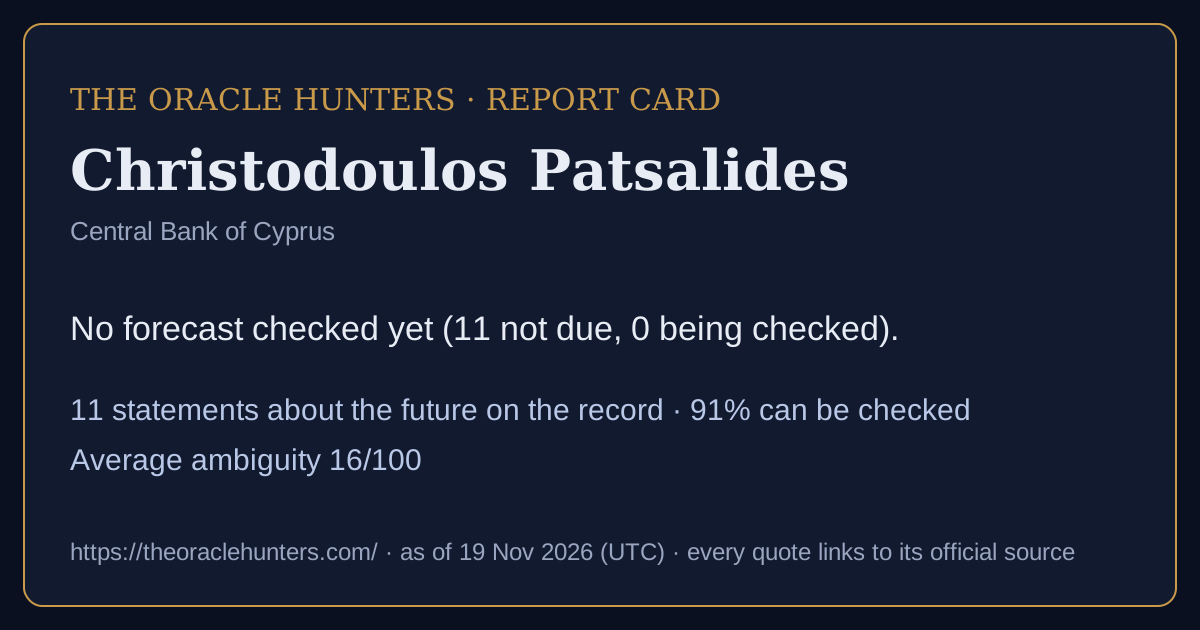
Track record: No forecast checked yet (11 not due, 0 being checked).
11forecasts & commitments on the record
91%can be checked as stated
16average ambiguity (0-100)
0goalpost moves recorded
0confirmed U-turns
Timeline
came true partly did not not due / being checked / too vague
Calibration score: shown after 10 checked forecasts with a stated likelihood (now 0).
How they speak about the future: based on data 11.
Kinds of claim: forecast 11. · Download this report card as a picture
In the nine words
How to read this
Each box is one sentence a public figure or institution said about the future, word for word, with a link to the official text. Can be checked means it names what will happen, by when, and how likely - so it can be compared with official figures later. Too vague to check means it does not. Ambiguity (0-100) is how many different ways the sentence can be read. When the date passes, the forecast is compared with official data and marked came true, partly or did not come true. Labels judge the sentence, never the person. Full guide and glossary.On the record (11)
I am confident that co-legislators will accelerate the legislative debate and keep 2029 on track - not as a hope, but as a commitment.
The disinflation process has continued to progress well, strengthening confidence that inflation will sustainably return to the 2% target in the medium-term horizon.
Over the period 2025-2027, inflation is projected to sustainably stabilize around 2%.
Looking forward, the Ministry of Finance projects that this downward trajectory will persist, with public debt expected to fall below 50% of GDP by 2028.
Looking ahead, based on March 2025 projections of the Central Bank of Cyprus, GDP is expected to continue to grow robustly at around 3% per year over 2025-2027.
The ECB's December projections estimate economic growth of 0.7% in 2024, 1.1% in 2025, 1.4% in 2026, and 1.3% in 2027.
According to the CBC's December 2024 projections, inflation is expected to stabilize near the 2% medium-term target, reaching 1.9% in 2025, 2.1% in 2026, and 2.0% in 2027.
These figures compare favourably to the euro area, where unemployment is forecast to stabilize at 6.1% by 2027.
It is projected to remain at 5% for the full year and to fall further to 4.6% by 2027, approaching levels indicative of full employment.
For the period 2025-2027, GDP is expected to grow by approximately 3% annually, driven primarily by a projected increase in domestic demand and, to a lesser extent, external demand.
Projections from the Ministry of Finance indicate that this downward trajectory will continue, with public debt expected to fall below 50% of GDP by 2028.
Also said - not checkable as stated (12 newest)
Remarks about the future with no date, figure or likelihood that could be checked. They are kept on the record and shown here, but not scored.
Co-legislators will need to remember three things: (a) that the ECB will track no one;
Co-legislators must decide what will be enshrined in the law and what will be set out in the ECB's scheme rulebook - but let's be clear about what people expect:
But co-legislators will have to grapple with the question: What does "intermediation" really mean in practice?
The trilogues will need to find a balance that is firm but flexible; strong enough to protect the public interest, but agile enough to allow innovation.
We must renew and deepen the European project, shaping it into an even more resilient, autonomous, united and forward-looking union that delivers for all its citizens.
Through sound monetary policy, effective supervision, and proactive regulatory engagement, we will continue working closely with all stakeholders - in Cyprus and across Europe - to promote financial stability, foster innovation and build the foundations for long-term prosperity.
Speech by Mr Christodoulos Patsalides, Governor of the Central Bank of Cyprus, at 4th ICPAC (Institute of Certified Public Accountants of Cyprus)Mediterranean Finance Summit, Limassol, 22 May 2025.
However, the April's reading upticks in services and core inflation, although likely due to stronger than expected Easter effects, warrant continuous close monitoring.
To build a financial ecosystem that is not only resilient in the face of crisis but also conducive to long-term prosperity, we must complete the long-standing project of deepening Europe's financial architecture.
A fully realized CMU will allow investors and savers to diversify more broadly and enable businesses - especially startups and scale-ups - to access deeper pools of equity and debt financing across the Union at lower costs.
It should be noted that in the euro area, public debt stood at 88.2% at the end of the third quarter of 2024.
Addressing these key issues is crucial for maintaining the sector's positive growth and will continue to be a primary focus of our oversight efforts.