Christine Lagarde
European Central Bank · EU
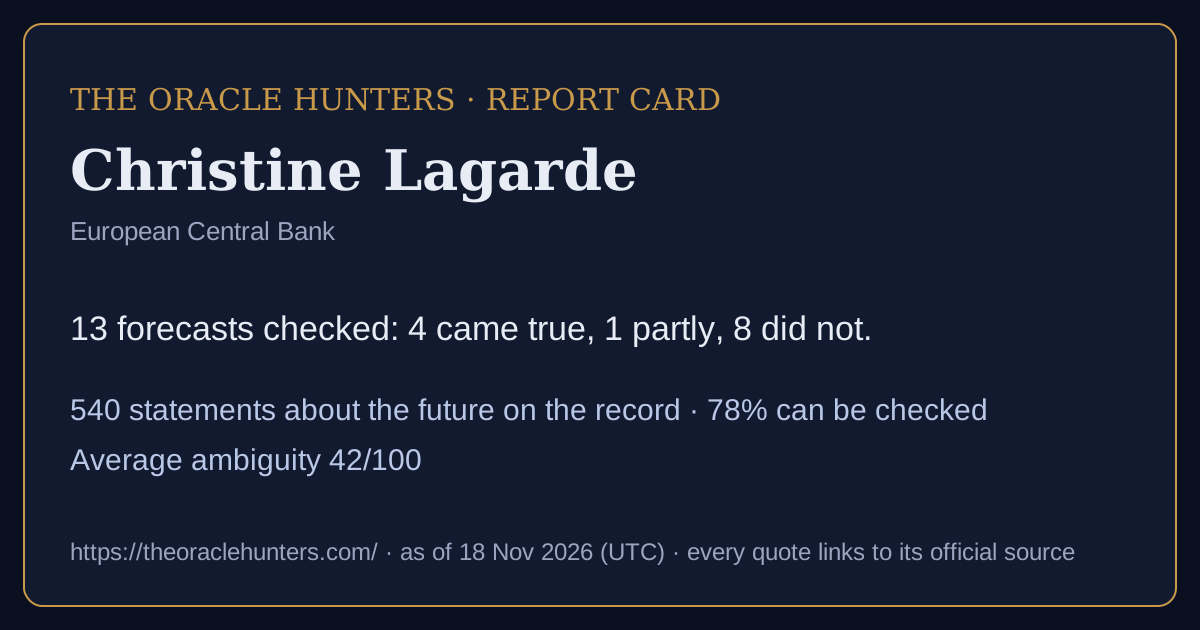
Track record: 13 forecasts checked: 4 came true, 1 partly, 8 did not.
540forecasts & commitments on the record
78%can be checked as stated
42average ambiguity (0-100)
0goalpost moves recorded
0confirmed U-turns
Timeline
came true partly did not not due / being checked / too vague
Calibration score: shown after 10 checked forecasts with a stated likelihood (now 8).
How they speak about the future: based on data 420, stated on authority 84, educated guess 36.
Kinds of claim: forecast 373, mixed claim 103, scenario (if… then) 35, commitment 28, speculation 1. · Download this report card as a picture
In the nine words
πρόγνωσιςInference from evidence393 · 73%μαντείαInspired knowledge60 · 11%πρόνοιαPreparing for the future34 · 6%προαναγγελίαPublic pre-announcement26 · 5%πρόβλεψιςSeeing the signs13 · 2%εἰκασίαConjecture9 · 2%φρόνησιςPractical wisdom5 · 1%
How to read this
Each box is one sentence a public figure or institution said about the future, word for word, with a link to the official text. Can be checked means it names what will happen, by when, and how likely - so it can be compared with official figures later. Too vague to check means it does not. Ambiguity (0-100) is how many different ways the sentence can be read. When the date passes, the forecast is compared with official data and marked came true, partly or did not come true. Labels judge the sentence, never the person. Full guide and glossary.Checked
The latest ECB staff projections foresee the economy growing by 0.8% in 2024, 1.3% in 2025 and 1.5% in 2026.
Came true. Said: economic growth around 1.3% in 2025. Official figure for Euro area: 1.4% (World Bank open data). On target. Off by 0.1 points. official data · checked 14 Nov 2026 · automatic check against official data (rules v3)
We then expect inflation to decline to 2.0% in 2025 and 1.9% in 2026.
Came true. Said: inflation around 2% in 2025. Official figure for Euro area: 2.5% (World Bank open data). On target. Off by 0.5 points. official data · checked 14 Nov 2026 · automatic check against official data (rules v3)
Inflation is expected to decline to levels close to 2% in 2025.
Came true. Said: inflation around 2% in 2025. Official figure for Euro area: 2.5% (World Bank open data). On target. Off by 0.5 points. official data · checked 14 Nov 2026 · automatic check against official data (rules v3)
In our latest projections, Eurosystem staff expect headline inflation to average 5.4% in 2023, 3.0% in 2024 and 2.2% in 2025.
Partly came true. Said: inflation around 3% in 2024. Official figure for Euro area: 2.3% (World Bank open data). Close: outside the margin, but within one more half point. Off by 0.7 points. official data · checked 14 Nov 2026 · automatic check against official data (rules v3)
Staff now expect the economy to grow by 3.1 per cent in 2022, 0.9 per cent in 2023 and 1.9 per cent in 2024.
Came true. Said: economic growth around 0.9% in 2023. Official figure for Euro area: 0.5% (World Bank open data). On target. Off by 0.4 points. official data · checked 14 Nov 2026 · automatic check against official data (rules v3)
They foresee annual inflation at 6.8% in 2022 before it is projected to decline to 3.5% in 2023 and 2.1% in 2024.
Did not come true. Said: inflation around 3.5% in 2023. Official figure for Euro area: 5.9% (World Bank open data). Missed. Off by 2.5 points. official data · checked 14 Nov 2026 · automatic check against official data (rules v3)
We expect the drivers of inflation to ease over the course of this year.
Did not come true. Said: inflation would fall in 2022. Official figures for Euro area: 2.5% in 2021, 8.5% in 2022 (World Bank open data). official data · checked 14 Nov 2026 · automatic check against official data (rules v3)
As a result, we still see inflation moderating in the next year, but it will take longer to decline than originally expected.
Did not come true. Said: inflation would fall in 2022. Official figures for Euro area: 2.5% in 2021, 8.5% in 2022 (World Bank open data). official data · checked 14 Nov 2026 · automatic check against official data (rules v3)
Accordingly, our latest Eurosystem staff macroeconomic projections foresee headline inflation at 1.9 per cent in 2021, 1.5 per cent in 2022 and 1.4 per cent in 2023.
Did not come true. Said: inflation around 1.5% in 2022. Official figure for Euro area: 8.5% (World Bank open data). Missed. Off by 7.0 points. official data · checked 14 Nov 2026 · automatic check against official data (rules v3)
Our latest staff projections currently foresee annual real GDP growth at 4.6 per cent in 2021, 4.7 per cent in 2022 and 2.1 per cent in 2023.
Did not come true. Said: economic growth around 4.7% in 2022. Official figure for Euro area: 3.7% (World Bank open data). Missed. Off by 1.0 points. official data · checked 14 Nov 2026 · automatic check against official data (rules v3)
ECB staff project annual inflation to gradually increase, from an average of 0.3% in 2020, to an average of 1.0% in 2021 and 1.3% in 2022.
Did not come true. Said: inflation around 1% in 2021. Official figure for Euro area: 2.5% (World Bank open data). Missed. Off by 1.5 points. official data · checked 14 Nov 2026 · automatic check against official data (rules v3)
The latest ECB staff projections foresee annual real GDP growth at -8.0% in 2020, 5.0% in 2021 and 3.2% in 2022.
Did not come true. Said: economic growth around 5% in 2021. Official figure for Euro area: 6.4% (World Bank open data). Missed. Off by 1.4 points. official data · checked 14 Nov 2026 · automatic check against official data (rules v3)
In the baseline scenario, inflation is projected to average 0.3% in 2020, before rising slightly to 0.8% in 2021, and further to 1.3% in 2022.
Did not come true. Said: inflation around 0.8% in 2021. Official figure for Euro area: 2.5% (World Bank open data). Missed. Off by 1.7 points. official data · checked 14 Nov 2026 · automatic check against official data (rules v3)
On the record (540)
Adopting the Regulation on the establishment of the digital euro by the end of 2026 is key to making this possible.
Headline inflation is expected to decline after the first quarter as energy inflation falls, returning to around target towards the end of 2027.
Looking ahead, higher energy prices are expected to keep headline inflation well above target into the first half of 2027 and to gradually feed through to core and food inflation.
The September ECB staff projections foresee growth of 0.9% in 2026, 1.4% in 2027 and 1.5% in 2028.
To lay the groundwork for a seamless and secure launch, we will run a 12-month internal pilot in the second half of 2027.
If firms train their AI agents on proprietary data – for instance, their balance sheets or client flows – trade decisions may become less correlated than if traders were simply querying the same models with similar prompts. But greater autonomy also brings a new risk for financial markets: misalignment, where AI agents may pursue goals in ways their human overseers …
In a survey conducted this year, only 5% of asset managers said they gave AI autonomous or semi-autonomous authority over investment recommendations or trades. But that percentage may well increase over time.
ECB staff estimate that AI could raise euro area productivity growth by around 0.3 to 0.4 percentage points per year over the next decade under a scenario of swift and broad adoption.
A recent ECB survey finds that by late 2025, 38% of euro area firms already reported at least moderate use of AI. Yet only 7% reported significant use. Unlocking the full potential of AI will require substantial investment.
Firms are set to devote around 10% of total investment to AI in 2026, and AI-related borrowing already accounts for roughly a quarter of credit growth to firms. AI could significantly enhance Europe’s productivity, competitiveness and living standards.
The inflation outlook will be higher in 2027 and 2028 than we expected a few months ago, mostly due to higher energy prices.
The baseline of the September ECB staff projections sees headline inflation averaging 3.0% in 2026, 2.5% in 2027 and 2.1% in 2028.
The baseline of the September ECB staff projections expects the economy to grow by 0.9% in 2026, 1.4% in 2027 and 1.5% in 2028.
(2026), “Servers account for 60% of the total cost of ownership of a one-gigawatt AI data center”, Epoch AI, 14 May). 19 gigawatts multiplied by USD 38 billion equals around USD 720 billion, or roughly €600 billion at current exchange rates.
The cost of closing Europe’s data centre gap over the next decade could be as high as €600 billion, chips included. In the United States the whole of the capital market has been drawn in to make the buildout possible: bonds, private credit and securitisation alongside traditional lending.
The share of euro area workers using AI on the job has doubled in two years and now exceeds 50%, a level it took the internet about a decade to reach. Yet progress is not as fast as it could be, as the gap with the United States shows.
Euro area firms will devote around 10% of total investment to AI in 2026, and ECB staff estimate that AI-related borrowing accounted for about a quarter of the growth in credit to firms in the first quarter of this year.
Our economists estimate that if businesses take up AI quickly the euro area economy could be around €630 billion a year larger within a decade.
Then, we will have more sovereignty and faster growth.
EU leaders have called for the co-legislators to reach agreement on the market integration package by the end of 2026, moving Europe closer to a genuine single market for capital. We already have many of the ingredients for stronger long-term growth.
Recent research finds that, in the euro area, a 1 percentage point rise in the perceived share of domestic competitors investing in AI raises a firm’s own expected AI investment rate by around 0.6 percentage points.
Survey evidence suggests that firms in the euro area expect to allocate an average of around 9% of their total investment to AI this year. The question is whether Europe can create the conditions for that investment to spread and scale.
In 2026 it has continued to grow despite the energy shock, with domestic demand contributing positively to the quarter-on-quarter growth of 0.4% in the second quarter of 2026. Domestic demand is projected to remain the main source of growth for the euro area this year. The task now is to turn that domestic resilience into a more durable source of …
We faced an outlook of rising headline and core inflation, and a projection that saw inflation returning to 2% only in the last quarter of 2027, which was itself conditional on monetary policy adjusting.
But the public does not currently expect high inflation to be lasting: most measures of longer-term inflation expectations stand at around 2%, supporting the stabilisation of inflation around target in the medium term.
In May, inflation excluding energy and food also increased to 2.6%, partly reflecting the initial indirect effects of higher energy prices.
The main driver of inflation since February has been rising energy inflation, which was above 10% in April and May.
The war is likewise pushing up inflation, which rose to 3.2% in May, from 3.0% in April.
The June Eurosystem staff projections foresee headline inflation at 3.0% in 2026, 2.3% in 2027 and 2.0% in 2028.
Looking ahead, the June 2026 Eurosystem staff projections see real GDP growth at 0.8% in 2026, 1.2% in 2027 and 1.5% in 2028.
Already in the course of this year, our Pontes project will settle tokenised transactions in central bank money.
Last month, a collaboration between the ECB, the London School of Economics and the University of Oxford revealed how an extreme episode of water scarcity could put as much as 24% of euro area output at risk. Cutting through the noise Findings like these underline the scale of the climate and nature risks we face.
ECB research has found that four years after a drought or flood, regional output remains depressed by around 3 percentage points on average. And if extreme weather shocks were to hit entire economies, the resulting weakness in activity and incomes could dampen demand – potentially putting downward pressure on headline inflation.
Last summer’s heatwave, for example, is estimated to have added up to 0.7 percentage points to unprocessed food prices in the euro area after one year. But such events can also weigh on output, and probably more persistently so than was once thought.
The ECB already factors ETS2 into its macroeconomic projections, estimating that it will add around 0.2 percentage points to headline inflation in the euro area in 2028.
We will ensure that inflation returns to 2% over the medium term.
Inflation could turn out higher than the baseline, in particular if inflation expectations and wage growth were to rise in response more than expected.
Indicators of underlying inflation remain consistent with our 2% medium-term target.
Conversely, growth could turn out to be stronger if the economic repercussions of these wars prove to be more short‑lived than expected or if investment, reforms and new technologies lift productivity by more than expected.
We are determined to ensure that inflation stabilises at our 2% target in the medium term.
The March ECB staff projections see headline inflation averaging 2.6% in 2026, 2.0% in 2027 and 2.1% in 2028.
Core inflation is expected to moderate from 2.3% in 2026 to 2.2% in 2027 and 2.1% in 2028.
If households increase precautionary saving as they budget for higher energy bills, it could point to a more limited pass-through.
Relative to the baseline, annual inflation would be significantly higher across the horizon – by almost three percentage points in 2027 – and would not return to target within the projection period.
We will also monitor the demand side, as the risks to growth are on the downside.
If firms increase their selling prices disproportionately – as we saw in 2022 – it could trigger an equivalent response from workers, what I have called in the past tit-for-tat inflation. We will therefore watch carefully firms’ selling price expectations and micro evidence on price changes, as well as paying close attention to wage trackers.
But we will not be paralysed by hesitation: our commitment to delivering 2% inflation over the medium term is unconditional.
For example, in March 2022, just weeks after the Russian invasion of Ukraine, our baseline projected inflation at around 5% for that year.
Goldman Sachs (2023), “AI may start to boost US GDP in 2027”, 7 November.
Second, perceptions of current inflation shape expectations about future inflation. We monitor these expectations closely for any signs of a sustained deviation from our 2% medium-term target.
Showing the newest 50 - the ledger has all 540.
Also said - not checkable as stated (12 newest)
Remarks about the future with no date, figure or likelihood that could be checked. They are kept on the record and shown here, but not scored.
In setting future policy, we will make a comprehensive assessment of the incoming data based on our reaction function.
For that reason, the ESRB expects attackers to hold an advantage in the short to medium term, even as AI strengthens defences over time. Geopolitics Nevertheless, access to frontier models can still materially shorten the time a defender needs to respond to attacks.
So if we are to use AI wisely, policymakers need to anticipate risks to the financial system as a whole.
And financial authorities should ensure firms plan timely responses and work together where an attack could spread across the sector. Since the ESRB was established 15 years ago, the financial system has changed profoundly.
Nearly nine out of ten significant euro area banks use it. Furthermore, in a recent survey of EU securities market firms, seven out of ten respondents expected to increase their investment in AI. There is good reason for that interest.
No one knows whether this one will follow a similar route, but if it does, we will feel the effects here in Europe. Most European savers’ exposure to US tech giants runs through investment funds, which would have to sell into a falling market to meet redemptions.
The Commission’s impact assessment report for the Cloud and AI Development Act (SWD(2026) 502) projects a gap of 19 gigawatts between EU data centre demand and installed capacity by 2036.
The ECB will continue to play its part for Europe too.
The second priority is to bring wealth and growth back together, so that the companies that will create tomorrow’s jobs are built here in Europe and financed by our own savings.
If our strengths in one domain, such as the Single Market, are undermined by weaknesses in others, such as defence or fragmented, costly energy markets, we will be easy to divide.
Countries could take energy from Russia, demand from China and security from the United States.
In reality, Europe would be left with weakened growth and a social model we could no longer pay for.