Chris Stals
Central bank (via BIS)
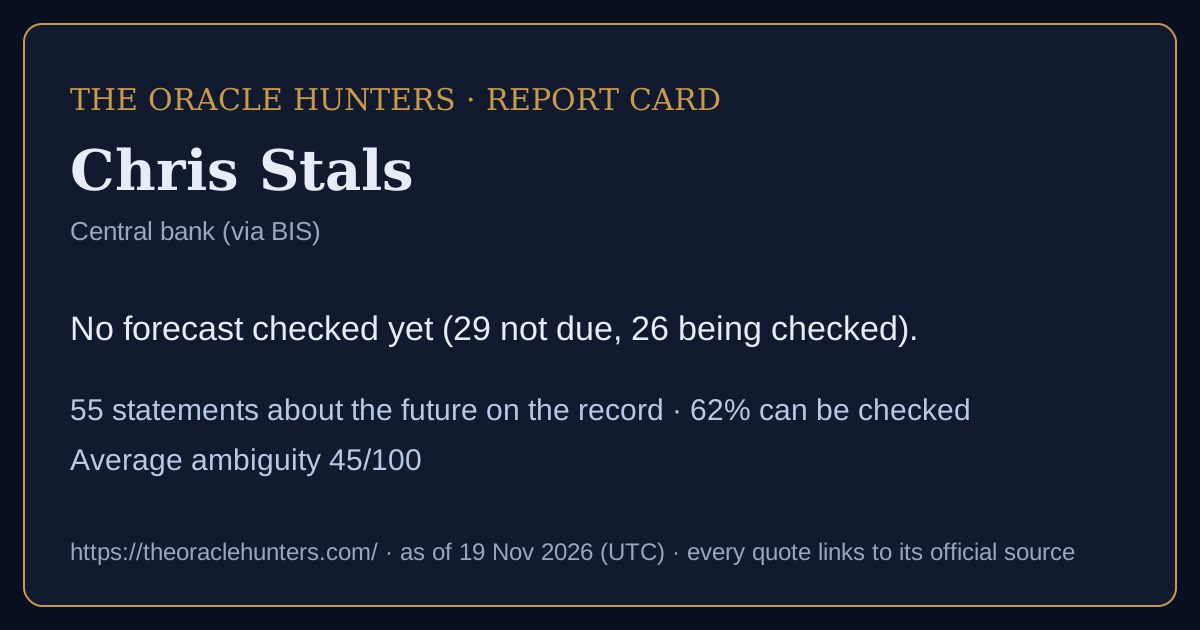
Track record: No forecast checked yet (29 not due, 26 being checked).
55forecasts & commitments on the record
62%can be checked as stated
45average ambiguity (0-100)
0goalpost moves recorded
0confirmed U-turns
Timeline
came true partly did not not due / being checked / too vague
Calibration score: shown after 10 checked forecasts with a stated likelihood (now 0).
How they speak about the future: based on data 35, stated on authority 14, educated guess 6.
Kinds of claim: forecast 40, scenario (if… then) 7, mixed claim 7, commitment 1. · Download this report card as a picture
In the nine words
πρόγνωσιςInference from evidence33 · 60%μαντείαInspired knowledge12 · 22%πρόνοιαPreparing for the future7 · 13%προαναγγελίαPublic pre-announcement1 · 2%πρόβλεψιςSeeing the signs1 · 2%εἰκασίαConjecture1 · 2%
How to read this
Each box is one sentence a public figure or institution said about the future, word for word, with a link to the official text. Can be checked means it names what will happen, by when, and how likely - so it can be compared with official figures later. Too vague to check means it does not. Ambiguity (0-100) is how many different ways the sentence can be read. When the date passes, the forecast is compared with official data and marked came true, partly or did not come true. Labels judge the sentence, never the person. Full guide and glossary.On the record (55)
There is a growing optimism, however, that a recovery in overall economic conditions will commence before the end of this year, and that next year will, on a world-wide basis, be a better year than 1999 — that is, provided that no further major shocks will occur in the global financial markets in the near future.
Gradually, the worsening conditions in the financial markets also affected real economic act The International Monetary Fund (IMF) revised its outlook for world economic growth in 1998 first from 3 to 2½ per cent (in August 1998), and then to 2 per cent (in October 1998).
Two years from now, i.e. in S 2000, South Africa will provide the Executive Director for the Group for a two-year period.
Under the t a decision of last year, there will be a further allocation of SDRs later this year, when will receive a further amount of SDR 180 million (R1.2 billion).
- This will include a continuous growth in gross domestic fixed investment at an aver of 4 per cent per annum.
- The capacity of the economy to produce goods and services will be raised gradually t a level of 5 per cent by the year 2004.
Taking account of the extensive globalisation of financial markets, the volume of worldwide cross-border transactions and the integrated inter-relationships of institutions and markets throughout the world, disruptions, if they do occur on any l will not remain localised.
Because of the inter-depend financial institutions in any closed system, care must be taken that all the financial each country will be compliant by the end of this year.
Unless this country can rely on some regular subs inflow of capital from the rest of the world, its economic growth rate will not creat jobs for the already large number of unemployed and the annual addition to the labour provide the resources needed for the social upliftment of the population.
There is no guarantee that somewhere down the road our economy will not tested again by the increasing volatility of an integrated world financial market s therefore important that we shall all learn from the two experiences of the past thre shall prepare our economy to prosper even within the environment of volatile inter capital movements.
- Having risen by 32.3 per cent from December 1997 to an all-time high in 1998, the average monthly level of share prices listed on the Johanne Stock Exchange declined by 38.7 per cent between May to September 1998.
The rate for repurchase transactions from the Res Bank increased from 14.78 per cent on 12 May 1998 to 24 per cent on 22 J 1998, before it settled early in July at a level just above 21 per cent institutions raised their prime overdraft rate from 18.25 per cent at t April 1998 to 25.5 per cent on 28 …
Th estimated daily liquidity needs of the banks increased from about R2 bil the beginning of May to more than R13 billion in early June 1998.
Conditions in the financial market will hopefully continue to improve furth to lead real economic activity into recovery in the course of the current business cycle improvements in the South African financial market conditions should therefore hopeful to an improvement in real economic activity, and particularly in gross domestic pro during the course of next year.
Forecasts for world economic growth in 199 systematically been scaled down from a rather ambitious 4 per cent made towards the end year to only about 2 per cent at this stage.
The overlook the fact that the Reserve Bank indeed raised the amount of accommodation available to banking institutions at the daily repurchase tender for central bank R4.1 billion early in May to R9.8 billion at this stage.
- the need to keep inflation in check in the aftermath of a depreciation of t more than 20 per cent since May this year.
The Reserve Bank's fluctuating repo rate similarly showed wide fluctuations increased from 14.8 per cent in early May to a peak of 24.0 per cent on 22 June, before set at a level of about 21 per cent.
In terms of the latest World Economic Outlook of the International Monetary F the global economic growth rate for 1998 will be reduced by the East Asian crisis from a forecast of 3½ per cent to not more than 3 per cent in 1998.
Unemployment is expected to increas 500,000 last year to 1.2 million workers soon.
Unemployment is rising sharply and will increase the number of living below the poverty line from 23 million to 40 million during the course of 1998.
In the end, the International Monetary Fund, the World Bank, a number of governments of industrial countries, and the international investment community, had to p massive amount of financial support -- more than US $120 billion -- to assist these coun countries themselves also had to implement painful corrective measures that will, over tim equilibrium in their economies.
With the continuing further removal of the remaining exchange controls, the South African financial markets will provide some exciting new challenges over the rest of this year.
Firstly, on 9 March 1998, the South African Multiple Option Settlement System (SAMOS) will be activated to pave the way for the introduction later this year of an on-line real-time
Next month, the Reserve Bank will introduce two important new initiatives in this regard:
Not everyting is, however, favourable for an expected economic recovery in South Africa next year.
It remains to be seen to what extent the unavoidable slow-down in real economic activity of the East Asian region will affect global economic developments over the next year.
Should these external disruptions settle down soon, and should the events of the past few months in East Asia not have too much of a ripple effect on the overall global economic growth prospects for 1998, South Africa can look forward to a period of steady and sound economic recovery next year.
As was expected, the rate of increase in consumer prices accelerated from 5.5 per cent in April 1996 to 9.9 per cent in April 1997 but then declined again to 8 per cent in September 1997.
In this multi-complex environment it is just unreasonable to expect of any governor of any central bank anywhere in the world to signal to markets in advance what adjustments in interest rates or other monetary policies could be expected over the next year.
What will be important for the stance of monetary policy over the next year will not be the approaching election in 1999, but rather current developments in these well-known basic financial aggregates.
The problems started in May this year in Thailand when the Thai currency, the baht, suddenly came under severe pressure.
The substructures for this ambitious new programme are now in place, and, as already indicated, the first phase will go live in March next year.
As a guideline the Reserve Bank currently regards a rate of increase of not more than 10 per cent per year in the M3 money supply as consistent with the prime objective of reducing inflation gradually to a level that will be more in line with the average rate of inflation in the economies of South Africa's major trading partners.
Precautions were also taken to ensure that all the Bank's electronic data processing systems will be able to cope with the technical 'Year 2000' problem with the change-over to the next millennium.
Over the next year, the co-ordination of financial co-operation in the region will be extended also to include the activities of commercial (private) banks and stock exchanges.
Should the present price of $320 be maintained for a full year, the loss in foreign exchange on the balance of payments will amount to R4.5 billion, or less than 3 per cent of total exports.
Increases in the money supply of less than 10 per cent will drag inflation downwards.
If the real economy, for example, expands by 3 per cent per annum, and the current rate of inflation is 7 per cent, a continuous increase in the nominal money supply at rates of more than 10 per cent per annum will eventually exert upward pressure on inflation.
Even today, the South African Reserve Bank is privately owned, with important restrictions on the rights of shareholders, for example that no individual shareholder may hold more than one-half per cent of the capital of the Bank, and that the Bank may not pay a dividend of more than 10 per cent per annum on the paid-up share capital of …
The South African Reserve Bank Training Institute will this year offer three three-week specialised courses on central banking for officials from SADC central banks; co-ordination of the exchange control policies applied by members of SADC.
For example, if the average rate of inflation in South Africa over time is 10 per cent per annum and the average rate of inflation in the rest of the world is 3 per cent, nominal interest rates in South Africa will on average be about 7 per cent above the level of nominal interest rates in other countries.
A South African investor who may have transferred his savings into a sterling investment earlier this year when the exchange rate between the rand and the pound was R8.00 = £1.00 could have lost 10 per cent of his investment within a very short period of time.
Optimism for the balance of payments for 1997 rests very strongly on the expectation that there will be a good net inflow of capital into the country during this year.
In the second quarter, the seasonally adjusted annualised rate of the deficit reached R12.9 billion and there was justifiable concern that it could increase even further.
If we want to make sure that the current trends in inflation will not be perpetuated, we must make sure that increases in the money supply will not automatically accommodate rising prices, or even further stimulate the inflationary pressures that are emerging from other sources.
Indeed, it is not unreasonable to assume that a total net inflow of capital in excess of the projected current account deficit will add some amount to the official foreign exchange reserves during the course of this year.
In real terms, that is after provision for depreciation, total government expenditure will indeed decline and therefore make an important contribution to the retention of macroeconomic equilibrium this year.
Agriculture will not make the same contribution to growth in 1997 and for economic analysis purposes it makes sense to assess the future prospects for non-agricultural production before deciding on a possible course for monetary policy during the rest of this year.
The current stimulus for inflation emanated mainly from the depreciation of the rand last year, but there is a danger that, if not checked at this stage, it could easily be converted into a new cycle of a continuous rise in the rate of inflation.
Showing the newest 50 - the ledger has all 55.
Also said - not checkable as stated (12 newest)
Remarks about the future with no date, figure or likelihood that could be checked. They are kept on the record and shown here, but not scored.
Always remember the old Chinese saying that a man must study as if he will live forever, but live as if he will die tomorrow.
- 2.1 A true central banker will always be against inflation.
- 2.5 By successfully restricting growth in the total domestic assets of the central bank, monetary policy will bring about positive growth in the total foreign assets of the country.
- 2.8 A country may be able to keep politicians out of interest rates, but you can never take interest rates out of politics.
Without co-operation between the central bank and the ministry of finance both monetary and fiscal policies will be weaker.
I wish I could spend another ten years working with you in meeting the great challenges we face together to develop the financial structures of our continent, and to establish in Southern Africa an intimate forum for effective central bank co-operation.
In the process, we shall provide a basis for gradual but effective cooperation and integration of the financial systems and markets of Southern Africa.
- The expansion of trade between Southern African states will be supported by a simultaneous integration of the financial sector.
- The extension of services across borders will be made easier.
- It is of vital importance for the Southern Africa region that maximum use shall be made of scarce resources.
Furthermore, the power to create money can easily be abused for short-term gains, but any excessive creation of money in the short-term will eventually lead to higher inflation (and therefore higher interest rates).
At this stage, I believe work should continue to proceed on the accepted road of focusing on identified projects that can be developed on a regional basis without full economic integration of the 14 countries now forming part of SADC.