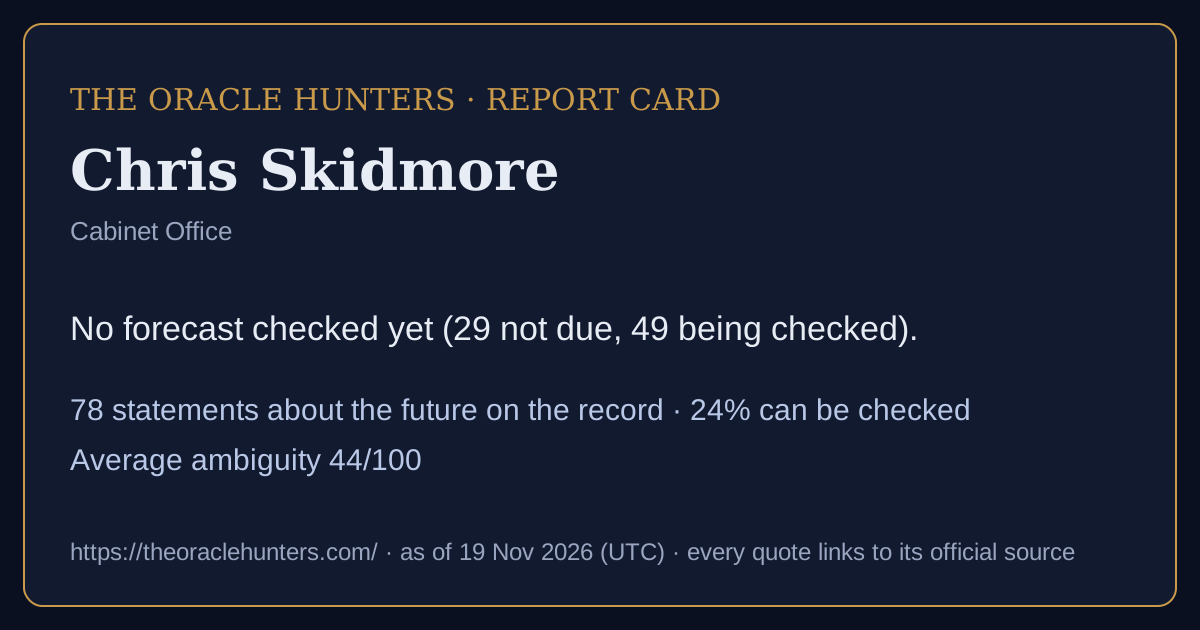
Chris Skidmore
Cabinet Office · GBR
Track record: No forecast checked yet (29 not due, 49 being checked).
78forecasts & commitments on the record
24%can be checked as stated
44average ambiguity (0-100)
0goalpost moves recorded
0confirmed U-turns
Timeline
came true partly did not not due / being checked / too vague
Calibration score: shown after 10 checked forecasts with a stated likelihood (now 0).
How they speak about the future: based on data 62, stated on authority 15, educated guess 1.
Kinds of claim: forecast 47, mixed claim 23, commitment 7, scenario (if… then) 1. · Download this report card as a picture
In the nine words
πρόγνωσιςInference from evidence55 · 71%μαντείαInspired knowledge14 · 18%προαναγγελίαPublic pre-announcement7 · 9%εἰκασίαConjecture1 · 1%πρόνοιαPreparing for the future1 · 1%
How to read this
Each box is one sentence a public figure or institution said about the future, word for word, with a link to the official text. Can be checked means it names what will happen, by when, and how likely - so it can be compared with official figures later. Too vague to check means it does not. Ambiguity (0-100) is how many different ways the sentence can be read. When the date passes, the forecast is compared with official data and marked came true, partly or did not come true. Labels judge the sentence, never the person. Full guide and glossary.On the record (78)
From the £80 million automotive battery industrialisation centre in Coventry that will allow companies to quickly develop their capabilities to manufacture batteries and get them to market, to the £10 million Northern Pathology Imaging Collaborative in Leeds, which will use artificial intelligence to develop more intelligent analysis of medical imaging and diagnose diseases at an earlier stage.
And it will only be through encouraging existing business and industry to invest in R&D, that we will also be able to meet 2.4% in 2,500 days.
This means researchers and innovators can continue to submit proposals to Horizon 2020 with confidence, right up to the point of exit, knowing that the best proposals will be funded – regardless of how we leave the EU.
For instance, in May I announced that EU students coming to England to start their higher education in 2020/21 will have home fee status and financial support, guaranteed for the duration of their courses.
I hope that we will secure a deal shortly: a deal, which we all know would enable our continued participation in EU programmes such as Horizon 2020 and Erasmus+.
Just last week the Secretary of State for Education announced we will make available up to an extra £120 million so we can have an Institute of Technology in every part of the country, and provide different regional economies with the unique mix of digital skills they t need to flourish.
And these are the lessons that we will learn as we implement further regulatory reforms, building on our white paper on regulation in the fourth industrial revolution, which I welcomed earlier this year.
This will support Cornwall’s ambition to be a centre for future flight technologies and follows the positive vote by the Council’s cabinet last week in support of their £12 million funding for the project.
I do not wish to repeat arguments I have made elsewhere in my ‘2.4% series’, apart from to reassure all of you in this room today that you have in me a Science and Research Minister who will campaign tirelessly to ensure that we deliver increases to our public research budgets, not just in the short term, but critically in …
In order to manage the transition through Brexit, I want to reassure the sector that EU nationals who start a higher education course in England in the 2020/21 academic year or before will continue to be eligible for ‘home fee’ status and student finance support on a similar basis to domestic students for the full duration of their course.
We want to get a deal with the EU which will protect our continuation in Horizon 2020, and will continue our participation in Erasmus+.
But I also believe that when it comes to admissions, in turn we will need to continue to be more radical still, as I spoke in my Birkbeck lecture in July, recognising that contextual offers will take on an increasing importance if we are to deliver a truly level playing field that provides opportunity from some of the most disadvantaged …
You’ve probably heard enough from me about my road to 2.4% speech series I’ve been making as Research and Innovation Minister, but the government’s commitment to raise research and development spending to 2.4% of GDP offers a considerable opportunity to space and other technology-based sectors.
And beyond Europe, we’re also excited to host several international space agencies at the UK Space Conference in September, which will be the most important space-related event in the UK this year.
For those who are waiting to start university this autumn, I hope you will go on to achieve great things irrespective of the grades you end up getting next month.
And all this will be complemented by the OfS review of Unistats in autumn this year – where the plan is to launch a reformed student information resource, with the goal of supporting informed choice for all.
Next month, thousands of young people across the country will find out how they did in their A-Levels or equivalent.
And I am delighted that next year will be a milestone year for Birkbeck – marking the 100th anniversary of its accession to the University of London.
That is why we launched British Patient Capital last year, with £2.5 billion public funding expected to unlock a further £7.5 billion of investment in innovative high-growth companies.
I have already announced this year a number of vital investments, including £279 million in January for global research partnerships and collaborations, seed funding for 23 ambitious projects through the Strength in Places Fund, and £76 million in June to develop centres of excellence in universities all over England including the world’s first centre for agri-robotics in Lincoln.
The partnership with IQE Plc will create a large-scale semiconductor materials foundry in Wales, creating 500 new skilled jobs by 2023 as part of a world-first compound semiconductor cluster.
And we will be backing small, high-growth businesses all over the UK through the British Business Bank Regional Angels scheme.
To ramp up from today’s levels to 2027, it is projected we’ll need to see an additional £12 billion each year from business.
Overall investment in R&D will need to more than double in nominal terms, from current level of £35 billion per year to around £75 billion per year by 2027.
So I am very pleased to announce today that we will be funding a £3 million extension to Remote Applications in Challenging Environments, or RACE – a remote handling and robotics test facility.
Of the new technologies we are backing, for instance, robotics could be worth nearly half a billion dollars by 2025.
So, for example, by 2030 our AI and Data mission will have transformed the prevention, early diagnosis and treatment of chronic diseases.
So I am pleased to announce the Government will be investing almost £1 million in the expansion of the Longitude Explorer Prize, working with NESTA Challenges.
For 2.4% to succeed, we will need to ensure that emerging technologies can grow from their scientific potential, into realisable and scalable commercial opportunities.
So far it’s supported 133 projects, leading to more than 300 new jobs being created, more than 100 patents being filed, and more than £100 million of private sector investment.
In the wider green economy, we’re employing some 400,000 people in green jobs, and we’re aiming to see that number increase to as many as 2 million over the next decade.
These winners, whose details we’ve published today, will be receiving a share of over £8 million to support the development of their technologies in energy efficiency, power generation, and storage – technologies which will, of course, be essential to the SEG, and to that home of the future.
Recently, I’ve been making a series of speeches on our national R&D investment, and our plans to increase spending on innovation to 2.4% of GDP, rising to 3% in the longer term – an increase that will affect every area of our lives.
Supplier led and subsidy free, we’re calling it the Smart Export Guarantee, or SEG for short, and its legislation has been laid in Parliament today – meaning it will be implemented before this year is done.
Last quarter, 54% of electricity generation was from low carbon sources, and on the 14 May this year a quarter of our power came from solar – these are the best results we’ve ever seen.
And I’m pleased to announce the data advisory committee I set up to support me will be meeting formally with me for the first time next month.
I hope that our reforms to Higher Education, with the establishment of the Office for Students, which will be fully operational from 1 August this year, will help embed and achieve that focus on quality which must be continued.
And my hope is that this will be a framework which we will use, not just to achieve the 2.4% target, but to confidently project to international audiences the value they will receive from collaborating with a transformed UK; one that has built its future on the collective strength of its research and innovation community.
Last week, in my first speech setting out our road to 2.4%, I announced the first 41 Future Leaders Fellows- in total we will invest £900 million in 550 fellows.
Crucially, this will last until the end of 2020 regardless of wider EU exit negotiations, safeguarding this world-leading facility and over 500 high-skilled science and engineering jobs.
Vitally we will continue to fund these projects for their entire lifetimes, beyond the end of 2020.
And, as announced by the UK Chancellor earlier this year, we will also undertake an independent review of our future frameworks for international collaboration, led by Sir Adrian Smith, which will support the early and effective implementation of the Strategy.
The fact of the matter is, if we need to increase R&D spending by more than double our current investment levels by 2027, then we are also going to have to substantially increase the numbers of people we have working in R&D in the same period – perhaps by as much as 50%.
And later this year – through our Industrial Strategy - we will support other Japanese firms here today like Nissan and Horiba Mira as they work with our universities, Highways England and the Connected Places Catapult, to attempt the most complex autonomously-controlled car journey ever undertaken in the UK.
In the event of a no deal, and in order to mitigate the worst, we will administer the Government Guarantee for those participating in Erasmus+ and the Horizon 2020 framework programme.
As Universities Minister, I’m delighted we currently have around 460,000 international students enrolled at universities and colleges across the country, and many of you may have seen the International Education Strategy we released just last weekend, in which we stated our ambition to increase this number by more than 30% by 2030.
And I will be visiting China myself next month to discuss important IP issues with my Chinese counterparts, and others.
Finally, I am aware this year is going to be a big one for higher education – not just with Brexit, but with all eyes fixed on the forthcoming Review of post-18 education in England.
And today, the OfS has also published its own guidance on what it expects Access and Participation plans to look like for the academic year 2020/21.
So, I ask you now: by 2030, when we think about the higher education sector we want to see, will it still be appropriate to talk about academic education versus technical education; to talk about Science versus the Arts; or indeed to talk about FE versus HE?
Showing the newest 50 - the ledger has all 78.
Also said - not checkable as stated (12 newest)
Remarks about the future with no date, figure or likelihood that could be checked. They are kept on the record and shown here, but not scored.
The student accommodation of the future must take account of the fact that students’ needs have never been more diverse, given the range of backgrounds today’s students come from and their differing identities, a ‘one size fits all’ approach will not, and is not, suitable.
Most importantly, the Secretary of State has made it clear in his letter to all Vice Chancellors that providers are expected to step up fire safety, ensuring that all student accommodation is safe and fit for purpose.
We need to address issues around student accommodation now so that the system is resilient to the rapid increase in student numbers coming over the next few years.
I am proud of the collaborative effort last year that went into producing the British Property Federation’s mental health and wellbeing guidance, for which I wrote the foreword, and strongly urge every private provider in the country to engage with that guidance.
We need to make sure higher education institutions, students and developers have the right relationships in place, so that PBSA offers real value for money and the steep trajectory of rent rises ends; so that the virtual tax on disabled students paying premium prices for accessible accommodation ends; and so that fire safety standards give students complete confidence in the …
In other words, it is in partnership with industry and academics in our existing research institutions and our existing universities, that we will deliver the uplift in the doubling of the R&D budget.
We will continue to do so, as our commitment to existing excellence, and maintaining existing capabilities, remains undiminished.
It will be by empowering existing institutions, and strengthening their collaborations, that we will have the maximum impact.
And we need to renew our focus on people, to develop our pipeline of researchers and innovators that will be delivering the step-change, right across the country, in research and development-driven productivity.
And, as I have outlined, it will be even brighter if we can work together in partnership to serve the teachers, the school leaders, but above all to serve students, who must be at the heart of our schools.
Some of those teachers and school leaders will be in this audience, so let me call on you too to share your own learning and experiences, both here at Bett and over the coming years, so that we can realise technology’s full potential.
Aiming for a target of getting everyone on a gigabit capable connection by the end of 2025, we are working with local authorities, trusts and schools to fund the installation of new full-fibre internet connections in approximately 1,700 schools across the UK—hundreds of which are to some of the most difficult to reach, rural parts of the nation.