Chris Huhne
Department of Energy & Climate Change · GBR
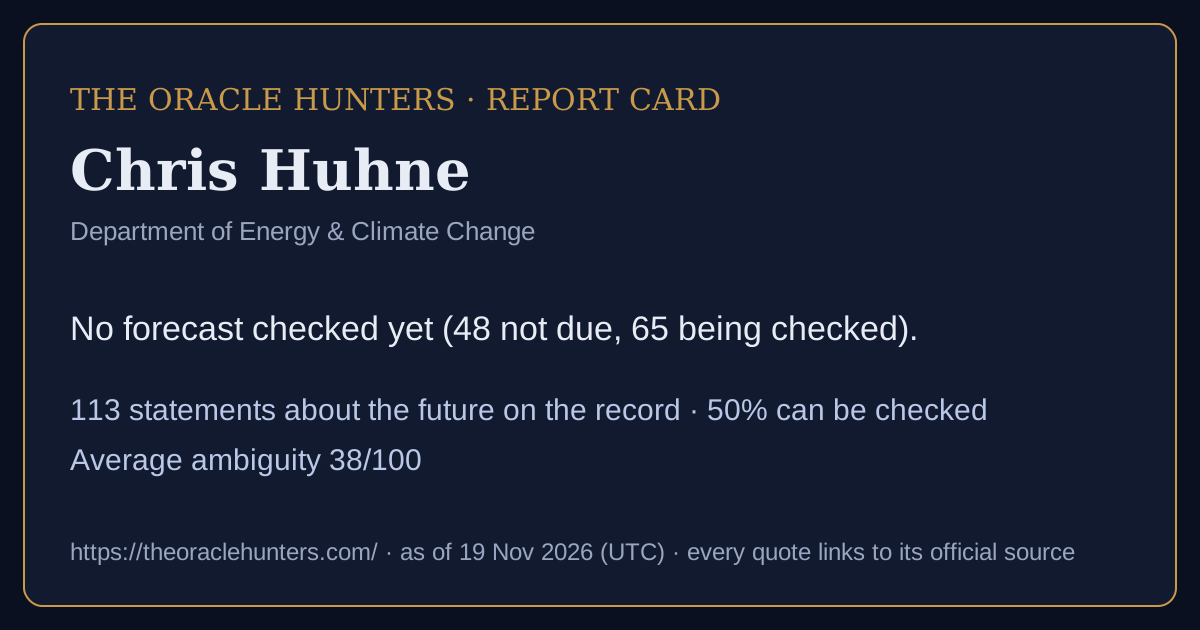
Track record: No forecast checked yet (48 not due, 65 being checked).
113forecasts & commitments on the record
50%can be checked as stated
38average ambiguity (0-100)
0goalpost moves recorded
0confirmed U-turns
Timeline
came true partly did not not due / being checked / too vague
Calibration score: shown after 10 checked forecasts with a stated likelihood (now 0).
How they speak about the future: based on data 87, stated on authority 20, educated guess 6.
Kinds of claim: forecast 66, mixed claim 35, scenario (if… then) 6, commitment 6. · Download this report card as a picture
In the nine words
πρόγνωσιςInference from evidence80 · 71%μαντείαInspired knowledge15 · 13%προαναγγελίαPublic pre-announcement6 · 5%πρόνοιαPreparing for the future6 · 5%πρόβλεψιςSeeing the signs4 · 4%εἰκασίαConjecture2 · 2%
How to read this
Each box is one sentence a public figure or institution said about the future, word for word, with a link to the official text. Can be checked means it names what will happen, by when, and how likely - so it can be compared with official figures later. Too vague to check means it does not. Ambiguity (0-100) is how many different ways the sentence can be read. When the date passes, the forecast is compared with official data and marked came true, partly or did not come true. Labels judge the sentence, never the person. Full guide and glossary.On the record (113)
Our energy import dependence could double by 2020.
Globally, the low-carbon and environmental sector is already valued at £3.5 trillion; by 2015, it is projected to reach £4 trillion.
Many details remain to be worked out over the coming months, including specific emissions reduction targets, the length of the commitment period, and a process for dealing with surplus emissions allowances.
The commitments in the new agreement will take effect from 2020.
By the end of 2012 we will have met in full our pledge of £1.5 billion in fast start finance.
Such a deal may be beyond our reach this year.
We are building towards the $100bn of climate finance that the developed world has promised to mobilise by the end of this decade.
We will also do what we can we help Africa find a path that leads to strong low carbon growth.
But the first Kyoto Protocol commitment period comes to an end next year, and Japan, Russia and Canada have said categorically that they will not enter another.
Our £2.9 billion International Climate Fund will provide scaled up climate finance out to March 2015.
We will push hard on this early next year.
But it is very much the UK’s intention that the Green Fund will be a key part of the finance delivery landscape, in which we will aim to put substantial parts of our climate finance if we can get the rules right over the next year or so.
We’re missing a trick unless we start supporting low-carbon manufacturing here in Britain - and grow the green supply chain: locking in profits and expertise, and creating the exports that will keep Britain competitive.
And as part of this work, our first call for proposals will focus on components of emerging offshore wind systems, with budget of up to £5m.
And by attracting in new investors, we will also increase competition in the UK energy market.
By the end of this decade, we must cut our carbon emissions by 34% on 1990 levels.
We expect green capital investment in heat to rise by £7.5 billion by 2020, supporting 150,000 manufacturing, supply chain and installer jobs.
But the Committee on Climate Change estimates that even with 65% of our energy provided by renewables in 2030, intermittency may cost just 1p per kilowatt hour.
Each of the reactors planned for the next fleet will deliver investment equivalent to that for the 2012 Olympics.
Half of my department’s budget goes in cleaning up this mess, and it will rise to two thirds next year.
From 2013, there will be new political leadership in the world’s major economies.
It’s expected to provide 18 million people with low-carbon, affordable transport, provide over 12 megawatts of clean electricity - and thousands of jobs.
Yet the pledges made in 2009 could, if met fully, could take us 60% of the way to our goal for 2020.
In Bangladesh we will help 15 million more people to protect themselves against the effects of climate change and natural disasters by building embankments and shelters, promoting climate resilient crops, and improving access to safe drinking water.
And we will be a powerful advocate for change when we host the third Clean Energy Ministerial here in London in 2012.
If we have not achieved a global deal by then, we will struggle to peak emissions by 2020.
Finally, the reforms I have set out today will achieve our aims at least cost to the consumer, with bills for households and businesses likely to be lower and less volatile over the period to 2030 than if we had left the market as it is.
If temperatures were to rise by just one degree - a rise so small you could barely feel it - then 65% of maize-growing areas in Africa would be less productive.
Not what causes climate change, or how we might stop it; but what it will mean for our world, and our way of life, if we do not stop temperature rising.
We know that climate change made the floods in autumn 2000 - which cost £3.5 billion, and flooded over 10,000 homes - two to three times more likely.
According to the UN Development Programme, the impacts of climate change could push another 600 million people into malnutrition by 2080.
The picture I will paint presupposes two things: that population growth remains steady, and that high carbon emissions result in dangerous climate change - both of which are likely if we do not tackle carbon emissions globally by 2020.
It is growing by 4% a year, faster than developed world gdp, and will accelerate.
We will face stiff competition: green growth is the hottest ticket in town.
It will open for business in 2012, using public money to unlock private investment in the companies that will deliver green growth.
And the oil price, as we have seen this year, could well be higher.
Indeed, IEA analysis shows that carbon capture and storage will have to deliver around 20% of global emission reductions by 2050.That’s around 3400 CCS plants by 2050, a fast-expanding market where the UK technology puts us in pole position. Around the world, some US$40 billion has already been earmarked for CCS projects.
The $46 billion Korea is investing in its ‘Green New Deal’ will create 960,000 jobs by 2012.
Independent analysis suggests export opportunities for the British economy could reach £3-to-10 billion a year by the late 2020s.
Without carbon capture and storage, the cost of staying below 2oC could be 70% higher.
Along with other carbon abatement technologies, CCS could sustain 70,000 to 100,000 jobs by 2030.
This will help us reach agreement in Europe on moving to a 30% emissions reduction target - and build momentum toward a legally binding global climate change deal
In line with the Coalition Agreement, Government will continue to argue for an EU move to a 30% target for 2020, and ambitious action in the 2020s.
To overcome this and to provide clearer signals for businesses and investors, government will review progress towards the EU emissions goal in early 2014.
This will take the form of the revised government carbon plan later this year, following the publication of the interim version in March.
Before the end of the year we will be announcing a package of measures for energy intensive businesses whose international competitiveness is most affected by our energy and climate change policies.
We will undertake a review of progress in early 2014 to ensure our own carbon targets are in line with the EU’s.
Let me repeat: once a property has had the Green Deal, payment will stay on the energy bill at that address - even if the occupants move out.
The review will produce an interim report in the Autumn, and a final report early in 2012.
The number of people employed in insulation alone could soar from 27,000 to 100,000 by 2015.
Showing the newest 50 - the ledger has all 113.
Also said - not checkable as stated (12 newest)
Remarks about the future with no date, figure or likelihood that could be checked. They are kept on the record and shown here, but not scored.
To meet the global 2 degree target and create a greener future, we will have to take some difficult decisions.
Only in China could single-digit growth in GDP be considered low.
Oil or gas price shocks could reverberate throughout our fragile economy, hampering growth.
And as China considers a form of emissions trading system to help deliver its ambitious domestic targets, UK and EU experience could prove a valuable resource - including technical and political support for domestic data management and reduction verification.
Change on that kind of scale will not go unnoticed - and nor should it.
Over the next few weeks, the competition website will be open for comments - and those comments will be taken into account by the judging panel.
Demand for electricity could double over the next forty years, as we turn our backs on internal combustion engines and gas boilers.
Clean, green electricity will power our cars and heat our homes.
I believe that the way that we deliver energy should be as beautiful as it can possibly be.
We need to start thinking - and talking - about what energy means to us.
The UK is one of the few countries to have pledged climate finance beyond the initial ‘fast-start’ period, and we will make an announcement on the Green Climate Fund once its design is completed.
It has persuaded the major emerging economies to acknowledge, for the first time, that their own emissions commitments will have to be legally bound.