Chris Grayling
Department for Work and Pensions · GBR
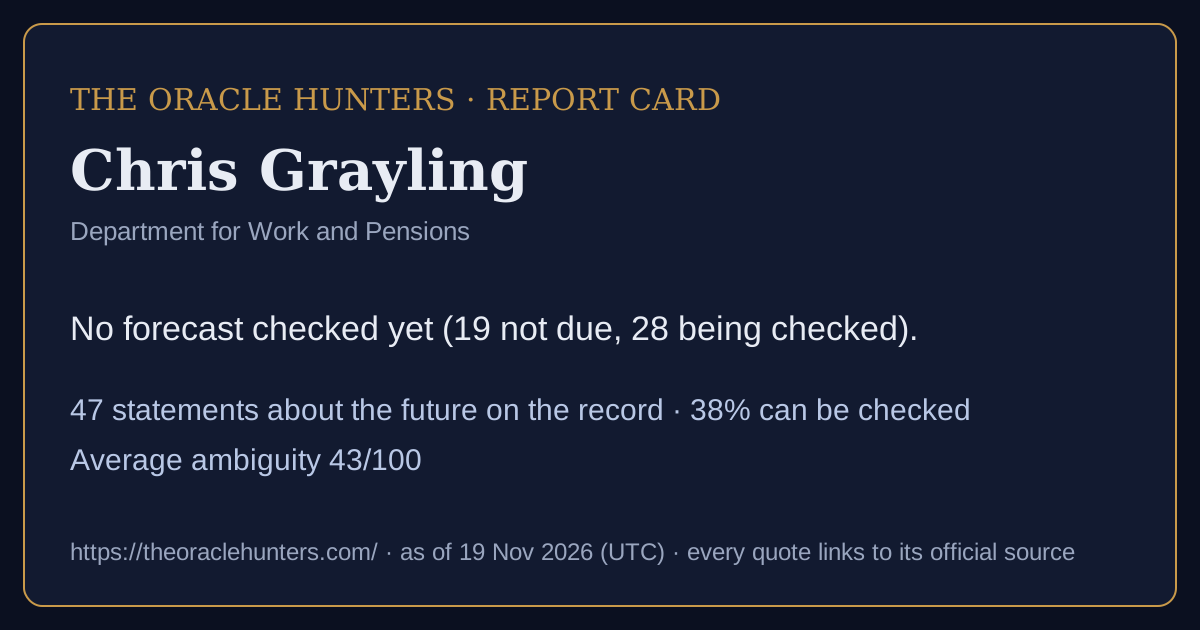
Track record: No forecast checked yet (19 not due, 28 being checked).
47forecasts & commitments on the record
38%can be checked as stated
43average ambiguity (0-100)
0goalpost moves recorded
0confirmed U-turns
Timeline
came true partly did not not due / being checked / too vague
Calibration score: shown after 10 checked forecasts with a stated likelihood (now 0).
How they speak about the future: based on data 37, stated on authority 8, educated guess 2.
Kinds of claim: forecast 33, mixed claim 10, commitment 3, scenario (if… then) 1. · Download this report card as a picture
In the nine words
πρόγνωσιςInference from evidence35 · 74%μαντείαInspired knowledge6 · 13%προαναγγελίαPublic pre-announcement3 · 6%εἰκασίαConjecture2 · 4%πρόνοιαPreparing for the future1 · 2%
How to read this
Each box is one sentence a public figure or institution said about the future, word for word, with a link to the official text. Can be checked means it names what will happen, by when, and how likely - so it can be compared with official figures later. Too vague to check means it does not. Ambiguity (0-100) is how many different ways the sentence can be read. When the date passes, the forecast is compared with official data and marked came true, partly or did not come true. Labels judge the sentence, never the person. Full guide and glossary.On the record (47)
We have the largest global hub for maritime services in London and the lowest headline rate of corporation tax in the G7 and one which will fall to 17% next year.
So as well as ratifying treaties such as the Ballast Water Management and Hong Kong conventions that seek to lessen maritime’s environmental impact, this document underlines how we will work with our partners at the IMO towards a global target of cutting maritime greenhouse gas emissions by at least 50% by 2050.
We are now updating the business case and anticipate being able to announce a delivery date in the next year.
The wider modernisation of northern roads will continue - through to the next stage of our Roads Investment Strategy between 2020 and 2025.
the completion of a continuous motorway route on the A1(M) and M1 between Newcastle and London which I opened in May this year
It will also provide better links to the £1 billion Airport City that’s already proving to be a catalyst for jobs and growth across south Manchester and Cheshire.
Without the £52 billion that aviation adds to our GDP, the million jobs it supports and all the inward investment it generates, we simply could not have reduced our deficit by three quarters over the past 7 years or achieved the record employment levels which we see in Britain today.
After our call for evidence last year, we will publish our response next month.
And to support further growth, we’re investing £100 million in R&D – match-funded by industry – across more than 50 collaborative projects.
In fact, I expect the first self-driving cars to reach the market – and to be used on UK roads – by 2021.
But it is estimated that the market for autonomous vehicles could be worth £28 billion to the UK by 2035.
Without action, by 2030 total delays due to inefficient use of airspace capacity could be 70 times more than in 2015.
By the end of 2019, all of them will be cut up for recycling, to be replaced by the kind of modern replacements that this region needs so badly.
The next operator will deliver modern, fast and efficient intercity and commuter trains, including a brand new set of bi-mode intercity trains from 2022.
A comprehensive upgrade that from 2020, will deliver faster and more comfortable journeys for millions of passengers — from Bradford to Blackburn and Stockport to Sheffield.
Earlier this year, PWC published a detailed report, looking at how the global economic order will change by 2050.
In 2018 we will publish a final white paper setting out our plans.
I am delighted that the Chancellor has made £80 million funding available through the Autumn Statement to support further infrastructure roll out for smart ticketing by the end of 2018.
In the early part of next year, the first phase of construction of HS2 to Birmingham will begin, and I recently announced the government’s preferred route for the further stages of that path to Manchester, Leeds and beyond.
Next year we will introduce longer trains on the line, with a 30% addition to capacity.
We’re nearly at the end of the £15 billion Crossrail project – on time and on budget.
Yet next year that title will be inherited by another UK project: HS2.
And we should expect Heathrow’s 3rd runway to start construction around 2022.
The Confederation of British Industry says that if the UK retains its aviation market share, air traffic growth in Asia alone will create an extra £4.7 billion in exports over the next 10 years, and the creation of 20,000 high value jobs.
In August I visited Manchester and saw how the new relief road will benefit the airport when it opens next year.
Delay Repay 15 will begin as quickly as possible, and will become easier for passengers next year when smart card users will be emailed by the operator and told when to claim compensation.
So that in 2033, we no longer have a rail network with a Victorian heart, but a network with an Elizabethan heart, able to deliver everything we expect of a 21st century transport system.
And when HS2 is open, it will support a further 100,000 jobs in the wider economy, 70% of which will be outside London.
That is why we will be making a further £40 million of funding available to support community and business projects that will enhance local life.
On the railways, we’re pressing ahead with electrification of the Midland Mainline, which by 2019 will allow electric trains to run from Bedford to Kettering and Corby.
Signalling our intention to put Parliament at the heart of these changes, ministers will be under a duty to report to Parliament on progress towards achieving the highest employment rate in the G7 and on progress against meeting our target of creating 3 million new apprenticeships.
In the first instance the best way to deliver that support is by bolstering the economic recovery and that is why new legislation will help to create 2 million more jobs in this Parliament and also enshrine in law our commitment to creating 3 million more apprenticeships.
Indeed, you might be one of the 13% of prisoners who claims never to have had a job in their lives.
He will be slightly more likely than not to have a long-term medical condition (51%) and nearly one in three will have a mental health condition.
We are determined to build that jigsaw as quickly as possible to create an environment were working together can see sustainable growth, in employment and economic activity and to see your businesses and your members go from success to success.
That is why first and foremost we remain focused upon reducing the deficit, but also alongside that work we will do everything we can to stimulate the economy, and provide support to get people into employment.
This has left 2.6 million disabled people on out of work benefits, many of whom could work, if given the right support.
I want next year’s annual report to say bids were up again on this year and that the Health and Safety Laboratory’s market share has increased yet further.
In addition, from August this year we will give Jobcentre Plus advisers the power to require some benefit claimants to attend training if someone is clearly missing a bit of their skills jigsaw that would help them to get a job.
Nor can it be right that until March this year people were allowed to claim excessive rates of Housing Benefit in parts of London - thousands of pounds per month in some cases - to pay rent that the vast majority could not afford, even those on high incomes - and those people themselves could not afford when back in …
The Work Programme will begin next month, and I believe it will transform the lives of many of our most vulnerable people.
But by incentivising work and making sure it pays with a simple taper through Universal Credit, we will strip away much of that complexity - reducing administration costs along with the opportunities for fraud and error that currently cost £5 billion per year.
So over the next 3 years, we will reassess 1.5 million people using the Work Capability Assessment, which looks at what people can do, rather than what they can’t.
From June this year, around six hundred thousand people a year will be referred to specialist providers.
The introduction of the Universal Credit will be detailed in a White Paper to be published shortly and put to Parliament in a Welfare Reform Bill next year.
This will save us £17.5 billion per annum by 2014-15.
So over the course of the next three years, we will reassess some 1.5 million people to make sure that everyone gets the support they need.
Also said - not checkable as stated (12 newest)
Remarks about the future with no date, figure or likelihood that could be checked. They are kept on the record and shown here, but not scored.
And despite the challenges involved, I’ve no doubt we will succeed in making the case for an airspace that’s ready to meet the needs of communities and the demands of the 21st century.
So, I hope soon we will have much greater clarity.
So, we need to work harder at conveying the message of why modernisation is needed - ahead of the formal consultations in 2021 and 2022 on proposed new flight paths.
As well as setting out how we will reduce greenhouse gas emissions and air quality pollutants from UK shipping, we will move to bring the UK’s penalties for ships breaking environmental law in our waters in line with international best practice, while encouraging the use of advanced technologies to help maritime environmental law enforcement.
And Maritime 2050 details how we will do that.
This document lays out how we will support these maritime clusters.
And how we will use our influence in the international arena to exert positive change for the global maritime sector.
And I believe the creation of HS2 will super charge economic growth for the north and the Midlands while providing the extra capacity required on busy north to south rail routes, which are currently among the most intensively used in Europe, and encouraging employers and businesses to not just focus on London and the south-east but the country as a …
Last autumn I joined West Midlands Mayor Andy Street to meet the team delivering the HS2 station at Curzon Street in Birmingham where the railway will help transform the city centre, and could unlock up to 36,000 jobs and 4,000 new homes.
It’s your work today that will help ensure the growth and prosperity of the whole country for generations to come.
But today, when we know that we will not get an improved deal if this one is rejected, then the decision to back it now is even more clear cut.
Bilateral arrangements will allow cross border rail services to continue – such as between Belfast and Dublin, and through the Channel Tunnel.