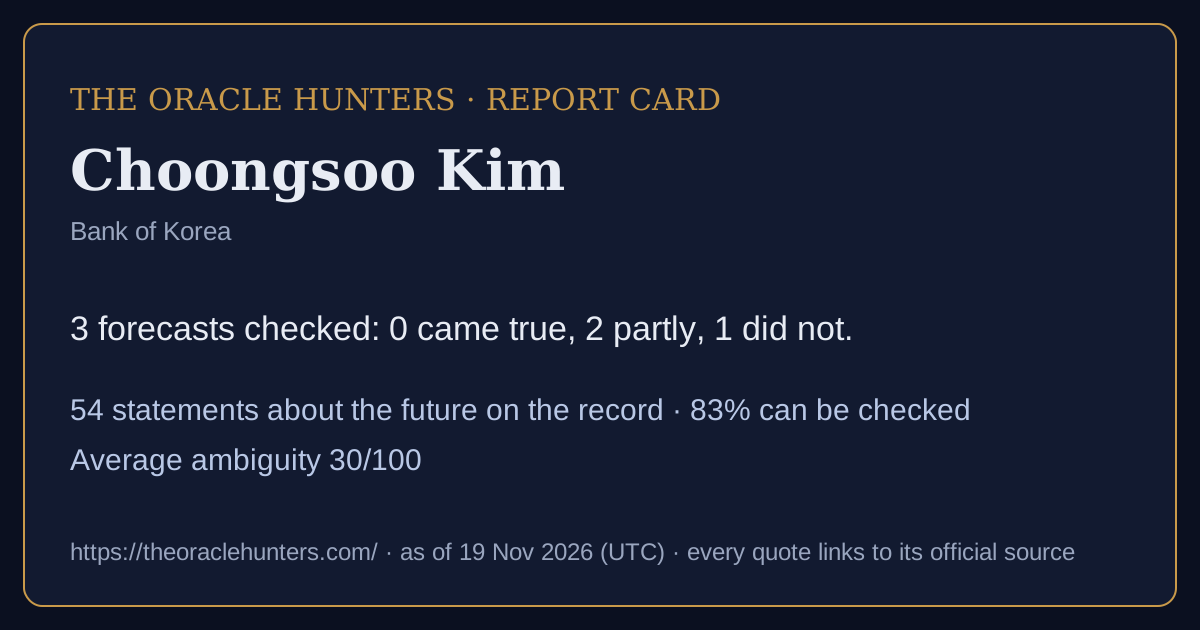
Choongsoo Kim
Bank of Korea
Track record: 3 forecasts checked: 0 came true, 2 partly, 1 did not.
54forecasts & commitments on the record
83%can be checked as stated
30average ambiguity (0-100)
0goalpost moves recorded
0confirmed U-turns
Timeline
came true partly did not not due / being checked / too vague
Calibration score: shown after 10 checked forecasts with a stated likelihood (now 2).
How they speak about the future: based on data 37, stated on authority 10, educated guess 7.
Kinds of claim: forecast 39, mixed claim 8, scenario (if… then) 7. · Download this report card as a picture
In the nine words
πρόγνωσιςInference from evidence35 · 65%μαντείαInspired knowledge9 · 17%πρόνοιαPreparing for the future7 · 13%εἰκασίαConjecture2 · 4%πρόβλεψιςSeeing the signs1 · 2%
How to read this
Each box is one sentence a public figure or institution said about the future, word for word, with a link to the official text. Can be checked means it names what will happen, by when, and how likely - so it can be compared with official figures later. Too vague to check means it does not. Ambiguity (0-100) is how many different ways the sentence can be read. When the date passes, the forecast is compared with official data and marked came true, partly or did not come true. Labels judge the sentence, never the person. Full guide and glossary.Checked
- The unemployment rate should drop from 3.8% this year to around 3.5% next year.
Partly came true. Said: unemployment around 3.5% in 2011. Official figure for Korea, Rep.: 3.0% (World Bank open data). Close: outside the margin, but within one more half point. Off by 0.5 points. official data · checked 14 Nov 2026 · automatic check against official data (rules v3)
GDP growth in 2011 is likely to come in at around 4.5%, somewhat lower than this year's.
Partly came true. Said: economic growth around 4.5% in 2011. Official figure for Korea, Rep.: 3.7% (World Bank open data). Close: outside the margin, but within one more half point. Off by 0.8 points. official data · checked 14 Nov 2026 · automatic check against official data (rules v3)
The GDP growth rate is projected to rise to 5.2% this year and 4.8% next year.
Did not come true. Said: economic growth around 4.8% in 2011. Official figure for Korea, Rep.: 3.7% (World Bank open data). Missed. Off by 1.1 points. official data · checked 14 Nov 2026 · automatic check against official data (rules v3)
On the record (54)
If the potential growth rate declines and policies are implemented without considering this, there is the danger of overestimating the negative GDP gap in absolute terms in a time of crisis, and this could lead to excessive policy responses.
The G20 meeting last month agreed to include in the communique that G20 countries will aim to increase their growth rates by 2%p over the next five years, and this marks a drastic turning point.
I believe that this was appropriate in terms of managing economic agents' inflation expectations, but it is very regrettable that we could not reduce the lower bound to below 2.5%.
Basel III on strengthening capital requirements will take effect globally from this year, and it has been decided that the Volcker Rule, which drew the most attention in the Dodd-Frank Act, will apply from July 2015.
This year there will be many changes in the Bank of Korea's policies, as much as in the external environment.
From the next quarter we also plan to release a 'BOK Quarterly Regional Economic Report', in which all domestic branches will take part.
We have set the medium-term inflation target range at from 2.5 to 3.5 percent for the next three years beginning from 2013, and are operating monetary policy accordingly.
I would like to suggest the following seven points, as attitudes and thoughts that I hope we will hold in our minds throughout this year:
As we can learn from Asian countries' experience in overcoming the late 1990s Asian financial crisis very fast on the back of major advanced nations' robust economic growth, if EMEs can sustain their relatively high growth rates as at present, this will be greatly helpful to advanced nations in breaking free from the current dilemma of reducing sovereign debt or …
To put it another way, a 1% increase of per capita GDP of advanced nations will lead to a 0.4%p per capita GDP growth in EMEs, and a 1% increase in per capita GDP in EMEs will be translated into 0.3%p per capita GDP growth in advanced economies.
The IMF recently estimated in its global economic outlook that while the contribution of EMEs to the global economic growth is expected to remain about 70% for the next five years as in the late 2000s, their share in the global GDP is forecast to continue to increase to 54% in 2016.
According to IMF estimates, emerging Asian economies' contribution to global GDP growth has risen from below the 30% level in the 1970s, to the mid-40% range in the 1980s up until the global financial crisis and as high as 50% during the past five years of the crisis, and is expected to be maintained at such a level for the …
According to a recent study by the Bank of Korea, a one percent increase in EMEs' GDP will boost AMEs' growth by 0.3 percentage point.
If we agree that the new global financial regulations will make crossborder capital flows less volatile, we should expect Asia to be able to reap the benefits of financial integration at lower risk.
Even in the face of heightened economic uncertainty at home and abroad, the Korean economy is forecast to grow at around 3 1/2% this year, led by domestic demand including facilities investment.
A simple, albeit speculative, calculation shows that such fiscal tightening will decrease the debt ratio by one percentage point if the fiscal multiplier is small enough, but push it up one percentage point if for example the fiscal multiplier is 1.5.
But it is at the same time true that sovereign debt sustainability will be at serious risk if the current anemic growth continues.
The latest projections by the IMF indicate EMEs' contribution to global economic growth as likely to remain at about 70% over the next five years, and their share in world GDP to be as high as 54 percent by 2016.
Italy and Spain are both projected to register negative growth for this year - at -2.2 and -1.7 percent, respectively.
The IMF projects that the average public debt ratio among G7 countries will rise to over 110 percent by 2016, with shrinking but still substantial fiscal deficits in the US and other countries over the projection horizon.
Many EMEs rely heavily on external demand for growth, and therefore will face challenges going forward if advanced economies do not grow fast enough.
Despite some irregular signs of economic recovery in the United States, the most recent economic outlook by the IMF points toward slower economic growth this year in advanced economies, particularly those in Europe.
Economic growth and financial prowess will prove elusive if systemic risk is not brought under adequate control.
We will need to strive actively to form a concrete foundation for strengthening the Bank's role in financial stability.
Amid the build-up in demand pressures from our swift recovery from the global crisis and economic upswing, consumer price inflation, after recording 4.1% in January, marked 4.5% in February, exceeding the upper bound of the Bank of Korea's medium-term inflation target.
The growth outlook for the Korean economy this year is clouded by the existence of several downside risks, among them the political unrest in the Middle East and North Africa, and resultant rise in international oil prices, and domestically, the damage caused by foot-andmouth disease.
Having said that, I expect inflationary pressures to be concentrated more in the first half of this year than in the second half, and particularly those stemming from supply-side factors like international commodity prices to ease in the second half relative to the first.
In the coming months, consumer price inflation may remain elevated at a high level for some time.
And as the effects of these downside and upside risks are likely to be of similar magnitude, we at the Bank of Korea expect the Korean economy to achieve favorable growth at the originally-forecast level of around 4.5% this year, with balanced contributions from exports and domestic demand.
Budgetary expenditures next year will be increased 6.0% over this year (260 trillion won) to 276 trillion won while for the year 2012 there will be a 4.0% increase to 287 trillion won.
- The major economic forecasting institutes are predicting that the rate of growth of the world economy will be a little above 4% in 2011 and around 4 1/2% in 2012.
While the Korean economy will stay on a solid growth track in 2011, political initiatives should be directed toward raising the living conditions of the public at large including the boosting of purchasing power by way of price stability and the creation of 'decent jobs', given the persistent gap between public perceptions of the level of economic activity and the …
- The unemployment rate should drop from 3.8% this year to around 3.5% next year.
Partly came true. Said: unemployment around 3.5% in 2011. Official figure for Korea, Rep.: 3.0% (World Bank open data). Close: outside the margin, but within one more half point. Off by 0.5 points. official data · checked 14 Nov 2026 · automatic check against official data (rules v3)
- Facilities investment, similarly, should mark a solidly-based upward trend, but the scale of its increase is expected to narrow owing to the completion this year of the majority of investment projects held over because of the financial crisis (6.5% in 2011 and 6.3% 2012).
2. The trend of an increase in economic activity should continue as next year's Q4 growth (year-on-year) is projected at 5.6%, well above this year's 4.8%.
Korea and Europe will get much closer to each other as the Korea-EU FTA takes effect from July of next year.
If countries pursuing economic development based on the principles of economic liberalization and market opening remain highly vulnerable to external shocks, the future effect will be harmful: in choosing their development strategies, many of the world's developing countries will choose to not pursue free trade.
In this year of 2010, growth rates in Asia are expected to climb to 7.5%, and the forecast is that they will account for 40% of world economic growth this year. 4
According to a study by Professor Angus Maddison, in real PPP terms Chinese GDP is projected to surpass that of the US by 2015, and the sum of Chinese and Indian GDP will be double US GDP by 2030. 1 From this observation, we can easily infer how fast the Asian economy should grow relative to the rest of the …
- Government expenditures for this year will contract to 261.4 trillion won, 4.2% less than last year's (272.9 trillion won).
- GDP growth for this year as a whole will be somewhere very close to 6% and next year it is expected to continue at its potential level.
In the case of China, the government's targeted 8% growth is likely to be easily reached both this year and next year.
- → The ratio of the current account surplus to GDP is expected to drop from 5.1% in 2009 to 2.0% this year and further to 1.0% in 2011.
- Core inflation, which strips out food and energy prices, is similarly expected to accelerate substantially from this year's 1.8% to 3.1% next year.
GDP growth in 2011 is likely to come in at around 4.5%, somewhat lower than this year's.
Partly came true. Said: economic growth around 4.5% in 2011. Official figure for Korea, Rep.: 3.7% (World Bank open data). Close: outside the margin, but within one more half point. Off by 0.8 points. official data · checked 14 Nov 2026 · automatic check against official data (rules v3)
Although consumer price inflation is presently holding steady at around 2.6%, upside price pressures are expected to build up going forward.
Actually the rate of GDP growth in the latter half year is forecast to drop from that of the first half, running at around 0.8% quarter on quarter.
Going forward, from the latter half of this year onwards, the robust growth trend is expected to carry on at around the level of the potential GDP, led by the private sector.
It should be particularly remarked that the rate of headline inflation is forecast to move above the midpoint of the Bank of Korea's medium-term target from the fourth quarter of this year onwards.
However, the expected cumulative losses in world output associated with the crisis for the years from 2008 to 2015 are forecast to run at $4,700 billion, about 20 times the initial subprime loss. 5 Then, the following question is an obvious one: How could such a relatively limited event have effects of such magnitude on the national or world economy?
Showing the newest 50 - the ledger has all 54.
Also said - not checkable as stated (12 newest)
Remarks about the future with no date, figure or likelihood that could be checked. They are kept on the record and shown here, but not scored.
We should not think that it is the role of the central bank to conclusively indicate that short-term interest rates will move the following month.
Both advanced and emerging market central banks should place their priorities on dealing with these issues, even if the degrees may differ.
Of course, there will be no disagreement that the central bank policy directions must be kept predicable in the medium- to long-term, through clear exchanges of information.
Meanwhile, I believe strongly that all of our central banks will respond adequately to the many difficulties we face, while broadening our mutual understandings of each other through the BIS meetings.
And while the social costs of such a type II error may be latent or unmeasurable at the moment, taken all together the repetition of such errors will have non-negligible social costs, which will have subsequent negative impacts on the growth potential of the economy.
I also envied you, as we Koreans must take a more than 10 hour-flight to see and visit the Chateau, but you French Central Bank people enjoy your lives working at the gorgeous Chateau.
With the G4 economies highly likely for the time being to adopt divergent policies, and to continue to develop new tools, we have to closely analyze the positive and negative effects of the implementation of non-traditional monetary policy tools that have been accumulating over time, and develop countermeasures to cope with them.
We should constantly bear in mind the question, 'What does the Bank of Korea mean to me, and who am I to the Bank of Korea?' If you get into the habit of asking yourself, 'What if this organization were to work well without me?' as you go about your business, you will develop yourselves as time passes.
As it is very difficult to forecast the direct and the indirect effects of such developments in advance, we need to respond in a flexible manner by keeping our guards up to ensure that we do not overlook any changes in the domestic and international markets by thinking flexibly.
Although the reform efforts will need to be continued going forward, agreement has been reached on a broad framework.
Financial systems of major economies have yet to be repaired in full and will have to adapt to new and more complex regulations.
Of course, the dearth of precedents makes it difficult to tell at what pace the unwinding of unconventional monetary policies should be carried out, and to predict what form its influences may take.