Chloe Smith
HM Treasury · GBR
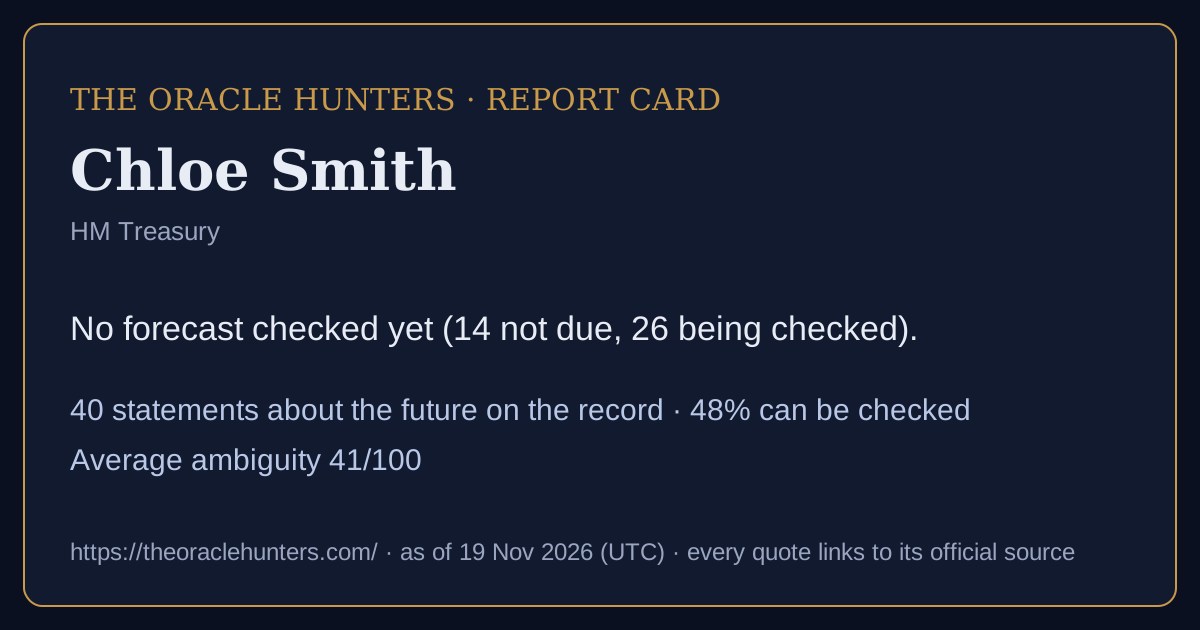
Track record: No forecast checked yet (14 not due, 26 being checked).
40forecasts & commitments on the record
48%can be checked as stated
41average ambiguity (0-100)
0goalpost moves recorded
0confirmed U-turns
Timeline
came true partly did not not due / being checked / too vague
Calibration score: shown after 10 checked forecasts with a stated likelihood (now 0).
How they speak about the future: based on data 29, stated on authority 8, educated guess 3.
Kinds of claim: forecast 28, mixed claim 10, commitment 2. · Download this report card as a picture
In the nine words
πρόγνωσιςInference from evidence28 · 70%μαντείαInspired knowledge7 · 18%εἰκασίαConjecture3 · 8%προαναγγελίαPublic pre-announcement2 · 5%
How to read this
Each box is one sentence a public figure or institution said about the future, word for word, with a link to the official text. Can be checked means it names what will happen, by when, and how likely - so it can be compared with official figures later. Too vague to check means it does not. Ambiguity (0-100) is how many different ways the sentence can be read. When the date passes, the forecast is compared with official data and marked came true, partly or did not come true. Labels judge the sentence, never the person. Full guide and glossary.On the record (40)
A deal that will bring more innovative cancer research to the UK, delivering roughly 10,000 personalised therapies by 2030.
In partnership with UKRI MRC and Alzheimer’s Research UK, we will be investing £9.5 million into better understanding – and treating – traumatic brain injuries.
Building on the Prime Minister’s announcement earlier this week of two new Turing AI World Leading Fellowships, my department is today announcing a £50 million package with UK Research and Innovation – funding for 42 new projects to explore the acceleration of responsible AI and machine learning.
The opportunities here are extraordinary: our own statistics show that the productivity boost of robotics adoption in just 7 service sectors of our economy could be up to £150 billion in 2035 – that is just short of the current GVA of the entire UK financial services industry!
Over the next three years, our government will invest £1.3 billion in employment support for disabled people and people with health conditions.
We had that profound achievement by seeing 1.3m more disabled people go into work, that has improved the lives of many disabled people, but there’s more to do to change lives tomorrow, the next day, next month and in the next decade.
We will offer more support to the 2.8 million people with health conditions receiving Universal Credit or Employment Support Allowance.
The Law Commission is examining ways to deal more effectively with co-ordinated harassment and abuse carried out by groups of people, and will publish their final recommendations this year.
I don’t know what you were up to in the run-up to the May elections this year, but even as most MPs and all kinds of other politicians and their teams across Great Britain were pounding the socially-distanced streets, my particular job was to make sure the elections could happen at all.
I’m going to touch first on the elections we’ve just seen this year.
That relative stability will enable us, working closely with you and your teams, to plan and implement important reforms over this year and beyond so that our democracy and elections continue to be admired across the world and command the confidence of voters.
My team will shortly be communicating plans for Local Authorities to start preparing to use their own data and to test the data match step in early 2020.
The government will share more examples this year where we are best placed – for example we are leading on research on how to remove registration barriers for people who are homeless or move frequently.
We will shortly publish further details about what we intend to do before the next scheduled General Election in 2022.
We will leave the political institutions of the European Union on 29 March 2019.
We are working with electoral administrators to ensure that we understand the ‘real world’ impact of IER and there will be plenty of number crunching and process crunching in the coming weeks with electoral administrators to ensure that the indicative figure we give each of you next month starts from a realistic and credible position.
Currently, as you will know, at least 85% of people who are eligible to vote are already registered.
So from June 2014 when IER is introduced, people will be able to register to vote online for the first time.
In a few months’ time we reach our next milestone, when we will assess the readiness to go live with Individual Electoral Registration in 2014.
And if we are smarter, more skilled and more open about how we do business, we will ensure the public sector is spending taxpayers’ money more effectively, more efficiently – and in ways that actively promote growth.
We will only achieve true taxpayer value, reduce the deficit, and promote growth if we continue to transform our approach to buying – placing more emphasis on early market engagement and making the procurement process more efficient.
Last year alone £1.1 billion worth of projects signed up to use Project Bank Accounts and I’m pleased to announce today that in 2012/13 we exceeded our target of £2 billion, with nearly £2.2 billion of spend having been committed via Project Bank Accounts since their introduction.
So successfully delivering projects at 15 to 20 per cent less than the historic benchmark will mean that the public sector will be building £1.2 billion worth more in projects by 2015.
We are well on our way to exceeding our target of £2 billion of committed spend being contracted via Project Bank Accounts since their launch.
We will only achieve growth if we in government and the wider public sector really transform our approach to buying – placing more emphasis on early market engagement, and discovering the value for money and innovation that SMEs can offer.
Many of you will be aware of this government’s aspiration to ensure that 25% of our business in central government should go – directly or indirectly – to SMEs by 2015.
Information on all these efforts can be found on GOV.UK and we will be reporting back again to parliament again at the end of this year.
By 2016 all Government construction projects will be using BIM level 2 – a goal we believe is very much achievable over the next three years.
In the 12 months since the launch of the Strategy we have taken steps, some significant, towards this position and Francis Maude will be making a statement later this year on our progress against the objectives of the Strategy one year on.
This international dialogue will continue in Seoul in 2013 and officials are already working with the South Koreans on building upon the achievements of London and Budapest.
This was followed up by a further conference in Budapest earlier this month where we announced £2m funding for a Global Centre for Cyber Security Capacity Building which will enable industry to back initiatives to tackle cyber crime and improve cyber security across the globe.
The subsea sector in particular has been very successful in recent years and is forecast to continue growing at around 8 per cent this year.
Increasing the climate change levy discount on electricity from the current level of 65 to 90 per cent from April next year;
By 2014-15, we expect around £18bn of additional investment in green infrastructure.
We will continue to review and amend those existing fiscal instruments to ensure they remain focused on achieving both economic and environmental objectives.
So at Budget 2011 we announced that the UK will be the first country in the world to introduce a minimum carbon price: £16 per tonne in 2013, rising gradually to £30 per tonne in 2020.
The bank is being allocated an initial capitalisation of £3bn and will be able to borrow from 2015/16 and when debt is falling as a percentage of GDP.
The transition to a green economy will require unprecedented investment in key green sectors - an estimated £200 billion for the energy system alone over the period to 2020.
Big Society Capital will be capitalised over the next five years using England’s share of the £400 million of money in dormant bank accounts.
It means from next year, anyone seeking to claim more than at £50,000 in reliefs, will have those reliefs capped at 25 per cent of their income.
Also said - not checkable as stated (12 newest)
Remarks about the future with no date, figure or likelihood that could be checked. They are kept on the record and shown here, but not scored.
We’ll be launching an open call this summer, where we will invite applications from those with bold visions to take their research to the next level.
So, although association is our hope, if we are unable to secure it on fair and appropriate terms, we will instead implement our bold and ambitious alternative – Pioneer.
But we want to go even further over the coming weeks and months.
That will allow NHS Trusts to accelerate the deployment of the most promising AI imaging and decision support tools.
Countries all over the world are thinking long and hard about how they should prepare for a technological change so fast and so significant that it could redefine the way we work and live our lives.
It’s these businesses which are making people’s lives better, spurring growth and creating employment opportunities that will unlock the full potential of communities right across the UK.
We know that there has to be a steady pipeline of investment over the coming years and that’s exactly what we’re providing.
And finally, we’re green-lighting a whole host of new UKRI projects for AI technologies that will help us reach our ambitious net zero targets.
Projects that will see a massive acceleration of energy efficient CO2 capture, especially in our new freeports and green freeports on the Scottish coast.
But it could also be used to create new pathogens that threaten human health, and bioweapons that could be used to harm people or disrupt critical infrastructure.
I think we need to work with business to grow economies – creating jobs and prosperity for citizens, building public trust.
Last month the Government met the commitment made in 2017 to see one million more disabled people in employment – in half the time expected.