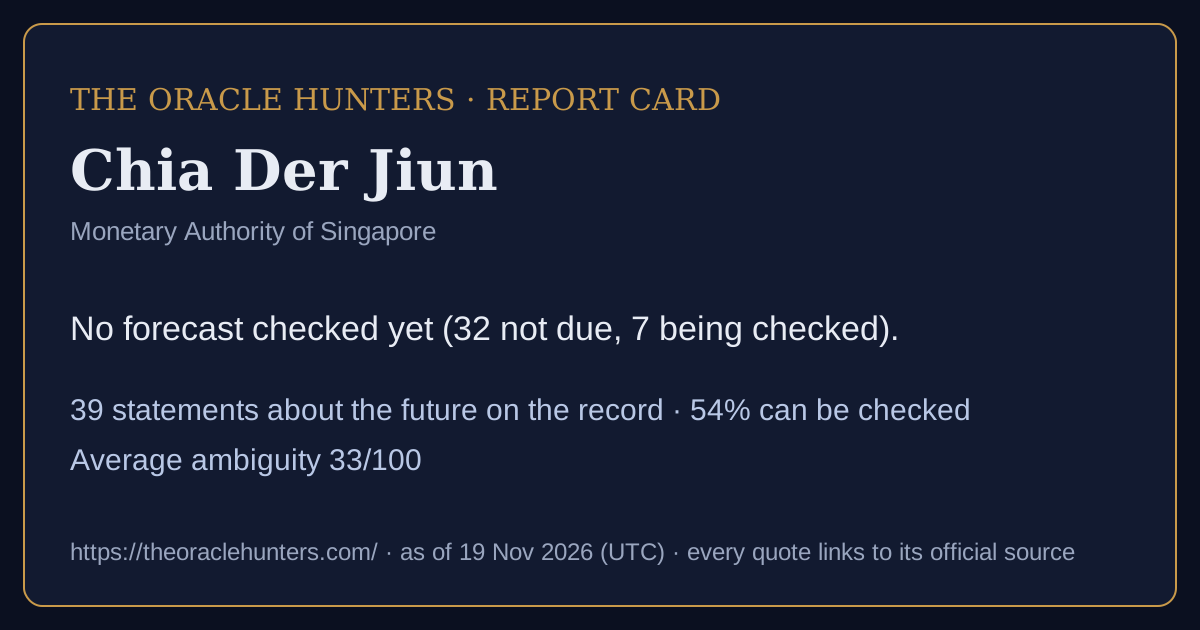
Chia Der Jiun
Monetary Authority of Singapore
Track record: No forecast checked yet (32 not due, 7 being checked).
39forecasts & commitments on the record
54%can be checked as stated
33average ambiguity (0-100)
0goalpost moves recorded
0confirmed U-turns
Timeline
came true partly did not not due / being checked / too vague
Calibration score: shown after 10 checked forecasts with a stated likelihood (now 0).
How they speak about the future: based on data 23, stated on authority 13, educated guess 3.
Kinds of claim: forecast 27, mixed claim 8, commitment 3, scenario (if… then) 1. · Download this report card as a picture
In the nine words
πρόγνωσιςInference from evidence23 · 59%μαντείαInspired knowledge10 · 26%προαναγγελίαPublic pre-announcement3 · 8%εἰκασίαConjecture2 · 5%πρόνοιαPreparing for the future1 · 3%
How to read this
Each box is one sentence a public figure or institution said about the future, word for word, with a link to the official text. Can be checked means it names what will happen, by when, and how likely - so it can be compared with official figures later. Too vague to check means it does not. Ambiguity (0-100) is how many different ways the sentence can be read. When the date passes, the forecast is compared with official data and marked came true, partly or did not come true. Labels judge the sentence, never the person. Full guide and glossary.On the record (39)
We expect volumes this year to grow even faster.
We expect to have findings from this work by the end of this year.
FFI will be operational in the next few months and scale up its programmes over the next year.
- The growth in 2025 broadly maintains the momentum over the 2021-2025 period, which averaged 4.6% in annual growth and added 4,200 jobs 1 annually, with the gains in employment going to locals.
MAS will next issue a set of supervisory expectations later this year with clear expectations, milestones and timelines for FIs' migration towards quantum resilience.
Inflation is forecast to step up further in July and stay elevated over the next few quarters before easing in the second half of 2027.
Inflation has picked up from a low base and will step up further in the period ahead before easing in the second half of 2027.
MAS Core and CPIAll Items Inflation are projected to average 1.5-2.5% in 2026, stay elevated in the first half of 2027 and ease discernibly in the second half of 2027.
Global economic growth and equity market valuations are highly reliant on AI, and could slow sharply or reverse if investment assumptions are reassessed.
If supply does not recover conclusively, the energy shock could have greater effects in the second half of this year as inventories are run down, and reduced supply of refined products exerts more of an impact.
Global growth forecast for this year has been downgraded 0.2 percentage points by the IMF in April to 3.1%.
It will be followed with a detailed document containing actionable insights and industry good practices next year, which can serve as a companion guide for FIs implementing the MAS Guidelines.
Over time, if some regulated stablecoins become systemic , regulatory frameworks will need to be strengthened further, cross-border regulatory cooperation enhanced, and access to central bank facilities considered.
We will release more details on this next year.
The pilot will start in January next year.
The IMF expects our region to grow 4.3% next year, a similar pace to this year.
Global GDP growth could moderate further in 2026 as the lagged impact of tariffs work through.
- The Asian Development Bank estimates that developing countries in Asia-Pacific will need to invest US$1.7trillion annually in infrastructure through 2030 to maintain growth, address poverty and mitigate climate change . 2
We remain committed to support the region's transition to a low-carbon economy, and are well-placed to do so.
The consultation on MAS' supervisory guidelines and the MindForge handbook will be published towards the end of this year.
The average annual net jobs created for 2021-2024 was 4,400 1 , with more than 90% of these going to locals.
Notably, the (released yesterday) show that GDP growth of Advance Estimates 4.3% year-on-year in Q2 was somewhat stronger than expected.
- Almost S$1.1 trillion in financing is estimated to be needed over the next decade to ramp up renewable energy capacity, upgrade existing power grid infrastructure, and invest in battery storage systems. 4
In doing so, we will unlock new opportunities for growth, create jobs, build resilient economies and make possible a more resilient future for all of us.
- Asia's demand for electricity is projected to rise at an annual rate of 4% until 2035 1 , driven by end-use sectors such as transport, industry and buildings.
This year's conference theme - "Navigating an Evolving Landscape" - is apt but may be understating the environment we are in today.
Earlier this year, IBF also brought together 13 financial institutions and the Institute of Technical Education (ITE), to launch the IBF Golden Jubilee ITE Scholarship. 54 ITE students will receive a study award and a 5-month internship in the financial sector starting in October.
We are prepared to provide up to S$100 million in funding support from the Financial Sector Technology and Innovation Scheme (FSTI 3.0) to financial institutions for both AI and Quantum projects and capabilities.
According to McKinsey, quantum computing use cases in financial services could create over US$600 billion in value by 2035.
We will continue to work on measures to help strengthen the resilience of, and consumer's confidence in, digital payment and banking services.
It is forecast to reach around 2% in 2025, barring further shocks.
Core inflation is expected to stay on its disinflation path and will ease more significantly in Q4 this year.
The output gap is expected to close by the end of the year.
Based on early estimates, the transition credits could help bring forward the retirement of two coal plants by at least 5 years, translating to a reduction of more than 3 million tonnes of carbon emissions per year.
These changes will start from 1 July 2024, with a goal of tripling the World Bank Group's guarantee business to USD 20 billion by 2030.
Singapore supports the standardisation of disclosure requirements, and has announced that we will introduce mandatory climate reporting beginning in 2025 in alignment with the ISSB standards. 7 Pervasive international adoption of ISSB standards will reduce the complexity and cost of reporting by businesses and financial institutions, and focus resources on delivering high-quality reporting.
2. e According to IMF, the private sector will need to supply up to 90% of the USD 2 trillion needed annually by emerging market and developing economies to reach net zero by 2050. [81
In Asia Pacific, the International Labour Organisation (ILO) puts the potential opportunity at 14.2 million net green jobs by 2030 [&! .But skills training and supporting policies will need to be in place so that this opportunity can be realised.
Global ESG assets surpassed US$30 trillion in 2022 and are on track to surpass US$40 trillion by 2030, over 25% of the projected US$140 trillion assets under management. [](https://www.mas.gov.sg/news/speeches/2024/investing-in-change-supporting-asias-development-and-transition#6) b.
Also said - not checkable as stated (12 newest)
Remarks about the future with no date, figure or likelihood that could be checked. They are kept on the record and shown here, but not scored.
There will also be regulatory and financial stability implications that central banks and regulators have to start considering.
Employees will need to be trained so as to get the most benefits out of AI use.
But we have to expect models to get more capable, and determined parties to jailbreak guardrails.
The proportion of firms reporting productivity gains are likely to increase as employees and organisations become better users of AI through training and process and product redesign.
First, economies will have to invest in their own resilience and growth.
With the ASEAN-China Free Trade Area 3.0 (ACFTA 3.0) concluded in 2024, this will further encourage intraregional trade and investment.
Should a sharper and prolonged energy price shock materialise, it will result in more forceful second round effects and more concerning inflationary dynamics.
Should export curbs on refined products be introduced by significant exporting countries, this will significantly worsen the situation and potentially disrupt cross-border supply chains.
The race may decelerate or wind down if the race is won, or if the market increases the cost of financing should it stop believing that the race could be won at reasonable cost relative to the winners' prize money.
We will reinforce our core foundations by investing in a skilled workforce, adopting a risk proportionate regulatory approach, promoting innovation and working in partnership with industry.
- Cuts to refining output will mean more supply stresses in downstream refined products.
In the next stage of development, we will further improve the customer journey and enhance functionalities.