The public record of what the powerful say about the futureAll times UTCYour time ATHENA News Room is liveSealed daily · anchored in BitcoinΕλληνικά A Tekmerion product
THE ORACLE HUNTERS • EVERY PROPHECY ON THE RECORD •AAAWgmp1bWIAAAAeanVtZGMycGEAEQAQgAAAqgA4m3EDYzJwYQAAABZcanVtYgAAAEdqdW1kYzJtYQARABCAAACqADibcQN1cm46YzJwYTo4MTk5ZDlhYi0zYzIzLTQwZDYtYTc1NS04MTM5NWJhODhjMTYAAAADl2p1bWIAAAApanVtZGMyYXMAEQAQgAAAqgA4m3EDYzJwYS5hc3NlcnRpb25zAAAAALxqdW1iAAAARGp1bWRjYm9yABEAEIAAAKoAOJtxE2MycGEuaW5ncmVkaWVudC52MwAAAAAYYzJzaIxn7Lz8d2kiZVLVmLMqjH8AAABwY2JvcqNpZGM6Zm9ybWF0bWltYWdlL3N2Zyt4bWxqaW5zdGFuY2VJRHgseG1wOmlpZDpjNjQzY2M2MC03NmU5LTRkODUtODAzNi04Y2U2YmUwZDA0MzRscmVsYXRpb25zaGlwaHBhcmVudE9mAAAB4mp1bWIAAABBanVtZGNib3IAEQAQgAAAqgA4m3ETYzJwYS5hY3Rpb25zLnYyAAAAABhjMnNoYoNKEfN7QooyLxBggQwrRAAAAZljYm9yomdhY3Rpb25zgqJmYWN0aW9ua2MycGEub3BlbmVkanBhcmFtZXRlcnOha2luZ3JlZGllbnRzgaJjdXJseC1zZWxmI2p1bWJmPWMycGEuYXNzZXJ0aW9ucy9jMnBhLmluZ3JlZGllbnQudjNkaGFzaFggGR++KIZKhTpFlfMpaeP4xKARvK6IpGRCm/JKHJsg8z+kZmFjdGlvbngdY29tLmFudGhyb3BpYy5jbGF1ZGUucHJvdmlkZWRqcGFyYW1ldGVyc6F4H2NvbS5hbnRocm9waWMub3JpZ2luLWNvbmZpZGVuY2VndW5rbm93bmtkZXNjcmlwdGlvbnhmQ2xhdWRlIHByb3ZpZGVkIHRoaXMgZmlsZSBhdCB0aGUgcmVxdWVzdCBvZiBhIHVzZXIgYW5kIG1heSBoYXZlIGNyZWF0ZWQgb3IgbW9kaWZpZWQgdGhlIGZpbGUgY29udGVudHMubXNvZnR3YXJlQWdlbnShZG5hbWVmQ2xhdWRlcmFsbEFjdGlvbnNJbmNsdWRlZPUAAADIanVtYgAAAEBqdW1kY2JvcgARABCAAACqADibcRNjMnBhLmhhc2guZGF0YQAAAAAYYzJzaLTPAMahVK/46OuJ/Q+uuA8AAACAY2JvcqVjYWxnZnNoYTI1NmNwYWRMAAAAAAAAAAAAAAAAZGhhc2hYII7HF9R24wInyRZy4rI4Fw0mI4Rb/ZNxjfxeO7PO35j2ZG5hbWVuanVtYmYgbWFuaWZlc3RqZXhjbHVzaW9uc4GiZXN0YXJ0GQiaZmxlbmd0aBkeBAAAAj5qdW1iAAAAJ2p1bWRjMmNsABEAEIAAAKoAOJtxA2MycGEuY2xhaW0udjIAAAACD2Nib3KlY2FsZ2ZzaGEyNTZpc2lnbmF0dXJleE1zZWxmI2p1bWJmPS9jMnBhL3VybjpjMnBhOjgxOTlkOWFiLTNjMjMtNDBkNi1hNzU1LTgxMzk1YmE4OGMxNi9jMnBhLnNpZ25hdHVyZWppbnN0YW5jZUlEeCx4bXA6aWlkOjljYzUwMDc4LTgzMDctNDI0ZS04NjE4LTVmYTQzMmE1MWJmNHJjcmVhdGVkX2Fzc2VydGlvbnODomN1cmx4LXNlbGYjanVtYmY9YzJwYS5hc3NlcnRpb25zL2MycGEuaW5ncmVkaWVudC52M2RoYXNoWCAZH74ohkqFOkWV8ylp4/jEoBG8roikZEKb8kocmyDzP6JjdXJseCpzZWxmI2p1bWJmPWMycGEuYXNzZXJ0aW9ucy9jMnBhLmFjdGlvbnMudjJkaGFzaFggjvXIkXvJ7aXB5IwuH8TLLMTeq4OAYClzgZHySVCatNCiY3VybHgpc2VsZiNqdW1iZj1jMnBhLmFzc2VydGlvbnMvYzJwYS5oYXNoLmRhdGFkaGFzaFggIhTKhum+9R2LsXAUkQyOeb6aKanhapGjq6FRT3EaJ9V0Y2xhaW1fZ2VuZXJhdG9yX2luZm+jZG5hbWVvQW50aHJvcGljIEZpbGVzZ3ZlcnNpb25lMS4wLjBrc3BlY1ZlcnNpb25lMi40LjAAABA4anVtYgAAAChqdW1kYzJjcwARABCAAACqADibcQNjMnBhLnNpZ25hdHVyZQAAABAIY2JvctKEWQISogEmGCFZAgowggIGMIIBjaADAgECAhRA5aAK7sI50L64g/oGQgU9Z1UTADAKBggqhkjOPQQDAzBJMRcwFQYDVQQKEw5BbnRocm9waWMsIFBCQzEuMCwGA1UEAxMlQW50aHJvcGljIENvbnRlbnQgQ3JlZGVudGlhbHMgUm9vdCBDQTAeFw0yNjA4MDcxODQzNTZaFw0yODA4MDYxOTQzNTZaMEQxFzAVBgNVBAoTDkFudGhyb3BpYywgUEJDMSkwJwYDVQQDEyBBbnRocm9waWMgQ2xhdWRlIENvbnRlbnQgU2lnbmluZzBZMBMGByqGSM49AgEGCCqGSM49AwEHA0IABJh6CmvLUBgFFNU0vUKlOVtE6djd17L5SuwX0LemFisBM3dkd/3cyjxFA3Qo5S46fX0/ihY0VZ7mfb9KF703t5OjWDBWMA4GA1UdDwEB/wQEAwIHgDAVBgNVHSUEDjAMBgorBgEEAYPoXgIBMAwGA1UdEwEB/wQCMAAwHwYDVR0jBBgwFoAUzlHiBIFOZFsj+OPEz5o+nMHXXMIwCgYIKoZIzj0EAwMDZwAwZAIwMXMdFJ4BetLLVY7ORuE9noqbbAZOZn/aArXyTwFAZfKrPzxF2vPoJNf1+UCdg1XGAjBwX1zd9WGqYkqmL5SFqw1QySjr1zJfpJM9+1rdDwSPLMOPOjKuiXjoU/pUUeG9RwmhY3BhZFkNngAAAAAAAAAAAAAAAAAAAAAAAAAAAAAAAAAAAAAAAAAAAAAAAAAAAAAAAAAAAAAAAAAAAAAAAAAAAAAAAAAAAAAAAAAAAAAAAAAAAAAAAAAAAAAAAAAAAAAAAAAAAAAAAAAAAAAAAAAAAAAAAAAAAAAAAAAAAAAAAAAAAAAAAAAAAAAAAAAAAAAAAAAAAAAAAAAAAAAAAAAAAAAAAAAAAAAAAAAAAAAAAAAAAAAAAAAAAAAAAAAAAAAAAAAAAAAAAAAAAAAAAAAAAAAAAAAAAAAAAAAAAAAAAAAAAAAAAAAAAAAAAAAAAAAAAAAAAAAAAAAAAAAAAAAAAAAAAAAAAAAAAAAAAAAAAAAAAAAAAAAAAAAAAAAAAAAAAAAAAAAAAAAAAAAAAAAAAAAAAAAAAAAAAAAAAAAAAAAAAAAAAAAAAAAAAAAAAAAAAAAAAAAAAAAAAAAAAAAAAAAAAAAAAAAAAAAAAAAAAAAAAAAAAAAAAAAAAAAAAAAAAAAAAAAAAAAAAAAAAAAAAAAAAAAAAAAAAAAAAAAAAAAAAAAAAAAAAAAAAAAAAAAAAAAAAAAAAAAAAAAAAAAAAAAAAAAAAAAAAAAAAAAAAAAAAAAAAAAAAAAAAAAAAAAAAAAAAAAAAAAAAAAAAAAAAAAAAAAAAAAAAAAAAAAAAAAAAAAAAAAAAAAAAAAAAAAAAAAAAAAAAAAAAAAAAAAAAAAAAAAAAAAAAAAAAAAAAAAAAAAAAAAAAAAAAAAAAAAAAAAAAAAAAAAAAAAAAAAAAAAAAAAAAAAAAAAAAAAAAAAAAAAAAAAAAAAAAAAAAAAAAAAAAAAAAAAAAAAAAAAAAAAAAAAAAAAAAAAAAAAAAAAAAAAAAAAAAAAAAAAAAAAAAAAAAAAAAAAAAAAAAAAAAAAAAAAAAAAAAAAAAAAAAAAAAAAAAAAAAAAAAAAAAAAAAAAAAAAAAAAAAAAAAAAAAAAAAAAAAAAAAAAAAAAAAAAAAAAAAAAAAAAAAAAAAAAAAAAAAAAAAAAAAAAAAAAAAAAAAAAAAAAAAAAAAAAAAAAAAAAAAAAAAAAAAAAAAAAAAAAAAAAAAAAAAAAAAAAAAAAAAAAAAAAAAAAAAAAAAAAAAAAAAAAAAAAAAAAAAAAAAAAAAAAAAAAAAAAAAAAAAAAAAAAAAAAAAAAAAAAAAAAAAAAAAAAAAAAAAAAAAAAAAAAAAAAAAAAAAAAAAAAAAAAAAAAAAAAAAAAAAAAAAAAAAAAAAAAAAAAAAAAAAAAAAAAAAAAAAAAAAAAAAAAAAAAAAAAAAAAAAAAAAAAAAAAAAAAAAAAAAAAAAAAAAAAAAAAAAAAAAAAAAAAAAAAAAAAAAAAAAAAAAAAAAAAAAAAAAAAAAAAAAAAAAAAAAAAAAAAAAAAAAAAAAAAAAAAAAAAAAAAAAAAAAAAAAAAAAAAAAAAAAAAAAAAAAAAAAAAAAAAAAAAAAAAAAAAAAAAAAAAAAAAAAAAAAAAAAAAAAAAAAAAAAAAAAAAAAAAAAAAAAAAAAAAAAAAAAAAAAAAAAAAAAAAAAAAAAAAAAAAAAAAAAAAAAAAAAAAAAAAAAAAAAAAAAAAAAAAAAAAAAAAAAAAAAAAAAAAAAAAAAAAAAAAAAAAAAAAAAAAAAAAAAAAAAAAAAAAAAAAAAAAAAAAAAAAAAAAAAAAAAAAAAAAAAAAAAAAAAAAAAAAAAAAAAAAAAAAAAAAAAAAAAAAAAAAAAAAAAAAAAAAAAAAAAAAAAAAAAAAAAAAAAAAAAAAAAAAAAAAAAAAAAAAAAAAAAAAAAAAAAAAAAAAAAAAAAAAAAAAAAAAAAAAAAAAAAAAAAAAAAAAAAAAAAAAAAAAAAAAAAAAAAAAAAAAAAAAAAAAAAAAAAAAAAAAAAAAAAAAAAAAAAAAAAAAAAAAAAAAAAAAAAAAAAAAAAAAAAAAAAAAAAAAAAAAAAAAAAAAAAAAAAAAAAAAAAAAAAAAAAAAAAAAAAAAAAAAAAAAAAAAAAAAAAAAAAAAAAAAAAAAAAAAAAAAAAAAAAAAAAAAAAAAAAAAAAAAAAAAAAAAAAAAAAAAAAAAAAAAAAAAAAAAAAAAAAAAAAAAAAAAAAAAAAAAAAAAAAAAAAAAAAAAAAAAAAAAAAAAAAAAAAAAAAAAAAAAAAAAAAAAAAAAAAAAAAAAAAAAAAAAAAAAAAAAAAAAAAAAAAAAAAAAAAAAAAAAAAAAAAAAAAAAAAAAAAAAAAAAAAAAAAAAAAAAAAAAAAAAAAAAAAAAAAAAAAAAAAAAAAAAAAAAAAAAAAAAAAAAAAAAAAAAAAAAAAAAAAAAAAAAAAAAAAAAAAAAAAAAAAAAAAAAAAAAAAAAAAAAAAAAAAAAAAAAAAAAAAAAAAAAAAAAAAAAAAAAAAAAAAAAAAAAAAAAAAAAAAAAAAAAAAAAAAAAAAAAAAAAAAAAAAAAAAAAAAAAAAAAAAAAAAAAAAAAAAAAAAAAAAAAAAAAAAAAAAAAAAAAAAAAAAAAAAAAAAAAAAAAAAAAAAAAAAAAAAAAAAAAAAAAAAAAAAAAAAAAAAAAAAAAAAAAAAAAAAAAAAAAAAAAAAAAAAAAAAAAAAAAAAAAAAAAAAAAAAAAAAAAAAAAAAAAAAAAAAAAAAAAAAAAAAAAAAAAAAAAAAAAAAAAAAAAAAAAAAAAAAAAAAAAAAAAAAAAAAAAAAAAAAAAAAAAAAAAAAAAAAAAAAAAAAAAAAAAAAAAAAAAAAAAAAAAAAAAAAAAAAAAAAAAAAAAAAAAAAAAAAAAAAAAAAAAAAAAAAAAAAAAAAAAAAAAAAAAAAAAAAAAAAAAAAAAAAAAAAAAAAAAAAAAAAAAAAAAAAAAAAAAAAAAAAAAAAAAAAAAAAAAAAAAAAAAAAAAAAAAAAAAAAAAAAAAAAAAAAAAAAAAAAAAAAAAAAAAAAAAAAAAAAAAAAAAAAAAAAAAAAAAAAAAAAAAAAAAAAAAAAAAAAAAAAAAAAAAAAAAAAAAAAAAAAAAAAAAAAAAAAAAAAAAAAAAAAAAAAAAAAAAAAAAAAAAAAAAAAAAAAAAAAAAAAAAAAAAAAAAAAAAAAAAAAAAAAAAAAAAAAAAAAAAAAAAAAAAAAAAAAAAAAAAAAAAAAAAAAAAAAAAAAAAAAAAAAAAAAAAAAAAAAAAAAAAAAAAAAAAAAAAAAAAAAAAAAAAAAAAAAAAAAAAAAAAAAAAAAAAAAAAAAAAAAAAAAAAAAAAAAAAAAAAAAAAAAAAAAAAAAAAAAAAAAAAAAAAAAAAAAAAAAAAAAAAAAAAAAAAAAAAAAAAAAAAAAAAAAAAAAAAAAAAAAAAAAAAAAAAAAAAAAAAAAAAAAAAAAAAAAAAAAAAAAAAAAAAAAAAAAAAAAAAAAAAAAAAAAAAAAAAAAAAAAAAAAAAAAAAAAAAAAAAAAAAAAAAAAAAAAAAAAAAAAAAAAAAAAAAAAAAAAAAAAAAAAAAAAAAAAAAAAAAAAAAAAAAAAAAAAAAAAAAAAAAAAAAAAAAAAAAAAAAAAAAAAAAAAAAAAAAAAAAAAAAAAAAAAAAAAAAAAAAAAAAAAAAAAAAAAAAAAAAAAAAAAAAAAAAAAAAAAAAAAAAAAAAAAAAAAAAAAAAAAAAAAAAAAAAAAAAAAAAAAAAAAAAAAAAAAAAAAAAAAAAAAAAAAAAAAAAAAAAAAAAAAAAAAAAAAAAAAAAAAAAAAAAAAAAAAAAAAAAAAAAAAAAAAAAAAAAAAAAAAAAAAAAAAAAAAAAAAAAAAAAAAAAAAAAAAAAAAAAAAAAAAAAAAAAAAAAAAAAAAAAAAAAAAAAAAAAAAAAAAAAAAAAAAAAAAAAAAAAAAAAAAAAAAAAAAAAAAAAAAAAAAAAAAAAAAAAAAAAAAAAAAAAAAAAAAAAAAAAAAAAAAAAAAAAAAAAAAAAAAAAAAAAAAAAAAAAAAAAAAAAAAAAAAAAAAAAAAAAAAAAAAAAAAAAAAAAAAAAAAAAAAAAAAAAAAAAAAAAAAAAAAAAAAAAAAAAAAAAAAAAAAAAAAAAAAAAAAAAAAAAAAAAAAAAAAAAAAAAAAAAAAAAAAAAAAAAAAAAAAAAAAAAAAAAAAAAAAAAAAAAAAAAAAAAAAAAAAAAAAAAAAAAAAAAAAAAAAAAAAAAAAAAAAAAAAAAAAAAAAAAAAAAAAAAAAAAAAAAAAAAAAAAAAAAAAAAAAAAAAAAAAAAAAAAAAAAAAAAAAAAAAAAAAAAAAAAAAAAAAAAAAAAAAAAAAAAAAAAAAAAAAAAAAAAAAAAAAAAAAAAAAAAAAAAAAAAAAAAAAAAAAAAAAAAAAAAAAAAAAAAAAAAAAAAAAAAAAAAAAAAAAAAAAAAAAAAAAAAAAAAAAAAAAAAAAAAAAAAAAAAAAAAAAAAAAAAAAAAAAAAAAAAAAAAAAAAAAAAAAAAAAAAAAAAAAAAAAAAAAAAAAAAAAAAAAAAAAAAAAAAAAAAAAAAAAAAAAAAAAAAAAAAAAAAAAAAAAAAAAAAAAAAAAAAAAAAAAAAAAAAAAAAAAAAAAAAAAAAAAAAAAAAAAAAAAAAAAAAAAAAAAAAAAAAAAAAAAAAAAAAAAAAAAAAAAAAAAAAAAAAAAAAAAAAAAAAAAAAAAAAAAAAAAAAAAAAAAPZYQLfUpeT/MPsu1gA3RgZ8fvvIDmyZYJDWmz6ftVFNojm4kOQbEdCSTa0XP3aqZnboyhQ+RU/hD3bq8nBGJ+yvrXI=The Oracle HuntersEvery prophecy, on the record. · Οἱ Κυνηγοὶ τῶν ΧρησμῶνUnder development

← Tracking the Prophets

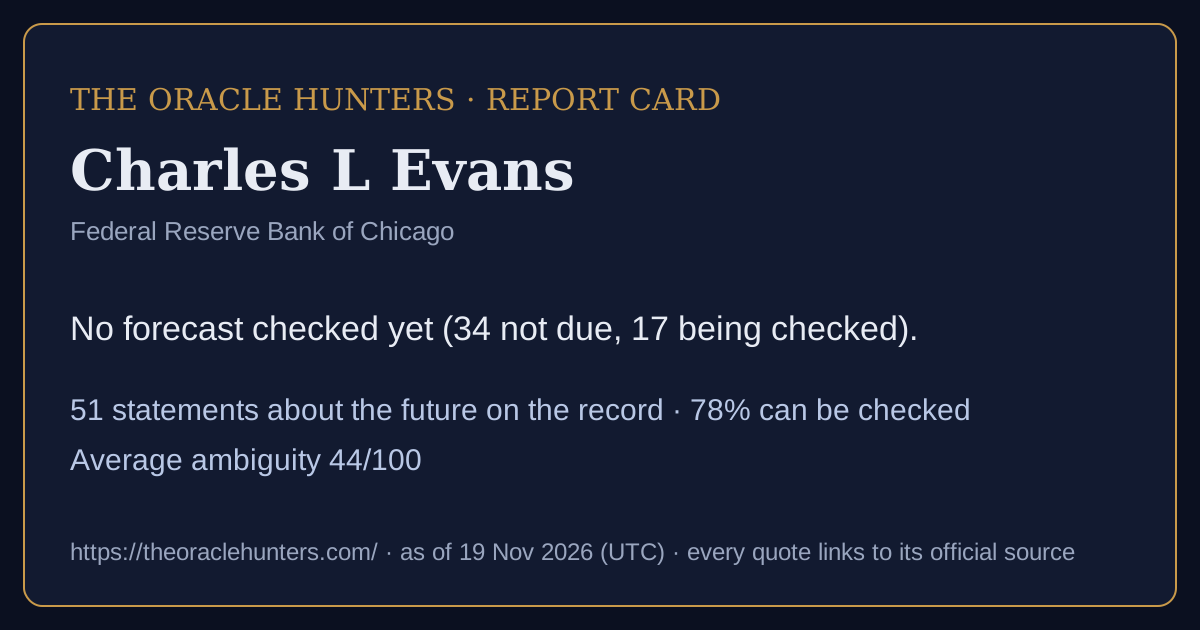
Charles L Evans

Federal Reserve Bank of Chicago

Track record: No forecast checked yet (34 not due, 17 being checked).
51forecasts & commitments on the record
78%can be checked as stated
44average ambiguity (0-100)
0goalpost moves recorded
0confirmed U-turns

Timeline

20112011: Not due yet2011: Due - being checked2011: Not due yet2011: Due - being checked2011: Due - being checked2011: Due - being checked2011: Not due yet2011: Not due yet (+10 more)20122012: Not due yet2012: Due - being checked2012: Due - being checked2012: Due - being checked2012: Not due yet2012: Due - being checked2012: Not due yet2012: Not due yet (+4 more)201320142014: Not due yet2014: Not due yet2014: Not due yet2014: Due - being checked2014: Due - being checked2014: Not due yet2014: Not due yet2014: Due - being checked (+13 more)
came true partly did not not due / being checked / too vague

Calibration score: shown after 10 checked forecasts with a stated likelihood (now 0).
How they speak about the future: based on data 42, educated guess 5, stated on authority 4.
Kinds of claim: forecast 32, mixed claim 12, commitment 5, scenario (if… then) 2. · Download this report card as a picture
In the nine words

πρόγνωσιςInference from evidence42 · 82%προαναγγελίαPublic pre-announcement5 · 10%εἰκασίαConjecture2 · 4%πρόνοιαPreparing for the future2 · 4%
How to read this Each box is one sentence a public figure or institution said about the future, word for word, with a link to the official text. Can be checked means it names what will happen, by when, and how likely - so it can be compared with official figures later. Too vague to check means it does not. Ambiguity (0-100) is how many different ways the sentence can be read. When the date passes, the forecast is compared with official data and marked came true, partly or did not come true. Labels judge the sentence, never the person. Full guide and glossary.

On the record (51)

Although some in-demand occupations may be experiencing stronger wage growth, overall compensation growth has been around 2 percent over the past six years.
Federal Reserve Bank of Chicago · said 08 Oct 2014 (date) · Monetary policy normalization - if not now, when? · evidence & why
At the same time, I expect inflation to rise gradually toward the FOMC's 2 percent target.
Federal Reserve Bank of Chicago · said 08 Oct 2014 (date) · Monetary policy normalization - if not now, when? · evidence & why
A corollary to this conclusion is that we should not shy away from policy prescriptions that imply forecasts of inflation that moderately overshoot our 2 percent target for a limited time.
Federal Reserve Bank of Chicago · said 08 Oct 2014 (date) · Monetary policy normalization - if not now, when? · evidence & why
πρόγνωσις · Inference from evidencePartly checkableMixed claimbased on dataambiguity 56/100below the RIM-1 standardNot due yetinflation
And as I mentioned earlier, I am expecting further improvements in economic activity, with real GDP growing at around 3 percent over the next 18 months and the unemployment rate declining further to a little over 5 percent by the end of 2016 - in line with what I think is its long-run neutral level.
Federal Reserve Bank of Chicago · said 08 Oct 2014 (date) · Monetary policy normalization - if not now, when? · evidence & why
πρόγνωσις · Inference from evidencePartly checkableForecastbased on dataambiguity 56/100below the RIM-1 standarddue 31 Dec 2016Due - being checkedgrowthlabour
My forecast is that real gross domestic product (GDP) will increase at an average rate of about 3 percent over the next year and half.
Federal Reserve Bank of Chicago · said 08 Oct 2014 (date) · Monetary policy normalization - if not now, when? · evidence & why
πρόγνωσις · Inference from evidenceCan be checkedForecastbased on dataambiguity 0/100implied call / likelihood: Yes · 70% · probablemeets the RIM-1 standarddue 31 Dec 2015Due - being checkedgrowth
A corollary to this is we should not shy away from policy prescriptions that generate forecasts of inflation that moderately overshoot our 2 percent target for a limited time.
Federal Reserve Bank of Chicago · said 29 Sep 2014 (date) · Is it time to return to business-as-usual monetary policy? A case for patience · evidence & why
πρόγνωσις · Inference from evidencePartly checkableMixed claimbased on dataambiguity 56/100below the RIM-1 standardNot due yetinflation
Unless economic conditions are fundamentally strong and the previous impediments to growth have receded sufficiently, the odds remain high that monetary authorities will need to retreat right back into the ZLB.
Federal Reserve Bank of Chicago · said 29 Sep 2014 (date) · Is it time to return to business-as-usual monetary policy? A case for patience · evidence & why
εἰκασία · ConjecturePartly checkableMixed claimeducated guessambiguity 56/100implied call / likelihood: Yes · 85% · for the most partbelow the RIM-1 standardNot due yetgrowth
Notably, in the Committee's Summary of Economic Projections released a week and a half ago, most participants anticipated that the unemployment rate would return to its long-run neutral level by the end of 2016 and that inflation then would be in the range of 1-3/4 to 2 percent.
Federal Reserve Bank of Chicago · said 29 Sep 2014 (date) · Is it time to return to business-as-usual monetary policy? A case for patience · evidence & why
πρόγνωσις · Inference from evidencePartly checkableForecastbased on dataambiguity 36/100below the RIM-1 standarddue 31 Dec 2016Due - being checkedinflationlabour
Looking ahead, we think that declines in the labor force participation rate and population growth will bring the trend in payroll employment growth down to fewer than 50,000 jobs per month by 2016.
Federal Reserve Bank of Chicago · said 29 Sep 2014 (date) · Is it time to return to business-as-usual monetary policy? A case for patience · evidence & why
πρόγνωσις · Inference from evidenceCan be checkedForecastbased on dataambiguity 0/100implied call / likelihood: Yes · 85% · for the most partmeets the RIM-1 standarddue 31 Dec 2016Due - being checkedgrowthlabour
This risk consideration means that the decision to lift the funds rate from zero should be made only when we have a great deal of confidence that growth has enough momentum to reach full employment and that inflation will return to a sustainable 2 percent rate.
Federal Reserve Bank of Chicago · said 29 Sep 2014 (date) · Is it time to return to business-as-usual monetary policy? A case for patience · evidence & why
πρόγνωσις · Inference from evidencePartly checkableMixed claimbased on dataambiguity 36/100implied call / likelihood: Yes · 85% · for the most partbelow the RIM-1 standardNot due yetinflationgrowthlabour
But, for my part, I think it is more likely that we will achieve our employment mandate before inflation is clearly headed back to 2 percent.
Federal Reserve Bank of Chicago · said 29 Sep 2014 (date) · Is it time to return to business-as-usual monetary policy? A case for patience · evidence & why
πρόγνωσις · Inference from evidencePartly checkableMixed claimbased on dataambiguity 36/100implied call / likelihood: Yes · 70% · probablebelow the RIM-1 standardNot due yetinflationlabour
A corollary to this is we should not shy away from policy prescriptions that generate forecasts of inflation that moderately overshoot our 2 percent target for a limited time.
Federal Reserve Bank of Chicago · said 24 Sep 2014 (date) · Patience is a virtue when normalizing monetary policy · evidence & why
πρόγνωσις · Inference from evidencePartly checkableMixed claimbased on dataambiguity 56/100below the RIM-1 standardNot due yetinflation
Indeed, in the Committee's Summary of Economic Projections released about a week ago, most participants anticipated that the unemployment rate would return to its long-run neutral level by the end of 2016 and that inflation then would be in the range of 1-3/4 to 2 percent.
Federal Reserve Bank of Chicago · said 24 Sep 2014 (date) · Patience is a virtue when normalizing monetary policy · evidence & why
πρόγνωσις · Inference from evidencePartly checkableForecastbased on dataambiguity 36/100below the RIM-1 standarddue 31 Dec 2016Due - being checkedinflationlabour
This risk consideration means that the decision to lift the funds rate from zero should be made only when we have a great deal of confidence that growth has enough momentum to reach full employment and that inflation will return sustainably to 2 percent.
Federal Reserve Bank of Chicago · said 24 Sep 2014 (date) · Patience is a virtue when normalizing monetary policy · evidence & why
πρόγνωσις · Inference from evidencePartly checkableMixed claimbased on dataambiguity 36/100implied call / likelihood: Yes · 85% · for the most partbelow the RIM-1 standardNot due yetinflationgrowthlabour
In this case, the goals are 2 percent inflation over the medium term and unemployment at its natural rate, taken here to be 5-1/4 percent, which is my long-run projection.
Federal Reserve Bank of Chicago · said 09 Apr 2014 (date) · Monetary goals and strategy · evidence & why
πρόγνωσις · Inference from evidencePartly checkableForecastbased on dataambiguity 56/100below the RIM-1 standardNot due yetinflationlabour
Policies that would instead place us on a slow glide path toward our targets undermine the credibility of our claim that we will do our job and meet mandated policy goals in a timely fashion.
Federal Reserve Bank of Chicago · said 09 Apr 2014 (date) · Monetary goals and strategy · evidence & why
If you believe that financial stability can only be achieved through higher interest rates - interest rates that would do immediate damage to meeting our dual mandate goals at a time when unemployment is still unacceptably high - then we ought to at least ask ourselves if the financial system has become too big and too complex.
Federal Reserve Bank of Chicago · said 28 Mar 2014 (date) · Thoughts on accommodative monetary policy, inflation and financial instability · evidence & why
εἰκασία · ConjecturePartly checkableMixed claimeducated guessambiguity 56/100below the RIM-1 standardNot due yetinterest rateslabour
If more restrictive monetary policies were pursued to generate higher interest rates, they would likely result in higher unemployment and a sharp decline in asset prices, choking the moderate recovery.
Federal Reserve Bank of Chicago · said 28 Mar 2014 (date) · Thoughts on accommodative monetary policy, inflation and financial instability · evidence & why
πρόνοια · Preparing for the futurePartly checkableScenario (if… then)educated guessambiguity 36/100implied call / likelihood: Yes · 70% · probablebelow the RIM-1 standardNot due yetinflationlabour
Sophisticated models that extract inflation expectations from the yield curve show that investors' inflation expectations at the three-year horizon are below 2 percent and will be below 2 percent for several years.
Federal Reserve Bank of Chicago · said 28 Mar 2014 (date) · Thoughts on accommodative monetary policy, inflation and financial instability · evidence & why
To reiterate, I currently expect that low inflation and still-high unemployment will mean that the short-term policy rate will remain near zero well into 2015.
Federal Reserve Bank of Chicago · said 28 Mar 2014 (date) · Thoughts on accommodative monetary policy, inflation and financial instability · evidence & why
πρόγνωσις · Inference from evidenceCan be checkedForecastbased on dataambiguity 0/100implied call / likelihood: Yes · 70% · probablemeets the RIM-1 standarddue 31 Dec 2015Due - being checkedinflationlabour
Simply put, we need to average 2 percent inflation over the medium term.
Federal Reserve Bank of Chicago · said 28 Mar 2014 (date) · Thoughts on accommodative monetary policy, inflation and financial instability · evidence & why
πρόγνωσις · Inference from evidencePartly checkableMixed claimbased on dataambiguity 56/100below the RIM-1 standardNot due yetinflation
The unemployment rate is 8-1/4 percent - well above the rate anyone on the FOMC sees as being consistent with our longer-run goal; in my view, this is a substantially higher rate than one might attribute to supply-side factors, such as extended unemployment insurance and a heightened degree of mismatch in labor markets.
Federal Reserve Bank of Chicago · said 16 Mar 2012 (date) · Monetary policy communications and forward guidance · evidence & why
In August 2011, we added a particular type of forward guidance to our policy, first saying we would likely keep rates low until mid-2013 and then, in January, indicating that sub-par economic performance would likely warrant exceptionally low rates until at least late 2014.
Federal Reserve Bank of Chicago · said 16 Mar 2012 (date) · Monetary policy communications and forward guidance · evidence & why
πρόγνωσις · Inference from evidencePartly checkableForecastbased on dataambiguity 36/100implied call / likelihood: Yes · 70% · probablebelow the RIM-1 standarddue 30 Jun 2013Due - being checked
Suppose as we move through next year that our projections for 2014 have an unemployment rate above 7 percent and inflation close to 2 percent.
Federal Reserve Bank of Chicago · said 16 Mar 2012 (date) · Monetary policy communications and forward guidance · evidence & why
πρόγνωσις · Inference from evidencePartly checkableForecastbased on dataambiguity 36/100below the RIM-1 standarddue 31 Dec 2014Due - being checkedinflationlabour
At the same time, the outlook for inflation is subdued, with most FOMC participants' forecasts for increases in total personal consumption expenditures prices averaging roughly between 1-1/2 and 2 percent over the next three years.
Federal Reserve Bank of Chicago · said 16 Mar 2012 (date) · Monetary policy communications and forward guidance · evidence & why
πρόγνωσις · Inference from evidencePartly checkableForecastbased on dataambiguity 56/100below the RIM-1 standarddue 31 Dec 2015Due - being checkedinflation
I believe that our latest communications efforts are an important step in further increasing such accountability to the public, as they reaffirm our commitment to both legs of the dual mandate and describe the ways in which we will seek to achieve those objectives.
Federal Reserve Bank of Chicago · said 16 Mar 2012 (date) · Monetary policy communications and forward guidance · evidence & why
statement indicated that the Committee thought economic conditions are likely to warrant exceptionally low levels for the federal funds rate at least through late 2014, but six of the 17 policy projections showed that the funds rate would be 1-1/2 percent or higher at the end of that year.
Federal Reserve Bank of Chicago · said 16 Mar 2012 (date) · Monetary policy communications and forward guidance · evidence & why
πρόγνωσις · Inference from evidenceCan be checkedForecastbased on dataambiguity 36/100implied call / likelihood: Yes · 70% · probablebelow the RIM-1 standarddue 31 Dec 2014Due - being checkedinterest rates
Our outlook then was for real GDP growth to be around 1.75 percent in 2011 and then rise to 2.75 percent in 2012.
Federal Reserve Bank of Chicago · said 11 Jan 2012 (date) · Managing monetary policy risks · evidence & why
πρόγνωσις · Inference from evidencePartly checkableForecastbased on dataambiguity 71/100below the RIM-1 standardNot due yetgrowth
If, contrary to most evidence, the natural rate of unemployment is higher than 7 percent, then under this policy inflation will rise more quickly and without any improvements to the real side of the economy.
Federal Reserve Bank of Chicago · said 11 Jan 2012 (date) · Managing monetary policy risks · evidence & why
Indeed, simulations of standard models suggest that core inflation is likely to remain below 3 percent even under a policy of extended monetary accommodation.
Federal Reserve Bank of Chicago · said 11 Jan 2012 (date) · Managing monetary policy risks · evidence & why
With my own view that inflation is likely to run below this rate over the next few years, I believe we will miss on our inflation objective as well.
Federal Reserve Bank of Chicago · said 11 Jan 2012 (date) · Managing monetary policy risks · evidence & why
The November FOMC forecasts for core inflation in 2012 were concentrated near 1.8 percent, and the forecasts for total inflation in 2013 and 2014 were in the range of 1.5 percent to 2.0 percent.
Federal Reserve Bank of Chicago · said 11 Jan 2012 (date) · Managing monetary policy risks · evidence & why
πρόγνωσις · Inference from evidencePartly checkableForecastbased on dataambiguity 36/100below the RIM-1 standarddue 31 Dec 2013Due - being checkedinflation
Indeed, the FOMC's latest forecasts are for the unemployment rate to remain above 8.5 percent through 2012 and to fall only to about 8 percent in 2013.
Federal Reserve Bank of Chicago · said 11 Jan 2012 (date) · Managing monetary policy risks · evidence & why
πρόγνωσις · Inference from evidencePartly checkableForecastbased on dataambiguity 36/100below the RIM-1 standarddue 31 Dec 2013Due - being checkedlabour
However, as Kenneth Rogoff recently wrote in a Financial Times piece, 'Any inflation above 2 percent may seem anathema to those who still remember the anti-inflation wars of the 1970s and 1980s, but a once-in-75-year crisis calls for outside-the-box measures.' 5 I agree wholeheartedly with Professor Rogoff.
Federal Reserve Bank of Chicago · said 05 Dec 2011 (date) · A risk management approach to monetary policy · evidence & why
Earlier this year, most forecasters thought that the recovery was gaining traction and that economic activity would increase at a solid - though not spectacular - pace through 2012.
Federal Reserve Bank of Chicago · said 05 Dec 2011 (date) · A risk management approach to monetary policy · evidence & why
πρόγνωσις · Inference from evidencePartly checkableForecastbased on dataambiguity 36/100below the RIM-1 standarddue 31 Dec 2012Due - being checkedgrowth
The first part of such a policy would be to communicate that we will keep the funds rate at exceptionally low levels as long as unemployment is somewhat above its natural rate.
Federal Reserve Bank of Chicago · said 05 Dec 2011 (date) · A risk management approach to monetary policy · evidence & why
The FOMC forecasts for core inflation were concentrated near 1.8 percent this year, and its forecasts for total inflation were in the range of 1.5 percent to 2.0 percent for 2012, 2013 and 2014.
Federal Reserve Bank of Chicago · said 05 Dec 2011 (date) · A risk management approach to monetary policy · evidence & why
πρόγνωσις · Inference from evidencePartly checkableForecastbased on dataambiguity 36/100below the RIM-1 standarddue 31 Dec 2012Due - being checkedinflation
Indeed, the FOMC's latest forecasts are for the unemployment rate to remain above 8-1/2 percent through 2012 and to fall only to about 8 percent in 2013.
Federal Reserve Bank of Chicago · said 05 Dec 2011 (date) · A risk management approach to monetary policy · evidence & why
πρόγνωσις · Inference from evidencePartly checkableForecastbased on dataambiguity 36/100below the RIM-1 standarddue 31 Dec 2012Due - being checkedlabour
Even so, our latest forecast made in early November revised down our outlook for 2011 by a full percentage point and projected GDP growth at just 2-3/4 percent in 2012 - barely above most analysts' views of the potential rate of output growth for the economy.
Federal Reserve Bank of Chicago · said 05 Dec 2011 (date) · A risk management approach to monetary policy · evidence & why
πρόγνωσις · Inference from evidenceCan be checkedForecastbased on dataambiguity 0/100implied call / likelihood: Yes · 70% · probablemeets the RIM-1 standarddue 31 Dec 2012Due - being checkedgrowth
Given the economic scenario and inflation outlook I have discussed, if it were possible, I would favor cutting the federal funds rate by several percentage points.
πρόνοια · Preparing for the futurePartly checkableScenario (if… then)educated guessambiguity 36/100implied call / likelihood: No · 35% · probablebelow the RIM-1 standardNot due yetinflationinterest rates
Today, we are facing an unemployment rate of 9 percent with little prospect of meaningful declines soon and the medium-term outlook for inflation is under 2 percent.
πρόγνωσις · Inference from evidencePartly checkableForecastbased on dataambiguity 56/100below the RIM-1 standardNot due yetinflationlabour
As Ken Rogoff wrote in a recent piece in the Financial Times , 'Any inflation above 2 percent may seem anathema to those who still remember the anti-inflation wars of the 1970s and 1980s, but a once-in-75-year crisis calls for outside-the-box measures'. 9 The Fed has done a good deal of thinking out of the box over the past four …
I think we should consider committing to keep short-term rates at zero until either the unemployment rate goes below 7 percent or the outlook for inflation over the medium term goes above 3 percent.
πρόγνωσις · Inference from evidencePartly checkableMixed claimbased on dataambiguity 56/100below the RIM-1 standardNot due yetinflationlabour
To the degree that the public doubts that we will, current accommodation is reduced because expected future short-term rates, interest rate uncertainty and associated risk premiums all will be higher than they otherwise would be.
προαναγγελία · Public pre-announcementPartly checkableCommitmentstated on authorityambiguity 56/100implied call / likelihood: Yes · 70% · probablebelow the RIM-1 standardNot due yetinterest rates
In my mind, the Federal Reserve Act is very clear in specifying that the Federal Reserve has a dual mandate: The FOMC should provide for monetary and financial conditions that support maximum employment and price stability. 2 With regard to inflation, we should seek to keep inflation near 2 percent over the medium term.
πρόγνωσις · Inference from evidencePartly checkableMixed claimbased on dataambiguity 71/100below the RIM-1 standardNot due yetinflationlabour
This conditionality could be conveyed by stating that we would hold the federal funds rate at extraordinarily low levels until the unemployment rate falls substantially, say from its current level of 9.1% to 7.5% or even 7%, as long as medium-term inflation stayed below 3%.
Federal Reserve Bank of Chicago · said 07 Sep 2011 (date) · The Fed's dual mandate responsibilities and challenges facing US monetary policy · evidence & why
πρόγνωσις · Inference from evidencePartly checkableForecastbased on dataambiguity 56/100implied call / likelihood: No · 35% · probablebelow the RIM-1 standardNot due yetinflationinterest rateslabour
The '2 percent, or a bit less' interpretation of our price stability mandate comes from the responses to the Survey of Economic Projections which FOMC participants submit four times per year, and in which the majority of participants have said 2% is their long-run forecast under conditions that include appropriate monetary policy.
Federal Reserve Bank of Chicago · said 07 Sep 2011 (date) · The Fed's dual mandate responsibilities and challenges facing US monetary policy · evidence & why
πρόγνωσις · Inference from evidencePartly checkableForecastbased on dataambiguity 56/100implied call / likelihood: Yes · 70% · probablebelow the RIM-1 standardNot due yetinflationinterest rates
To average 2%, inflation could be above 2% in some periods and below 2% in others.
Federal Reserve Bank of Chicago · said 07 Sep 2011 (date) · The Fed's dual mandate responsibilities and challenges facing US monetary policy · evidence & why
Such further policy accommodation does increase the risk that inflation could rise temporarily above our long-term goal of 2%.
Federal Reserve Bank of Chicago · said 07 Sep 2011 (date) · The Fed's dual mandate responsibilities and challenges facing US monetary policy · evidence & why
So, by this appropriate standard I think inflation likely will be below our goal of 2%.
Federal Reserve Bank of Chicago · said 07 Sep 2011 (date) · The Fed's dual mandate responsibilities and challenges facing US monetary policy · evidence & why

Showing the newest 50 - the ledger has all 51.

Also said - not checkable as stated (5 newest)

Remarks about the future with no date, figure or likelihood that could be checked. They are kept on the record and shown here, but not scored.

Of course, certain demographic factors such as the increasing number of baby boomers reaching retirement age mean we should have expected to see a substantial drop in labor force participation for reasons unrelated to cyclical job prospects and the health of the labor market.
Federal Reserve Bank of Chicago · said 09 Apr 2014 (date) · Monetary goals and strategy · evidence & why
πρόνοια · Preparing for the futurePartly checkableCall for actionstated on authorityambiguity 36/100implied call / likelihood: Yes · 70% · probablebelow the RIM-1 standardlabourhealth
Moreover, there will be episodes where monetary policy will need to be adjusted to deal with special factors.
Federal Reserve Bank of Chicago · said 09 Apr 2014 (date) · Monetary goals and strategy · evidence & why
Furthermore, given that the Taylor rule has failed so badly and done so for so long, how can we be confident that its prescriptions will still be a good policy to follow once the rule says that the fed funds rate should rise above zero again?
Federal Reserve Bank of Chicago · said 09 Apr 2014 (date) · Monetary goals and strategy · evidence & why
The U.S. Congress created the Federal Reserve System 100 years ago, largely as a way to provide an elastic currency that could mitigate the banking panics and other disruptions that impaired economic activity and contributed to deflations in the late 1800s and early 1900s.
Federal Reserve Bank of Chicago · said 09 Apr 2014 (date) · Monetary goals and strategy · evidence & why
εἰκασία · ConjectureToo vague to checkSpeculationbased on dataambiguity 71/100implied call / likelihood: No · 35% · probablebelow the RIM-1 standardgrowthfinance
Moreover, we've seen some more solid consumer spending, which should provide further impetus to overall growth this year.
Federal Reserve Bank of Chicago · said 28 Mar 2014 (date) · Thoughts on accommodative monetary policy, inflation and financial instability · evidence & why
πρόνοια · Preparing for the futurePartly checkableCall for actionstated on authorityambiguity 56/100below the RIM-1 standarddue 31 Dec 2014growth