Charles I Plosser
Federal Reserve Bank of Philadelphia
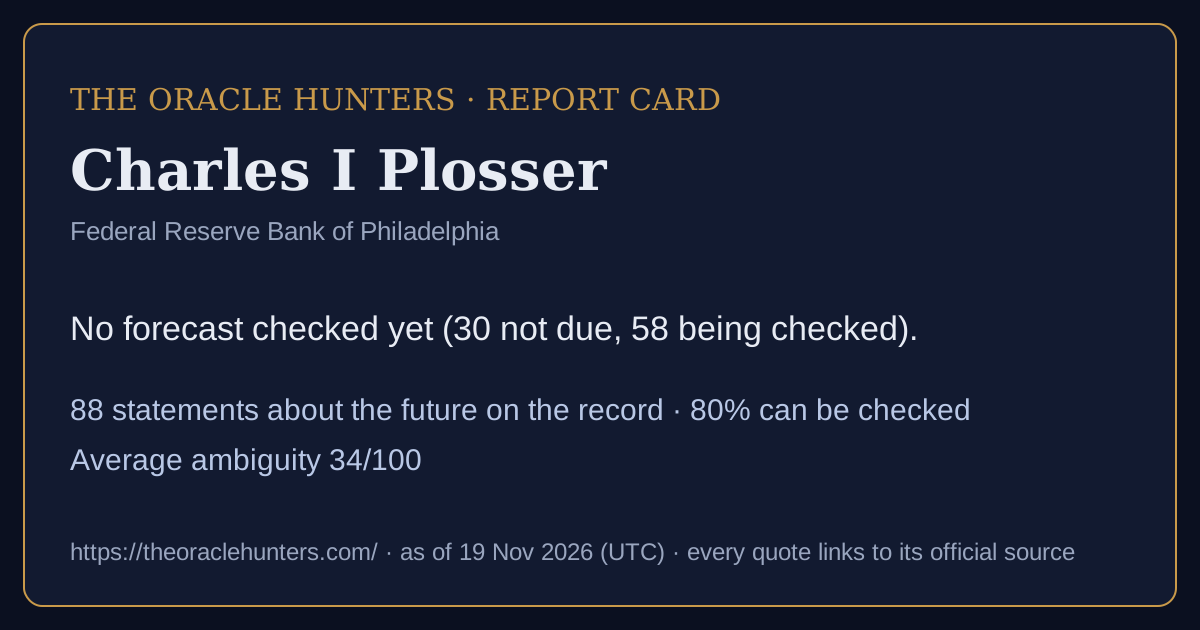
Track record: No forecast checked yet (30 not due, 58 being checked).
88forecasts & commitments on the record
80%can be checked as stated
34average ambiguity (0-100)
0goalpost moves recorded
0confirmed U-turns
Timeline
came true partly did not not due / being checked / too vague
Calibration score: shown after 10 checked forecasts with a stated likelihood (now 0).
How they speak about the future: based on data 80, educated guess 5, stated on authority 3.
Kinds of claim: forecast 69, mixed claim 14, scenario (if… then) 4, commitment 1. · Download this report card as a picture
In the nine words
πρόγνωσιςInference from evidence79 · 90%πρόνοιαPreparing for the future4 · 5%μαντείαInspired knowledge3 · 3%προαναγγελίαPublic pre-announcement1 · 1%εἰκασίαConjecture1 · 1%
How to read this
Each box is one sentence a public figure or institution said about the future, word for word, with a link to the official text. Can be checked means it names what will happen, by when, and how likely - so it can be compared with official figures later. Too vague to check means it does not. Ambiguity (0-100) is how many different ways the sentence can be read. When the date passes, the forecast is compared with official data and marked came true, partly or did not come true. Labels judge the sentence, never the person. Full guide and glossary.On the record (88)
Looking forward, I believe we will see growth averaging about 3 percent in 2015 before edging down to a long-term trend growth rate of about 2.4 percent.
Private sector forecasters seem to share this view as the Philadelphia Fed's most recent Survey of Professional Forecasters shows that long-term inflation expectations remain stable at 2 percent.
Employment will continue to expand, and inflation will move closer to our 2 percent target.
Ten years ago, I suspect most commentators would have told you that six years of a nearzero federal funds rate target and more than $3.5 trillion of long-term asset purchases by the Fed would likely produce an economic boom in the near term and would risk inflation in the longer term.
Nevertheless, I anticipate that the FOMC will conduct policy over time in such a manner that inflation will gradually move toward the Fed's 2 percent target.
If potential output is lower in the future than previously thought, then there is likely to be less 'slack' in the current economy than one might think.
How soon will we reach the year-end 2015 number?
In fact, in September, the central tendency was lowered yet again to 5.9 from 6.0 percent for 2014 and to 5.4 from 5.6 percent by the end of 2015.
The unemployment rate is now below where the Committee thought it would be at the end of 2014 and is now within the range expected at the end of 2015.
For instance, in the Summary of Economic Projections (SEP) submitted in December 2013, the central tendency of FOMC participants was an unemployment rate of 6.3 to 6.6 percent at the end of 2014, and by the end of 2015, the central tendency was expected to be 5.8 to 6.1 percent.
At the end of this month, we will get the first look at the third quarter, which I expect will help us reach an average of about 3 percent for the remainder of this year and in 2015, before settling back down to long-term growth levels of about 2.4 percent.
I anticipate that consumer and business spending will help real GDP to grow at about 3 percent for the remainder of this year and next before reverting to trend, which I see as about 2.4 percent.
The Philadelphia Fed's most recent Survey of Professional Forecasters also increased its average estimate of headline PCE inflation to 1.8 percent in 2014, up from 1.6 percent in the last survey.
Unemployment continues to improve more quickly than many had expected, and inflation appears to be drifting up toward our 2 percent goal.
Compare that with December 2013 SEP estimates for 2014, and you will find that we are already at the top of the FOMC's central tendency of 1.4 to 1.6 percent for PCE inflation.
I believe consumer and business spending will help real GDP to grow at about 3 percent for the remainder of this year and next before reverting to trend, which I see as about 2.4 percent.
The unemployment rate is below where the Committee thought it would be at the end of 2014 and is now within the range expected at the end of 2015.
For instance, in the Summary of Economic Projections (SEP) submitted in December 2013, the central tendency of FOMC participants was to end 2014 with an unemployment rate of 6.3 to 6.6 percent, and by the end of 2015, the central tendency was expected to be 5.8 to 6.1 percent.
My example uses five simple rules that have been discussed in the literature and describes their implications for the projected path of the funds rate from now through 2015.
While real GDP growth for 2014 was marked down, which reflected the disappointing first quarter, the outlook for the second half of the year and the projections for 2015 and 2016 were unchanged.
We have ample monetary accommodation in the economy to ensure that we will be able to achieve our 2 percent target over time.
My view of inflation is that it will stabilize at about 2 percent in 2015.
Specifically, I think the unemployment rate may reach 5.8 percent by the end of this year and 5.6 percent by the end of 2015.
The weakest forecast anticipates a funds rate of nearly 1 percent by the end of 2015, while the strongest forecast envisions a funds rate of about 4.7 percent in part because both inflation and unemployment 'overshoot' their long-run and sustainable values and corrections must follow.
I would not be surprised if the unemployment rate moved up a bit next month, but the downward trend continues, and we are making significant improvement.
Prospects for labor markets will continue to improve, and I expect the unemployment rate will continue to decline, reaching 6.2 percent or lower by the end of 2014.
I expect that the unemployment rate will fall below 6.2 by the end of 2014.
I also believe that inflation expectations will be relatively stable and that inflation will move up toward our goal of 2 percent over the next year.
We are likely to see growth return to around 3 percent through the rest of 2014.
So as the economy gradually moves toward our 2 percent inflation target and the labor market continues to improve, we will need to calibrate monetary policy to reflect the improvements.
The Department of Commerce estimates that STEM employment grew at three times the rate of non-STEM employment in the previous decade and is projected to grow at twice the rate of non-STEM jobs through 2018.
- President Plosser expects growth of about 3 percent in 2014.
I also believe that inflation expectations will be relatively stable and that inflation will move up toward our goal of 2 percent over the next year.
Prospects for labor markets will continue to improve, and I expect the unemployment rate will continue to decline, reaching 6.2 percent or lower by the end of 2014.
I expect that the unemployment rate will reach about 6.2 percent by the end of 2014, and, if anything, that may prove too pessimistic.
Inflation expectations will be relatively stable, and inflation will move up toward the FOMC target of 2 percent over the next year.
He also expects the unemployment rate to continue its steady decline and to reach about 6.2 percent by the end of 2014.
In December 2012, the FOMC indicated that it intended to keep the federal funds rate target near zero at least as long as the unemployment rate was above 6.5 percent, the inflation rate between one and two years ahead was projected to be no more than 2.5 percent, and inflation expectations remained well anchored.
It now seems unlikely that the program will end until the unemployment rate is below - or as indicated in the FOMC statement, perhaps 'well below' - 6.5 percent.
Last June, the Committee suggested that it might begin to reduce the pace of purchases in the fall and perhaps end them when the unemployment rate reached 7 percent.
I also believe that inflation expectations will be relatively stable and that inflation will move up toward our goal of 2 percent over the next year.
Prospects for labor markets will continue to improve, and I expect the unemployment rate will continue its decline, reaching 6.2 percent by the end of 2014.
Although growth in the first quarter is likely to be somewhat slower than the rapid pace we saw in the second half of last year, overall, I anticipate economic growth of around 3 percent this year, a pace that is slightly above trend.
This growth is sufficient to result in a continued decline in the unemployment rate, which should reach about 6.2 percent by the end of 2014.
This makes me somewhat more optimistic than most of my FOMC colleagues, who reported a central tendency of 6.3 to 6.6 percent by the end of 2014.
My forecast is largely in line with those of my colleagues on the FOMC, whose most recent projections had a central tendency of growth of 2.2 to 2.3 percent for 2013, and accelerating to 2.8 to 3.2 percent in 2014.
This gives me some hope that business fixed investment, which has been generally lackluster during the course of the recovery, will pick up somewhat this year.
I also believe that inflation expectations will be relatively stable and that inflation will move up toward our goal of 2 percent over the next year.
Prospects for labor markets will continue to improve gradually, and I expect the unemployment rate will continue its decline to 6.2 percent by the end of 2014.
I believe this growth will continue to lead to declines in the unemployment rate over the next year and should result in an unemployment rate of about 6.2 percent by the end of 2014.
Showing the newest 50 - the ledger has all 88.
Also said - not checkable as stated (12 newest)
Remarks about the future with no date, figure or likelihood that could be checked. They are kept on the record and shown here, but not scored.
That is why monetary policy choices today must focus on the intermediate to long term and anticipate what the economy might look like over the next one to three years.
Thank you, Dr. (Karen) Lawson, for that kind introduction and thanks to the Union League's Public Affairs Committee and the Business Leaders Forum for inviting me here today for what will be my final public speech as president of the Federal Reserve Bank of Philadelphia.
However, its charter was not renewed - Congress could not override the veto of President Andrew Jackson, who led the opposition to the central bank.
One recent change in the directors' roles came under the Dodd-Frank Wall Street Reform and Consumer Protection Act of 2010: Only the six nonbank directors on each board may vote to select a Reserve Bank president, subject to the approval of the Board of Governors.
The primary objective of the new central bank was to provide an 'elastic currency' so that banks could meet the cash demands of businesses and consumers.
Before the Federal Reserve, circulating cash was predominately in the form of private bank notes, which could become scarce in times of panic.
- He thinks policymakers should describe the reaction function that determines how the current and future policy rates will be set depending on economic data.
Labor markets continue to heal, and their stronger-than-expected recovery should serve to underpin continued economic expansion.
Instead, I believe we should describe how we will respond to the data; that is, we should describe a reaction function.
It should pursue its objectives in a systematic, rule-like manner and help the public understand how policy will react systematically to changes in economic conditions.
We won't know what the official first estimate will be until the end of this month, but even that slight slowdown would lead to full-year growth in 2014 that is a bit higher than many had expected.
One reason why policymakers must think long term is that the effects of monetary policy actions on inflation and employment may not be felt for many quarters and maybe years in the future.